20070228

A Massachusetts mill town keeps coming back


The once downtrodden mill town of North Adams, MA, keeps attracting interest as former factory space is repurposed.

The biggest rejuvenation project has been MassMOCA, the Massachusetts Museum of Contemporary Art (seen above). But small steps are in the works as well. For example, the Berkshire Mountains region is getting another microbrewery in the form of the Cold River Brewing Co.

The facility will only make beer, unlike the nearby Barrington Brewery and Pittsfield Brew Works which also operate restaurants on site. Cold River will produce craft beers, made with 100% barley or wheat malt. Plans call for initial production two days a week during its first year, with a 7,500-barrel output.

Christopher Post, of Becket, MA, and partners Allan Duvall, Chris Cuzme and Alex Hall, all of New York City, submitted the application for a 15-barrel microbrewery to be located in a 4,000-square-foot space once occupied by the Delftree Mushroom Factory's sanitation and packaging facility. Their proposal is scheduled to go before the city planning board on March 12.

Post, a native of the United Kingdom who was an investment banker, became a brewmaster in 2005 and worked at the Chelsea Brewing Co. in Manhattan and the Greenpoint Beer Works in Brooklyn, where Duvall was the brewmaster.

MassMOCA bills itself as "one of the largest cultural institutions in the country" with more than 300,000 square feet of developed space and another 300,000 of "mothballed" space, in 26 buildings on 13 acres. It mounts five exhibitions a year and presents morew than 80 major performing arts events.


North Adams, which was the birthplace of famous suffragette Susan B. Anthony (when the neighborhood in which she was born was called simply Adams), is a hilly city that still boasts stately Greek Revival, Second Empire and Italianate mansions that once were home to wealthy owners of textile mills and shoe factories that boomed during the Civil War. A good example of Second Empire architecture, The Blackinton Mansion, now is the city library.

ON THE WEB
• The Transcript (daily newspaper)
Massachusetts College of Liberal Arts
The Berkshires
Sights & Attractions
Where To Stay

20070227

A guide for the solo female traveler


Travel is tricky enough for groups or couples, but for women traveling abroad the problems are multiplied.

There's a new downloadable 16-page guide called "What You Should Know Before Traveling Abroad: Cultural, Health and Safety Advice for Women."

The guide, developed MEDEX Assistance Corp., a provider of emergency and security assistance to travelers, covers such topics as cultural and traditional customs and taboos, the current political and social climate of their destinations, appropriate modes of dress and body language.

"Western norms for women that tend towards gender neutrality are not commonly accepted in some other cultures and, in fact, can be the root of misunderstanding, harassment and even physical threats," said Somaia Abdelrahim, MEDEX's senior client relations manager.

Virginia gets new natural history museum


Sometimes what goes on behind the scenes at museums is as interesting as what the public sees.

Workmen have been laboring to complete the exhibits and finishing touches on the Virginia Museum of Natural History (VMNH) in Martinsville scheduled to make its debut in March.

The first specimen was installed on Jan. 23. It's a 14-million-year-old Eobalaenoptera, a whale fossil slightly over 30 feet long. It was discovered by VMNH curators in Caroline County, VA.

The facility is scheduled to host a "100 Hour Celebration" for the opening, with a dedication ceremony on March 30. The museum opens to the public the following day when visitors will get their initial look at the new structure as well as state-of-the-art permanent exhibit galleries, "Uncovering Virginia," "How Nature Works: Rocks," and "How Nature Works: Life."

The special exhibits "Feathered Dinosaurs of China," featuring one of the most important fossils ever discovered, and "Chinasaurs: The Great Dinosaurs of China" will be at the new museum from April 6 through June 17.

From June 30 through Jan. 18, 2008, the exhibit "Beyond Jamestown: Virginia Indians Yesterday and Today" will highlight the history, culture and contributions of Virginia's eight Indian tribes. The "Beyond Jamestown" exhibit at the new VMNH facility is part of the America's 400th Anniversary celebration.
Click map to enlarge

On Sept. 14-15, VMNH will hold its 23rd Annual Indian Festival, celebrating the heritage of Native Americans living in Virginia today, with drumming, dancing, demonstrations, games, crafts and refreshments.

The VMNH is an agency of the Secretary of Natural Resources for the Commonwealth of Virginia, the museum has over 22 million objects in its collections, and reaches nearly 1 million people annually through on-site and traveling exhibitions, classroom outreach programs, Web site, public events and award- winning publications.

ON THE WEB
• Martinsville Speedway
• Patrick Henry Community College
Community Profile
Print and electronic media

20070225

Live and let dine


ATLANTIC CITY, NJ -- If you're planning to be in the Atlantic City area on March 7, you may want to forego the casino scene for a while to take part in an investment that has a guaranteed return.

It's the date of the 24th annual "The Press of Atlantic City Restaurant Gala," the annual black-tie fundraiser for the Atlantic Cape Community College Foundation. The event has raised in excess of $1.7 million for student scholarships at the college’s Academy of Culinary Arts since 1984.

So, visitors not only get to help college students pay for theior education, they get to sample creations from Academy students as well as 40 area restaurants, including a "desert extravaganza" by Master Chef Eugen Ess of the Trump Taj Mahal.

Tickets for the event, to be held at the Atlantic City Convention Center, are $190 per person.Tables of 12 are available at $2,280. Details: (609) 343-5674.

ON THE WEB
Gambling & Casino Guide
The Press of Atlantic City
Atlantic Cape Community College
Atlantic City Tourism
• Events Calendar
Atlantic City Aquarium
Atlantic City Historical Museum
Restaurants & Dining Guide

20070224

Shrinking the world via cognac

William M. Dowd photos


LAS VEGAS, NV -- As we were assembling for a private dinner over the weekend, I was chatting with Frank Du, a Chinese-American journalist who works for a Chinese-language newspaper in Los Angeles.

Seine Kim, a Korean-American representative of The Thomas Collective, a New York public relations firm, walked into the room. Du smoothly switched to Korean to greet her, explaining to me that although Mandarin is his native tongue, he had lived in Korea and picked up the language there.

The marketing lady -- whose name was taken from the French river her parents had seen before her birth -- exchanged a few pleasantries in Korean with Du, then switched into perfect English with me. Although raised in Seoul, she explained, she had been born in Ithaca, N.Y., and wanted to move back to the U.S., so she studied English. In Beijing, China. Her time as a Manhattan resident has buffed away any residual accent.

The sound of French and French-accented English also wafted through the room as our hosts from the Martell House of Cognac arrived.

The mix emphasized the human interplay in a global economy that is continually erasing borders and making producers think beyond historic boundaries.

Martell is known for a long line of cognacs, but producers cannot rest on their laurels in the highly competitive field. Thus, the company was timing the U.S. debut of its Creation Grand Extra Cognac for the Lunar New Year (the Year of the Pig on the Chinese calendar, although celebrated all across Asia) to try enhancing its already strong image in Asian communities throughout the U.S.

A little background. Cognac is a brandy, a grape-based product -- an "eaux-de-vie'' fermented like wine then twice distilled. By French law, supported by the World Trade Organization, the spirit can originate only in the town of Cognac and six surrounding viticultural areas.

There is more than one kind of cognac due to the variety of soils in the region. The grapes used are from several white wine varieties, principally the Ugni Blanc, known elsewhere as the Trebbiano grape. Cognacs must be aged in wood at least two years. Most producers use Limousin oak; Martell prefers the more aromatic Troncais oak.

Any number of cognac labels may be familiar to Americans, such as Hennessey, Remy Martin, Courvoisier, Camus and Delamaine, but Martell is the oldest existing one, founded in 1715 by Jean Martell.

Jacques Menier (seen here), Asia Pacific sales director, was the main presenter of the new Creation Grand Extra, representing cellar master Bruno Lemoine. He guided participants through a special menu prepared at the Wing Lei restaurant in the Wynn Las Vegas hotel to describe how various cognacs can be paired with foods just as is done with wines. Not a bad direction to take since the U.S. is the world's largest consumer of cognac.

For our light starters -- lobster wonton soup, pork pot stickers and spring rolls -- the Martell Noblige worked well, with its light consistency and notes of pear, citrus and definite vanilla from a younger wood. The very popular Cordon Bleu -- perfumey from a flowery soil that speaks of violets and bits of citrus and walnut -- worked nicely with a wider variety, a diver scallop with jalapeno, cilantro and ponzu vinaigrette, Pacific cod with a fricassee of mussels, clams and Chinese sausage, and even a Sichuan beef filet with corn, bell pepper, water chestnut and rice noodle. X-O worked well with a dessert sampler tray ranging from light fruit sorbets to ganache-stuffed chocolate cake, once I was able to coax out its reluctant dried-fruit hints of apricot and plum.

The finale was the Creation Grand Extra. It's a soft, almost buttery, open distillation with an instant "montant,'' the first fragrance released from cognac. Definite notes of cedar and spice make this an immediately pleasing product.

However, my preference in the Martel line remains the Cordon Bleu, a "gouleyant'' cognac, meaning its body is fresh and light despite aging and, thus, easily enjoyed.

For what it's worth, cellar master Lemoine says his favorite drink is Cordon Bleu on the rocks.

Creation Grand Extra, with a suggested retail price of $299 for a 750-milliliter bottle, will be on the American market in May.

ON THE WEB
Official Vegas Tourism Site
• Official City Web Site
Online Entertainment Guide
Las Vegas Motor Speedway
McCarran nInternational Airport
UNLV: University of Nevada, Las Vegas
Las Vegas Cams
Vegas for Kids

20070222

An Alpine treat for visitors or consumers

A fleet of bicycles and bunches of sambucas nigra, a dainty white flower that blossoms for only a few days in early spring, seem an unlikely combination to bring something truly new to the adult beverage universe.

The blossom, more commonly known as the elderflower, has long been a European staple of herbal remedies as well as a component of a non-alcoholic syrup that in recent years has become a hip ingredient in creating cocktails at trendy bars.

The difference with the new product from Maison St. Germain of France is that its Delice de Sureau (sureau is French for elderflower, delice for delight) is a 40-proof artisanal liqueur, the first such use of elderflowers that anyone is aware of.

St. Germain, the shorthand market name for the liqueur, is produced from elderflowers harvested from the foothills of the French Alps by pickers known as bohemiens who then trundle them by bicycle down to local depots from where they are quickly shipped to the distillery. There, the flowers are put through a maceration process then married with grape spirits, known as eau de vie, plus a bit of citrus and cane sugar to create the pale golden finished product.

As the St. Germain copywriters say, "To put this in context, we can safely say that no men, bohemien or otherwise, will be wandering the hillsides of Poland this spring gathering wild potatoes for your vodka."

The major difference between the non-alcoholic elderflower syrup and the alcoholic elderflower liqueur -- other than the obvious of alcohol -- is in the level of sweetness. The former, usually made with frozen or freeze-dried blossoms, is quite sweet because it usually is one of a number of ingredients in a concoction. The latter is toned down in sweetness to allow it to be enjoyed straight without any cloying properties. In addition, its creators say the liqueur has a shelf life of one to two years compared to the stability of the syrups which runs more like a week or two.

In a sampling of St. Germain we were struck by the comparatively full-bodied flavor despite the very gentle nose. The notes of citrus and stone fruit, mostly peach, were apparent but we also caught a teasing flavor that took a moment to identify.

Aha, lilac.

I might have been unable to put my finger on it had I not experienced the same persistent, pleasant nuance in a Martell Cordon Bleu sampled at a recent cognac tasting dinner in Las Vegas.

Since, like part of the St. Germain recipe, cognac is a French eau de vie, that may account for the lilac presence that one can coax out along with the gentle elderflower.

William M. Dowd photo


As with so many new products, design is important. St. Germain certainly will attract attention on store shelves with its elegant octagonal bottle, each side gently indented and narrowing toward the bottom, the bottle topped with an antiqued brass-effect cap.

The liqueur's creators suggest, in addition to drinking it straight or over ice, coupling the new liqueur with the likes of champagne or a sauvignon blanc or even a green apple vodka in cocktails.

St. Germain, which initially has been made in a limited volume, will go on sale nationally March 1 in 50, 375 and 750ml sized bottles, with a suggested retail price of $32.99 for the largest bottle.
ON THE WEB
French Alpine ski resorts
Things to do
Map of the region
Cycling tours


Learn a New Language: Rosetta Stone

20070216

Washington's Distillery open to public March 31


RICHMOND, VA -- Elected officials don't often have their act together in time to do as much good as they can. But, when it comes to something connected to our first president, they did OK.

The Virginia House of Delegates today passed a bill approved earlier in the state senate to allow Historic Mount Vernon to sell small amounts of commemorative spirits as part of the reconstructed George Washington's Distillery.

The action means the whiskey, made at the rebuilt still on the grounds of Washington's home in Virginia, will be legally available in time for his birthday, Feb. 22, if signed into law by Gov. Tim Kaine who already has said he will do so.

State Senator Linda T. "Toddy" Puller, the bill's original sponsor, said, "I'm pleased to play a role in revitalizing a piece of Washington's legacy. We recognize the importance of keeping Washington's spirit alive -- in all respects."

In Virginia, only stores operated by Virginia Alcohol Beverage Control (VABC) may sell distilled spirits. Senate Bill 807 enables Mount Vernon to receive a special VABC store designation allowing visitors to purchase samples of George Washington's Straight Rye Whiskey and other special historic products when the distillery opens to the public on Saturday, March 31.

"By allowing us to sell George Washington's rye whiskey, our visitors will be able to taste an authentic flavor of the 18th Century, while learning more about Washington's entrepreneurial spirit," said Dennis Pogue, chief historian at Historic Mount Vernon.

According to Mount Vernon historic records, Washington had the 2,250 square foot distillery built in 1797. In 1799, it produced 11,000 gallons of whiskey. In 2003, Washington's own whiskey recipe was distilled by a team of master distillers, representing America's most celebrated spirits brands, in collaboration with Mount Vernon's historian, under special license from the federal government and the Commonwealth of Virginia.

The Distilled Spirits Council of the United States (DISCUS) and its member companies, with the support of the Wine and Spirits Wholesalers of America, have been the major donors to Mount Vernon for the $2.1 million project to excavate and reconstruct the historic distillery.

ON THE WEB
Mount Vernon Estate & Gardens
The Mount Vernon Trail
Mount Vernon Yacht Club
Community Profile

20070215

A voice in your head


We've all heard a little voice telling us to be careful not to drink too much. Most of the time we didn't know where it was coming from. If you're a guy and find it happening in New Mexico, there's a simple explanation.

The state has shelled out $10,500 for 500 talking deodorizer cakes to be used in men's room urinals in bars and restaurants.

Recorded messages embedded in the sanitary supply tell the patron, in a woman's voice, "Hey, big guy. Having a few drinks? Think you had one too many? Then it's time to call a cab or call a sober friend for a ride home. Remember, your future is in your hand."

The program is an offshoot of the sort of thing used in anti-drug capaigns in various parts of New York, Colorado, Pennsylvania and in Australia.

New Mexico had 143 alcohol-related deaths in 2005, the country's eighth-highest rate, and men have 78% of all drunk-driving related convictions in the state.

ON THE WEB
Order a New Mexico travel guide
Maps of the state
New Mexico Travel
• Visitors's Guide to Northern NM
Santa Fe
Las Cruces Convention & Visitors Bureau
New Mexico Magazine

Wineries, 'dineries' team up in Pa. Dutch country


A "sneak preview" of sorts will be offered during March at the 11 wineries of Pennsylvania's UnCork York Wine Trail as part of their 2nd annual Tour de Tanks.

Visitors will be able to sample wines taken straight from the barrel or tank at the wineries in the Pennsylvania Dutch Country.
Tickets are available online or at participating wineries for the event, scheduled for each Saturday-Sunday in March, are $15 with one ticket good at all participating wineries for all five weekends. Ticketholders get a 10% discount on wine purchases.

One difficulty with touring any wine country with which you're not familiar is finding decent dining. The Tour de Tanks has set up 11 "dineries" to go with the 11 wineries, offering all-inclusive menus every Friday through Sunday in March for $30 per person. The full list is available online. It looks like a fairly convenient way to visit what is a rambling tour area covering parts of three contiguous counties -- Adams, York and Dauphin -- in the Harrisburg/Lancaster/York/Getysburg region of south central Pennsylvania.

Participating wineries are, aplhabetically, Adams County Winery, Allegro Vineyards, Four Springs Winery, Fox Ridge Vineyard & Winery, Glen Mere Winery, Marburg Estate Winery, Moon Dancer Vineyards & Winery, Naylor Wine Cellars, Nissley Vineyards, Seven Valleys Vineyard & Winery and West Hanover Winery.

ON THE WEB
York County Convention & Visitors Bureau ("Factory Tour Capital of the World")
Gettysburg Convention & Visitors Bureau
Pa. Dutch Country Welcome Center
Dauphin County Visitors Network

20070212

Women's Hall of Fame spurring development

SENECA FALLS, NY -- The new National Women's Hall of Fame scheduled to be completed in 2008 in a former knitting mill is an idea that has the region's tourism industry excited. One problem associated with such development, however, has been a scarcity of lodging.

That will be taken care of with the announcement this week that a 70-room hotel is expected to open on the south side of the Cayuga-Seneca Canal at about the same time as the Hall of Fame. Details are being worked out and a concept plan is expected to be unveiled next month, according to the Finger Lakes Times.

"The hotel is being classified as mid-scale," the newspaper said. "It will be built on a 2.5-acre parcel with about 780 feet of water frontage and will offer breakfast services, a meeting room, an exercise room and an indoor pool.

"Also under consideration are the reconstruction of the historic clock tower behind the Seneca Falls Historical Society off Cayuga Street, green space, walkways, parking and public access to the canal."

The small upstate town is part of a tourist loop that includes the rolling countryside of the Finger Lakes wine region.

State Sen. Michael Nozzolio, who has been instrumental in directing state funds to local redevelopment, said in a statement, “The continued development of the canal is great news for the Seneca Falls community and continues our efforts to revitalize the Seneca Falls Harbor, enhance tourism and bring jobs to our region.”

The current Hall of Fame, established in 1969, moved into its present location, a former bank building, in 1979.

Seneca Falls is regarded as the "The Birthplace of Women's Rights." Local resident Elizabeth Cady Stanton (shown above), Lucretia Mott and 300 other women and men held the first Women's Rights Convention, in 1848. "The Declaration of Sentiments," which among other things demanded the right to vote for women, was passed by the assemblage.


ON THE WEB
Community profile
Online Front Page
Outdoors & Recreation

20070207

Mmmm, border beer


If you like trying new twists on old drinks and you're heading for a border state on business or pleasure, keep an eye out for Miller Chill.

Miller Brewing Co. is scheduled to put this new beer in test markets next month in Texas, New Mexico, Arizona, Florida and the San Diego, CA, area.

The 110-calorie brew will be marketed as an upscale light beer, cheaper than most imports but costlier than most domestic beers. It is a chelada-style beer, infused with salt and lime.

Although the advertising campaign will have a tagline of "Se habla Chill," Miller insists its target audience is not just Hispanics despite the concentration of Hispanic people in the test markets.

Pete Marino, a Miller spokesman, said in a statement, "We're trying to court the market in general, not just Hispanics. ... We are going after mainstream domestic brands. This will be a more refreshing light beer experience. It's a very different type of product."

Last month, it began importing Aguila, Colombia's top-selling lager which is brewed by parent company SABMiller Inc. The company is also importing two SABMiller beers from Peru -- Cristal and Cusqueña.

ON THE WEB
Click here if you're thinking of visiting any of those test market states.

20070204

Cape Breton an island to drive for


The Cabot Trail scenic highway meanders along the coast.


Up in the wilds of Cape Breton, Nova Scotia, there's a company named the Glenora Distillery. It is located in a glen, its address is Glenville, and it is near Glenora Falls.

However, the Scotch Whisky Association (SWA) is trying to force Glenora to stop calling its single malt whisky, Canada's sole such beverage, Glen Breton. This comes on the heels of the Canadian Trade-Marks Opposition Board's ruling that Glenora can continue using the word Glen despite oposition from the Scotland-based SWA.

The SWA plans to appeal the ruling to the federal court in Canada. Its stance is that using the word "glen" makes consumers think the whisky is made in Scotland.

The Trade-Marks Board said, in part, "The essence of the opponent’s argument is that Canadian users and purchasers of whisky have been educated to associate the word Glen solely with scotch whisky."

However, if the association "truly believed that the word Glen merits special protection for producers of scotch whisky, it should have long ago taken steps to protect that word as a geographical indication of Scottish origin, much as it did for the words ‘scotch whisky'."

This whole dustup is rather uncharacteristic of Cape Breton, an island connected to mainland Nova Scotia by the Canso Causeway which spans the Strait of Canso.

It's a comparatively quiet place known for its coal mines, steel manufacturing, fishing fleet and musical style, with a population hovering around 145,000 and a range of scenic vistas that make it driving heaven for tourists.

In the 18th Century, the island was home to a French military garrison that guarded the entrance to the Gulf of St. Lawrence and to defend the fishing fleet. The French, who called the island ÃŽle Royale, turned it over to the British in 1763 under the Treaty of Paris.

Approximately 50,000 Scots moved to Cape Breton during the first half of the 19th Century, blending their heritage with those of French and Irish settlers before them. Gaelic traditions, which covered both the Irish and the Scots, dominated the culture. Alexander Graham Bell, a native of Scotland, settled on Cape Breton in 1885 after he made his fortune with the invention of the telephone.

The island is mainly a rocky coastline, rolling farmland, glacial valleys, barren headlands, mountains and woods. The northern portion is the Highlands, an extension of the Appalachian mountain chain and home to the Cape Breton Highlands National Park. The Cabot Trail scenic highway encircles the coastal perimeter of the plateau.

Fortress Louisbourg is Canada's largest National Historic Site. It depicts the 18th-century fortified French harbour town of Louisbourg.


ON THE WEB
Visiting Cape Breton
Cape Breton Web cams
Cape Breton University
Cape Breton Post daily newspaper
Cape Breton Music

20070202

Perhaps the Hitler Youth menu was over the top

There's no accounting for taste, or the lack of it.

Puneet Sablok wanted to attract attention to his restaurant in Navi Mumbai, India, a suburb of Mumbai (Bombay). He succeeded.

In fact, iIt got so much attention in its first week of operation that he's planning to change the name and the logo -- from Hitler's Cross to something a little less upsetting to most people.

He made the decision after a little sit-down with members of the city's small Jewish community.

"Once they told me how upset they were with the name, I decided to change it," he said. "I don't want to do business by hurting people."

The swastika symbol, which was appropriated by the Nazis, was originally an ancient Hindu symbol and it is displayed all over India to bring luck.

"He realized he made a mistake and listened to reason," said Elijah Jacob, a community leader. "Some people have wrong conceptions of history and he realized it was not appropriate."

If you're planning on dropping in, Hitler's Cross serves pizza, salad and pastries, under whatever name it winds up using.

20070201

Beer dinner in the Texas Hill Country

William M. Dowd photos

Lobby of the Hyatt Regency Hill Country Resort & Spa.


SAN ANTONIO, TX -- After 20 years of moving from one hotel kitchen to another, chef Jeff Foresman thought he'd seen it all.

Foresman trained in the respected Johnson & Wales University culinary program in Providence, R.I., then moved among eight Hyatt Hotels from Florida to Hawaii to California to San Francisco to Washington. D.C.

Things changed when he met Jaime Jurado (seen here), director of brewing operations for The Gambrinus Co. Jurado holds master's and doctoral degrees in engineering but worked his way through college in breweries in Maryland and Florida. When it became clear his career preference didn't involve a drafting table, he went off to study brewing in Munich, Germany.

Beer guru Jaime Jurado

Each man went on to establish credentials as among the best in their field. Both wound up here in San Antonio -- Jurado some years back, Foresman eight months ago -- but their paths didn't cross until a major wine competition in January at the posh Hyatt Regency Hill Country Resort & Spa here.

A wine event might seem an odd place for beer to be spotlighted, but those involved in judging large competitions are known to prefer anything but wines after a day swirling, sipping and spitting sometimes hundreds of them.

Thus, the 7th annual San Antonio Express-News Wine Competition that drew an international field was ready for a beer dinner for judges and staff.

Jurado is an erudite and voluble beer advocate who, rather than merely having each course paired with a particular beer, wanted brews used as an essential ingredient in every dish.

"Beer, like wine, has enough different properties to enhance food in the preparation stages, not just in accompanying what you're eating,'' Jurado said.

"For example, you might use an IPA (India Pale Ale), which is hoppier and more bitter than other beers, in an oiler course using a vinaigrette. Or, you can take into account beer's chemical properties and how they'll affect other food ingredients in the cooking process.''

Foresman was a bit gunshy at first, despite Jurado's international credentials as one of the stars of the elite Master Brewers Association of the Americas.

"It took a while to experiment with precisely how to use the beer,'' Foresman said. "For example, for the jumbo prawns hors d'oeuvres, it wasn't difficult to figure out how to use the beer in the basic preparation, but we wanted to stretch what we did and how to go about it.''

Jurado and Foresman collaborated on scripting a five-course dinner that incoporated a line of Shiner brand beers brewed by The Gambrinus Co.

The Texas-based firm also brews Pete's Wicked Ale in Utica, N.Y., Bridgeport Ales in Portland, Ore., and Trumer Pils in Berkeley, Calif., as well as Tappeto Volante of Italy and Moosehead of New Brunswick, Canada, and is the importer for Groupo Modelo's Corona beer for the eastern U.S.

The aforementioned prawns canape was one of two butler-passed hors d'oeuvres.

"We boiled the prawns with their shells in a court boullion of water, Shiner Light Beer, pickling spices, peppercorns and parsley stems, then chilled it overnight in the broth,'' Foresman said. "Then we spread a mixture of cream cheese, whipped at high speed with lemon, salt, pepper and light beer, on toasted bread rounds, put the shrimp atop them and brushed a bit of a beer reduction on top.''

The trick in this dish, Foresman said, was to use only a dot of the reduction "because in the reducing process it became bitter -- almost unpalatable as far as drinking it would be concerned, but just enough body to sink into the shrimp when brushed on.'' A mango chow-chow was the final topping.

The second canape was strips of portabella mushroom, brushed with olive oil, herbs and garlic, seared on a flat-top grill, skewered then drizzled with the light beer as the strips became soft. They were served with a grilled red bell pepper dipping sauce.

The four courses of the plated dinner were nicely balanced among simple and rich offerings. A superb shellfish chowder, presented en croute, relied on Shiner Bock, the company's flagship brew. Bits of Texas lump blue crab, scallops and shrimp were added to a thickened broth of shrimp/lobster stock and beer, topped with a leek and aged cheddar crust.

A simple salad of hydroponically-grown local lettuces served with fried brie croutons and a Shiner Blonde/lemon vinaigrette set up the next course, a hickory grilled ribeye steak.

A thick, succulent piece of aged Texas beef, cooked medium-rare, was served with a compound butter utilizing herbs and Shiner Hefeweizen (German for "yeast wheat beer''). The same beer was used to steam the vegetable accompaniments as well as to help caramelize garlic which was then pureed and added to mashed potatoes.

The dessert course was one Foresman balked at, at first.

"Jaime wanted me to use a seasonal Shiner Dunkelweizen in the batter for a warm flourless chocolate torte,'' the chef said. "I didn't think it would work, but he asked me to indulge him. So, I tried one with beer and one without. The beer version poofed up nicely and became lighter. We're thinking of using it regularly.''

The cake had a liquid chocolate ganache center plus a drizzle of pistachio creme Anglaise, all of which went superbly with the rich, dark wheat beer and its inherent caramel notes created by strong hops mostly from the Mt. Hood, Ore., hop fields.

Foresman's summation: "This was quite an experience, and we all learned a lot. It was our first beer dinner, but it certainly won't be our last.''


ON THE WEB
San Antonio, a City With a River for Its Heart
Texas Speed Limit Hits 80
New Texas Wine Region Designated

Drop in for a short one


At the risk of making the maddening Disney song echo for hours in your head, it's a small world after all.

Last summer I wrote an item about a 64-square-foot former railroad signal box structure in Cleethorpes, England, that had earned the title of the world's smallest pub.

The other day I received an envelope containing a note, a letter and some photos. The note, from Frances Hynds of Delmar, NY, informed me she and her husband, Given, had met a couple from Cleethorpes while on a cruise and had struck up a continuing correspondence. "I sent your article, and I have enclosed their reply," she wrote.

The reply, from Mary Keeble, said in part: "I couldn't believe it when I read about the small bar in Cleethorpes. We went to look for it and found it. I thought I would take some photographs ... . The pub is a small signal box on the light railway that runs near our promenade. It is very good."


By the way, the Greenwich Meridian passes through Cleethorpes. A signpost in the town shows various distances in miles. Among them: the North Pole 2,517, the South Pole 9,919, London 143, and New York 3,481.


ON THE WEB
Cleethorpes Online
• Cleethorpes: An Overview
Boxing at the Winter Garden

Omni gets an oil change


Omni Hotels is skimming the fat.

We speak here not of hotel spas. Rather, the chain announced today that all of its hotels will transition to a zero grams trans fat cooking oil by March 1.

The new oil, a combination of cotton seed oil and canola oil, will replace the partially hydrogenated oil now being used.

The change will impact menus in restaurants, in-room dining and banquet service. As always, the biggest hurdle was making good French fries, something fast-food chains have struggled with for years as they moved to non-trans fat oils.

Fernando Salazar, Omni vice president of food and beverage, agreed. "The ultimate test was the French fries. We weren't willing to make a change until we found a replacement that looks and tastes as good -- or better -- than our guests expect.

"We sought a solution for our valued guests that balances their dietary considerations with the high culinary standards they expect from a luxury hotel. We have been testing alternative oils since fall 2006 and are confident we have found the right replacement to meet consumer health needs and taste demands."

Omni Hotels encompasses 40 hotels and resorts in North America and the Caribbean. (The Montreal Omni is shown above.)

20070123

Saratoga Gaming & Raceway expanding

SARATOGA SPRINGS, NY -- The Victorian ambiance of this charming little Upstate New York city is known far and wide in conjunction with various entertainment venues and the Saratoga Race Course thoroughbred horse racing season. A short hop away, however, a combination gambling venue is beginning to give it a run for its tourist dollar money.

Saratoga Gaming and Raceway, a complex containing a harness racing track as well as a video gambling casino, is marking its third anniversary with an expansion.

The complex, the first video gaming facility in New York State, is adding room for 431 more video machines, which will bring the total to 1,700 by spring. The new gaming floor area also will include a "high limit" area woth games played in denominations up to $25.

A new restaurant, the Garden Buffet, will seat about 300, a complement to Fortunes, the multi-tiered upscale dining area that reopened in the summer of 2005. (See my review of Fortunes.)

Vapor, a nightclub that is part of the expansion, has been designed to host live performances, DJs and special events. It will feature two floors of seating and two bars.

Although the harness track opened in 1941, it had been operating for most years in the shadow of the iconic thoroughbred track until video gaming was approved by the state. Prior to its addition in 2004, the highest total purses were $3.1 million dollars, according to track officials Last year that rose to $12 million, and the handle increased last year to a record $64 million.

"On the 2006 Breeder's Cup day alone racing handle was a record $905,000," said John Matarazzo, director of racing operations. He projects that in 2007 the purses will exceed $13 million dollars. In 2007 there will be 170 live racing days and simulcasting will increase to seven days a week. Live racing resumes on February 2 at 7:00pm.

Details: The complex is located on Crescent Avenue in Saratoga Springs. Gaming hours are 10 a.m. to 2 a.m. daily. Simulcast races are shown daily. Live harness races begin at 7 p.m., with occasional 12:45 p.m. matinees at 12:45. The racing schedule is on the Web site.
ON THE WEB
Saratoga.com
Saratoga Performing Arts Center (SPAC)
Saratoga Race Course
National Museum of Dance & Hall of Fame
Children's Museum
Grant Cottage State Historical Site
National Museum of Racing & Hall of Fame
Saratoga Automobile Museum
• NYS Military Museum

20070116

An unkind cut for Ramsay USA

NEW YORK -- Brit celebri-chef Gordon Ramsay may be the darling of TV producers in his homeland and in the U.S., but his New York City restaurant debut wasn't greeted with glowing words by at least one reviewer.

New York magazine restaurant critic Adam Platt says the NYC unveiling of "Hell's Kitchen" star Ramsay "falls well short of heavenly."

With other American outposts on the drawing boards in Boca Raton, FL, and Los Angeles, that is not good press despite Ramsay's reputation for quality at his nine UK restaurants, including his eponymous one in London that is the only restaurant in England with a three-star Micheln rating.

Of course, that's merely one critic's opinion. Here's another, from a fellow Brit who knows Ramsay's work on the homefront.

If you're planning to be in NYC and want to try Gordon Ramsay's, it's located in The London, a midtown Manhattan hotel at 151 West 54th St.

20070110

We're bordering on insanity


Mexico is in such lovely shape even its police are being disarmed because of runaway lawlessness.

A few days ago, the federal government said it was sending 3,000 soldiers and police, backed by 28 boats, 21 planes and nine helicopters, to Tijuana -- located just across the border from San Diego, CA, and a major entry point to the U.S. for illegal drugs -- to help fight drug trafficking and gang violence.

In Tijuana, police have been ordered to surrender their firearms so federal officials can inspect them for any connection to drug smuggling operations. As a result, Tijuana cops are refusing to patrol unarmed. Not the dumbest decision in the world since 300 people were killed in gang-related violence in the city in 2006 and unarmed cops make tempting targets.

Of course, there could be a school of thought that disarming the local cops would help avoid any armed confrontation with the incoming authorities until they learn who's straight and who's crooked. Just surmising here.

Mexico certainly is a land of sharp contrasts. (See here and here.) A few weeks ago to the southeast of Tijuana, in Oaxaca state, there was armed rioting over unhappiness with the local government and troops had to be moved there to quell the rebellion. Coincidentally, I was traveling at the same time in relative serenity in Jalisco state, north of Oaxaca, on a tour of historic sites and tequila operations.

The only hint of danger I noticed was the positioning at regular intervals of well-armed federales -- Mexico's state police -- on the major east-west toll highway. It is known for its calmness, compared to the more direct but more dangerous unpatrolled free highway that runs roughly parallel to it.

Seeing grim-faced, stocky, camouflage-wearing, highly-armed federal police giving everyone the once-over at rest stops and at randomly-spaced checkpoints may give bad guys the willies, but they brought a certain contentment to the folks in my van.

20070109

Time and lava wait for no man


Once more I am reminded not to postpone things I'd really like to do. Not only is man's own lifespan a short one, but Nature is a fickle beast.

It was just a couple of years ago I was vacationing on the Caribbean island of Antigua. Nice place. Pretty vegetation, lush resorts, pleasant people. But, all in all, not a lot to do. However, I did have the opportunity to fly over to neighboring Montserrat, a tiny 10-by-7-mile island known for its natural beauty until a 1997 volcanic eruption covered half of it in ash and hardened lava, killed 19 people and drove half the remaining population of 10,000 off the island.

The attraction was to see up-close what a volcanic flow could do. Actually seeing it edge-by-edge with the unaffected part of the island, according to several residents of Montserrat I spoke with while they were on Antigua on business.

One thing led to another and I never did go. Now comes word that the Soufriere Hills volcano is acting up again (as seen here), tossing smoke and ash five miles in the air. The crater's lava dome continues to grow and experts say the mounting pressure could be released in a powerful blast. That would pretty much do in the rest of the island, and at least keep visitors from touching down there.

As Humphrey Bogart might have put it, the problems of one little tourist don't amount to a hill of beans in this crazy world. But, I still wish I had dropped in. It's not every day you can feel the earth move under your feet.

20070102

Mexican resort adds new spa


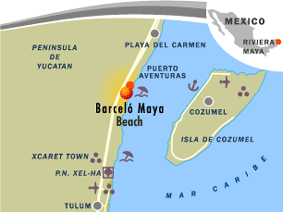
The Barcelo Maya Beach Resort in Mexico has opened a new spa facility at the all-inclusive resort complex that includes the Barcelo Maya Tropical and Colonial Beach Hotels. The twist here: Mayan-influenced architecture and European-style spa services.

The spa is located in a garden area of the resort. It includes a Mayan Temazal lodge, which it describes as "a traditional Indian sweat lodge," along with eight outdoor cabins for tropical massages, and such services such as facials, manicures, pedicures and hairstyling.

Adjacent to the spa is an expanded fitness center with exercies equipment as well as state of the art weight and fitness rooms.

The Barcelo Maya Beach Resort encompasses more than a mile of Caribbean beach protected by a natural coral reef and is surrounded by a nature park. It is less than 50 miles from the Cancun International Airport and is close to the Mayan ruins of Tulum.

The resort is comprised of four all-inclusive hotels that collectively offer nearly 2,000 guestrooms, 14 restaurants, and 10 bars as well as a variety of swimming pools, a children's water park, shopping galleries and two night clubs that feature live orchestras, nightly entertainment and dancing.

Barcelo Hotels and Resorts, established in 1931 in Spain, has a growing presence in Latin America with 32 hotels and more than 10,000 guestrooms in Latin America and the Caribbean.


Learn a New Language: Rosetta Stone

20061231

A mogul's castle is his home

William M. Dowd photo


SAN SIMEON, CA --When media mogul William Randolph Hearst decided to create his own art-filled paradise on a mountaintop north of San Francisco, he selected a spot called San Simeon.

He preferred to call it La Cuesta Encantada -- the Enchanted Hill.

The fabulous Hearst Castle complex houses what was the largest one-person-owned art collection in the 20th Century. Hearst had individual pieces of art, tapestry collections, statuary -- even entire buildings -- he purchased on his many world travels crated and shipped back to the United States. So extensive was the collection, some treasures have never been unpacked, and remain warehoused off-site.

In addition, he had many species of plants and animals brought in to populate the mountaintop lair as well as on the land encompassed by the vast Hearst Ranch down at sea level on the surrounding flatlands.

Excavation on the project began in 1922, and in 1927 Hearst moved into the partially-completed complex -- the period in which he reigned as a Hollywood mogul and entertained the likes of Charlie Chaplin, Douglas Fairbanks, Mary Pickford and his own mistress, actress Marian Davies. Work continued off and on through 1947.

On the main grounds is a series of "cottages" that actually are lavish guest houses, all of which at one time played host to the Hollywood elite for elaborate picnics, tennis tournaments, musical entertainments and private film screenings. The edifice and the lifestyle were the basis for actor/director Orson Welles' controversial and classic film "Citizen Kane" in which a fictitious character named Charles Foster Kane functioned as a thinly-veiled version of Welles' uncomplimentary view of Hearst.

The State of California now owns the complex, donated to it by The Hearst Corp. It is open to the public for guided tours.

One of the most fascinating aspects of seeing the castle and grounds is the realization that it is not just a trove of treasures from many of the world's great civilizations, but each room is in itself a work of art rather than simply a display case for the treasures.

We've all shared our memories of places we've visited, explaining, for example, lovely pieces of artwork we've seen hanging on walls of museums and mansions. At the Hearst Castle, however, the walls themselves are works of art. Some were moved whole from the Doge's Palace in Venice, some from ancient Egyptian excavations. Floors from Moorish castles are the floors of some of the Hearst rooms. Statues and columns lining the mosaic-tiled pools were not made for that purpose; they were repurposed from ancient Roman and Greek ruins.

The Hearst Corp., which still owns the ranch, has plans to create a resort complex there as well as continuing its cattle and agricultural pursuits.
ON THE WEB
Dowd's Guides


20061229

Beau Rivage bouncing back


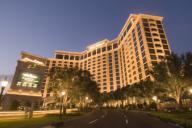
The Beau Rivage Resort & Casino in Biloxi, MS, was hard-hit by Hurricane Katrina. Today, the complex wrapped up its $550 million comeback by opening the Beau Rivage Theatre.

The theater features a 1,550-seat showroom with a $3 million sound and lighting system.

Beau Rivage reopened in late August, overhauled after the hurricane with new interior design, 1,740 guest rooms and suites, a redesigned casino, 11 restaurants, four bars, 12 retail venues, a spa and salon, a convention center and a golf course.

"We are proud to be part of the resurgence of Gulf Coast tourism and to bring some of the biggest names in their respective fields to Beau Rivage," president George Corchis said in a statement.

The resort's newest show production is "Imaginaya," Russian for "imagine," which will run from Feb. 2 through June 3. It was created by Russian choreographer Alla Duhova and includes performances by Todes, the Russian circus and dance company.

The Beau Rivage Theatre has scheduled for 2007 the Four Tops & The Temptations (Dec. 29), Little Richard (Dec. 31), Bryan Adams (Jan. 5), Willie Nelson (Feb. 8), Howie Mandel (Feb. 16), Blue Man Group (Feb. 17), Julio Iglesias (Feb. 22 and 23), Gladys Knight (March 2), Wayne Newton (March 9), Kenny Rogers (March 16), Paul Anka (March 23), Lord Of The Dance (April 13, 14, 15), The Beach Boys (May 26 and 27) and Ron White (June 1).

Its main restaurant is OLiVES, created by chef Todd English, a two-time James Beard Award winner and Bon Appetit magazine "Restaurateur of the Year." It debuted earlier this month.

20061215

Catskills due for a casino

MONTICELLO, NY -- Tens of thousands of people love to build their vacations around the attractions of Las Vegas, Atlantic City, Reno and other, lesser casino gambling communities.

Before long, they'll be able to add New York's ancient Catskill Mountains to their destination list.

A proposed Mohawk casino today received environmental approval from federal officials, a step that should speed up the long delayed $600 million project.

The U.S. Department of the Interior approved an environmental review of the St. Regis Mohawk Indian tribe's project, according to an announcement by Leslie Logan, tribal spokeswoman.

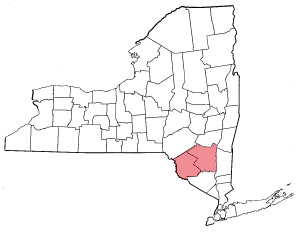
The site is a 30-acre parcel next to Monticello Gaming & Raceway in Sullivan County about 75 miles north of New York City and the same distance south of Albany.

The horse track is owned by Empire Resorts, which would build the new casino. The casino would offer blackjack, roulette, craps and traditional slot machines.

Monticello is in the heart of the old Borscht Belt that once was home to dozens of resorts catering predominantly to Jewish families from the New York metro area. They featured nightclubs that were the incubators for many entertainers such as Jerry Lewis, Alan King and Buddy Hackett who went on to international stardom.

Most of those hotels have been boarded up for years, or torn down, with one failed plan after another put forth to try to revive the economy of the region. Adding video gambling at the Monticello Raceway harness track was one step and proponents of casino gambling say the Indian casino will be a major shot in the arm.

However, don't try booking your rooms yet. Several more large hurdles need to be cleared.

For example, construction cannot begin until the governor -- in this case, Elliot Spitzer, who will be sowrn in next month to suceeded George Pataki -- signs off on the review and the Interior Department puts the land into trust for the Mohawks. In addition, the state must amend the gambling compact that allows the Mohawks to operate a casino in northern New York to include the Catskills facility.
ON THE WEB
• 

20061205

Big Apple going trans-fat free

NEW YORK -- Health-conscious travelers will find the latest thing in the city to their taste.

New York today became the first city in the United States to ban trans-fats in restaurant food, a ban that takes place in the midst of debate over numerous studies proclaiming an obesity epidemic, particularly among younger and lower income people.

Trans-fats have been linked to heart disease, and blamed for raising levels of undesireable LDL in cholesterol while lowering the levels of desireable HDL.

Common foods containing partially hydrogenated vegetable oil, a common form of trans-fats, include such things as processed foods, baked goods, pizza dough and cracjers.

"It's basically a slow form of poison," David Katz, director of the Yale-Griffin Prevention Research Center, told the Associated Press. "I applaud New York City and frankly, I think there should be a nationwide ban."

The ban isn't without its detractors. Many food industry representatives claim the city exceeded its authority in ordering restaurants to abandon an ingredient that is permitted by the U.S. Food & Drug Administration.

"This is a legal product," said E. Charles Hunt, executive vice president of the New York State Restaurant Association. "They're headed down a slippery slope here."

As far as a phase-in is concerned, the city's Board of Health says restaurants will be barred by July 2007 from using most frying oils containing trans-fats, and one more year to eliminate trans-fats from all foods.
ON THE WEB
• Revealing trans-fats
Dowd's Guides

No NASCAR for NY

STATEN ISLAND, NY -- NASCAR fans who had hoped the stock cars would be coming to the Big Apple can cross that one off their to-visit list.

International Speedway Corp., which had hoped to construct a track here on Staten Island, one of New York's five boroughs, has called off the project.

"While we are disappointed that we could not complete the speedway development on Staten Island, our enthusiasm for the metropolitan New York market is in no way dampened," ISC president Lesa France Kennedy said in a public statement Monday. "We continue to view the region as a prime location for a major motorsports facility."

Kennedy runs ISC, the publicly-traded sister company of NASCAR. The two entities had hoped to create a $150 million complex that would seat at least 80,000 fans on a former oil tank farm. The company had purchased 676 acres to do so.

Strong local opposition, based on fear of traffic tie-ups and environmental concerns, stalled the project and led to the decision to forego it and sell off the land, which real estate experts describe as the largest undeveloped acreage in the five boroughs.
ON THE WEB
The schedule
The standings
The drivers
Dowd's Guides

Meanwhile, in downtown Ashgabat …


Update: In late December 2006, the subject of this story -- Turkmenistan President Saparmurat Niyazov -- died. Click here for details.

British comic actor Sasha Baron Cohen has, if nothing else, made most of the English-speaking world aware of the nation of Kazakhstan through his put-on film "Borat." But life sometimes trumps art, as in the case of Turkmenistan, like Kazakhstan a former Soviet satellite nation.

Should you plan to visit either of the Central Asian nations, check out Kazakhstan here and Turkmenistan here.

Or, pay attention to David Remnick's take on Turkmenistan as published in The New Yorker magazine. Here's how it begins. You can get the rest of the story on the magazine’s online archive.

“Of the 15 states of the former Soviet empire, Turkmenistan, just north of Iran, is the one that has turned out to be a cruel blend of Kim Jong Il’s North Korea and L. Frank Baum’s Oz. Not long after the Soviet collapse in 1991, a former Communist Party hack named Saparmurat Niyazov became President-for-life, dubbed himself Turkmenbashi — Leader of All the Turkmen — and commenced building the strangest, most tragicomic cult of personality on the Eurasian landmass.

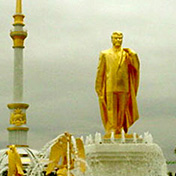
“Doctors there now take an oath not to Hippocrates but to Turkmenbashi; the month of January is now called Turkmenbashi; and in the capital Ashgabat, there is, atop the Arch of Neutrality, a 250-foot gold statue of Turkmenbashi that, like George Hamilton, automatically rotates to face the sun.

“It is extremely difficult to get a visa. Journalists can visit only rarely. But imagine a society in which the ubiquitous, inescapable leader’s image (on the currency, on billboards, on television screens night and day) is that of a saturnine frump who resembles Ernest Borgnine somewhere between 'Marty' and 'McHale’s Navy'."

“Niyazov is a leader of whims. He has banned opera, ballet, beards, long hair, makeup (for television anchors), and gold-capped teeth. He demands that drivers pass a ‘morality test.’ At his command, the word for ‘April’ became Gurbansoltan eje, the name of his late mother. Evidently, he prizes fruit: there is now a national holiday commemorating local melons. And, as if the shade of Orwell were not sufficiently present in Turkmenistan, Niyazov has established, despite an abysmal human-rights record, a Ministry of Fairness.”

20061129

Indiana gets 3rd wine trail


Indiana has gained its third wine trail, a joint effort of seven different central Indiana wineries under the simple title Indy Wine Trail.

The member wineries: Buck Creek Winery (Indianapolis), Chateau Thomas Winery (Plainfield), Easley Winery (Indianapolis), Ferrin’s Fruit Winery (Carmel), Grape Inspirations Winery (Carmel), Mallow Run Winery (Bargersville), and Simmons Winery (Columbus).

Upcoming events will include celebrations around Valentine’s Day, a barbecue feast during the summer and visits with the winemakers. The new trail features a "passport" program which allows visitors to receive a free wine glass after visiting all seven wineries.

For an update and live links to wine trails in Indiana and every state in the nation, visit Dowd's Guide to American Wine Trails.

20061124

Irish coffee recipe has (gasp!) changed


If you're one of those travelers who keep putting off visitng offbeat icons of American cities, you've blown your opportunity to try America's original Irish coffee.

The Buena Vista Cafe in San Francisco, the American home of Irish coffee and the single largest U.S. commercial consumer of Irish whiskey, has changed the recipe of its legendary drink.

According to my colleagues at the San Francisco Chronicle, who seem rather exercised by the whole affair, "The BV has switched from its own private brand of Irish whiskey, made by the Cooley distillery in County Louth, Ireland, to Tullamore Dew, mass produced in Dublin. The change is so subtle it can hardly be noticed, but the difference between the two Irish whiskeys has sent shock waves though the world of Irish coffee drinkers."

The change was occasioned when cafe owner Bob Freeman decided that Tullamore is smoother and better than the whiskey he had been using.

The Buena Vista, says the Chronicle, "is where Irish coffee first came to America, 54 years ago this month" and it consumes "18,720 liter-sized bottles (of Irish whiskey) a year. The Buena Vista is the cathedral of Irish coffee in the United States."

Bartender Joe Sheridan invented the drink at Shannon airport in Ireland. Stanton Delaplane, the iconic Chronicle travel writer, discovered it there and convinced Jack Koeppler, owner of the Buena Vista, to bring it to the United States. Thus, when anything about the recipe changes, the Chron folks get antsy about the Irish coffee first served in the U.S. on Nov. 10, 1952.

You can read the Chron's story here. And, you can read the Buena Vista Cafe's full story here.

20061119

Jalisco becomes a world treasure

William M. Dowd photos


Mono's age was impossible to ascertain.

His naturally dark skin, dyed a deeper shade of mahogany by years in the unrelenting Jalisco sun, was creased enough to resemble a map of the Mexican state's meandering backroads.

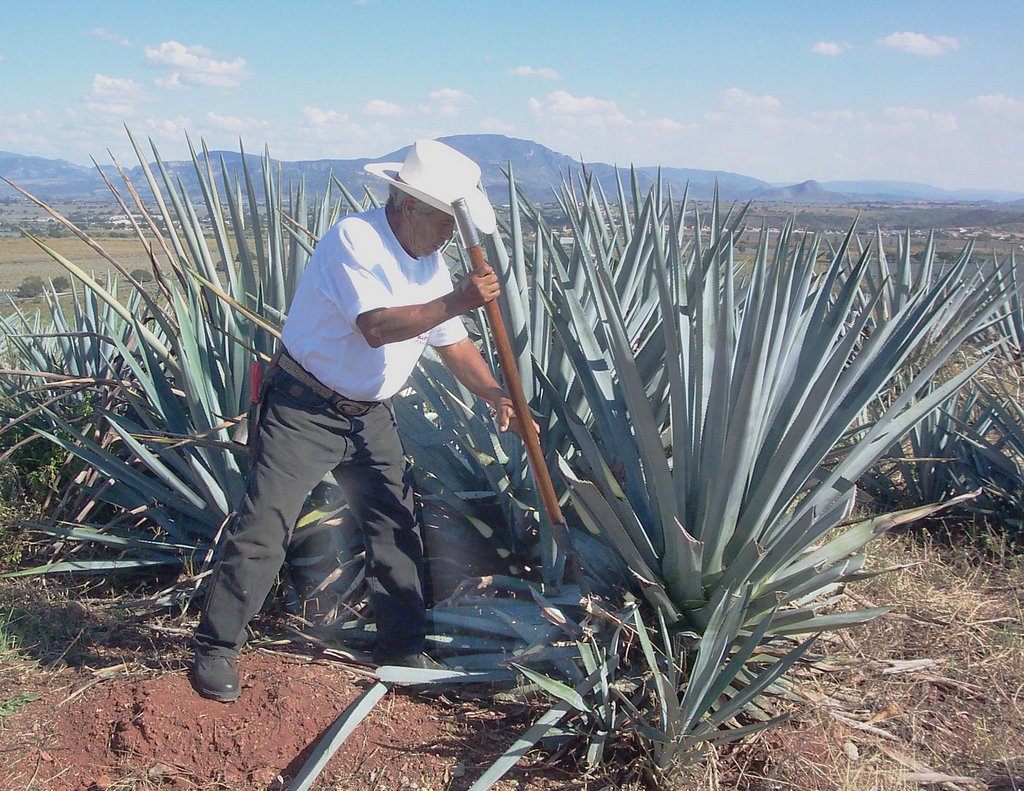
But, it was his shoulders that drew the eye. Like large, knotted bunches of rocks, out of proportion to his physique yet supple enough to help maneuver the shovel-like coa de jima that helped him earn a living.

Again and again, the long-handled cutting tool flashed over the blue agave plant until the sharp outer leaves were gone and it was trimmed enough for other workers to pick up for transport to the nearby tequila distillery.

Mono, Spanish for monkey, got his nickname from his co-workers for his nimbleness in cutting and harvesting the huge cores of the plants used in making the best tequila.

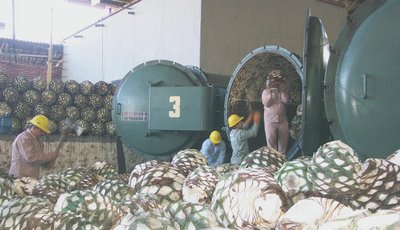
The workers are known as jimadores. They are laborers who wield the coa, a long-handled tool with a razor-sharp curved blade, to chop off the long spiky leaves of the agave plants and sever the pina, the heart of the plant, from its shallow roots. A heart that can weigh as much as a man.

"Mire esto. Ahora, corte el aqui" -- Look at this. Now, cut it here -- Mono instructed an American visitor intent on slicing up his own agave plant. The visitor guided the coa in a downward swipe, again and again. One pina harvested and cleaned and his shoulders already hurt.

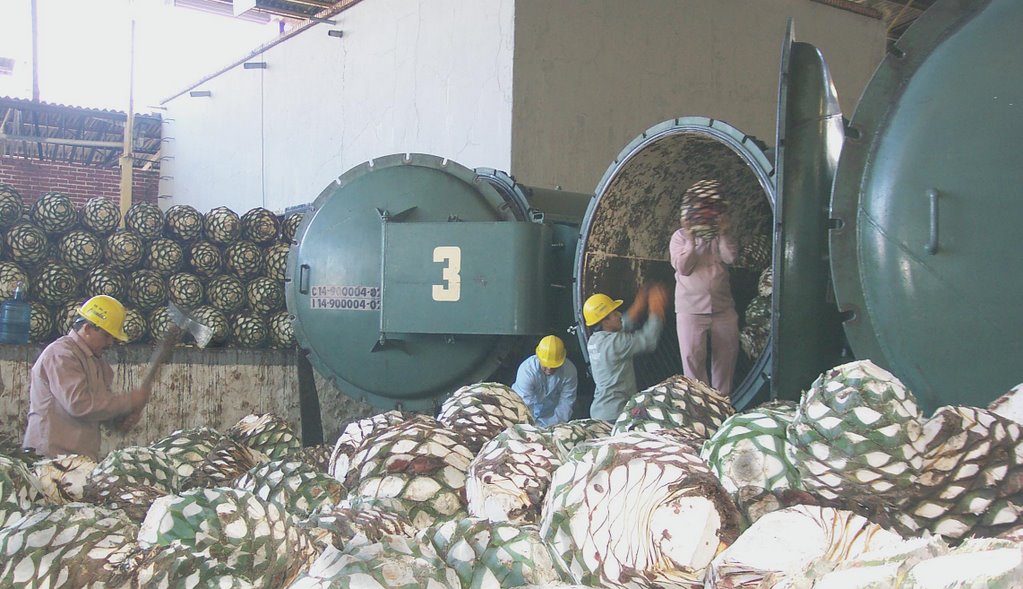
Mono and his fellow jimadores each cut loose and trim dozens of dense agave cores every day, destined for the nearby Don Eduardo processing plant on the outskirts of the city of Tequila. He sometimes harvests as many as 60 a day himself, starting at sunup and working quickly before the mid-day sun turns the sprawling fields into a shimmering blanket of heat mirages that blur into the soft blue haze created by the agave leaves.

The jimadores exist on one end of a food chain, or perhaps more accurately a beverage chain, that breathes life into the economy of Jalisco, the Mexican state recently named a World Heritage Site by the United Nations' UNESCO agency in honor of its agricultural and historical importance.

Jalisco (pronounced hah-lees-ko) is perhaps best known for its tequila and for several of its tourist-haven cities, Puerto Vallarta and Guadalajara, the latter the nation's second largest metro area after Mexico City.

The heralded tequila has as much of a national mystique as Champagne does in France or sake in Japan. And, it begins with Mono and his compatriots in the agave fields.

There are more than 130 types of agave, but it is the blue agave that is the epitome of the plant, the one whose pinas contain the clear sap from which the best tequila is made, a drink that supports an industry that supports a state that helps support a troubled nation.
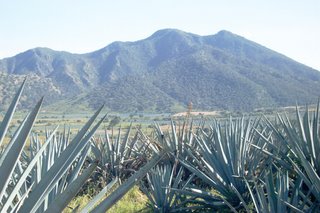
Blue agave grows in various parts of Mexico, but nowhere more in abundance than around Tequila, the town that gave the drink its name. From a distance, the huge fields of blue agave give the illusion of water. Close up, they evoke more of a dessert-like feel, the spiky blue-green plants springing from rich, brownish volcanic soil.

Unlike the jagged peaks and thin air of the great plateau just to the northeast that sweeps up to Mexico City and its hideous urban blight, Jalisco offers valleys, sprawling vistas, clean cities, fertile farmland and a deep historical significance as a center of indigenous culture and birthplace of Mexican democracy.

This state of 6.7 million people -- which stretches from central Mexico west to the Pacific Ocean -- is increasingly attracting foreign tourists as well as expatriate American and European residents drawn by the mild climate, relaxed pace and inexpensive living conditions (about 10 pesos to the U.S. dollar).

Tourism is a major economic necessity for Jalisco, but its attractions are markedly different from each other. Puerto Vallarta, for example, has grown from a seaside fishing town to a glitzy, international tourist haven of 180,000 residents, thanks to its Pacific location and sophisticated marketing. Inland, Guadalajara, a city of 3 million in a metro area of 4.7 million, is a tourist
attraction that has remained very culturally Mexican.

Greater Guadalajara, which includes the adjacent city of Zapopan, is a place of side-by-side cultures -- a proud show of modernity with signs for Sony, Reebok, McDonald's and Blockbuster, but a reverence for displaying the elements of pre-European influence in museums and galleries.

It also is a place that can literally be taken several ways. Just as mimes must have fans somewhere on this globe, not everyone thinks of mariachi music as a musical form of joke despite the best efforts of late-night American television comics who love using those bands as props.

Mariachi was born in Guadalajara, springing from the stuff of wedding bands into a full-blown art form complete with its own music, costuming and protocols. Large crowds gather in mariachi halls that resemble European beer gardens to listen to, and sing along with, the mariachi bands. Even the elaborate clothing of the charro, the traditional cowboy of Mexico, owes its design sensibilities to the form-fitting, embroidered mariachi suits and wide-brimmed sombreros.

Events revolving around churches and church traditions still are extremely prominent in this Catholic country. One of the most festive times is Dia de los Muertos, the Day of the Dead festival which actually covers both Nov. 1 and 2. It is a time for cheerful remembrances of the departed with cemetery visits, restrained festivities, and literally thousands of makeshift altars springing up in homes, businesses and on the streets.
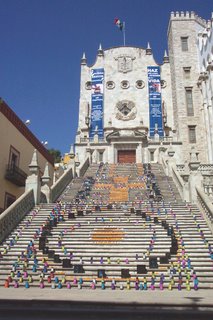
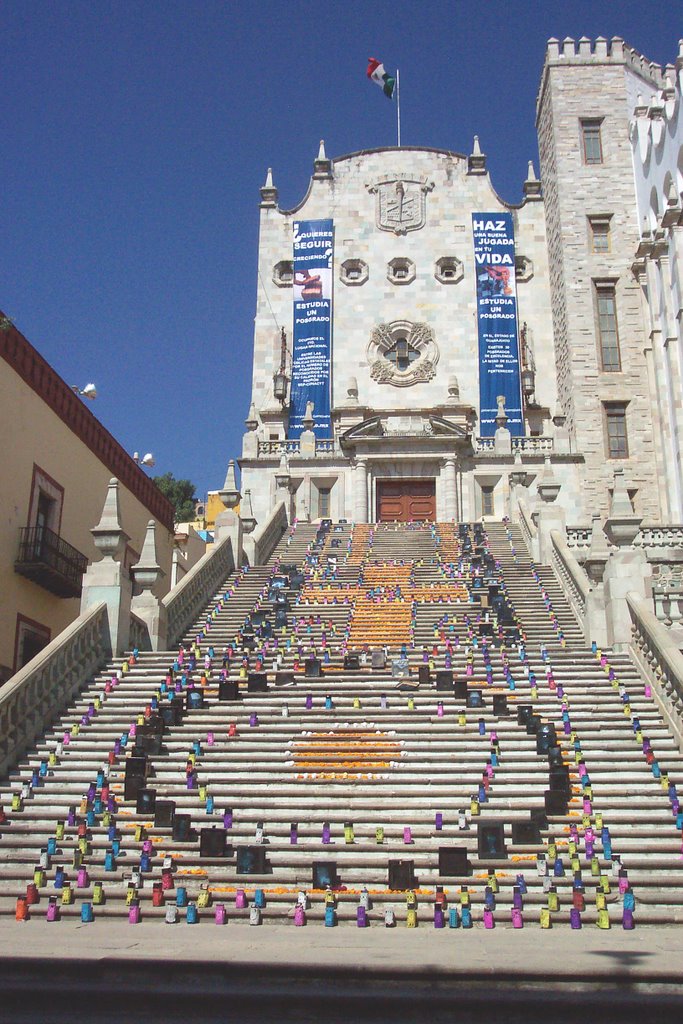
Even the steps of one large cathedral in Guadalajara are turned into a temporary altar each year, festooned with bright orange flowers, candles and photographs of the dead. Streets leading to churches and cemeteries are lined with vendors selling fresh-made foods and handicrafts and youngsters sell coffee cans full of water for a peso to visitors who want to wash down tombstones.

"It's tough to scale down the list of things to do here," local twentysomething businessman Javier Orendain Hernandez told a visitor. "We have the traditional things like the charreadas" -- a type of rodeo -- "and the Sunday bullfights, and of course the museums and the churches and festivals. But, the nightlife is great and getting bigger all the time with dance clubs and bars. That might exhaust you so much you won't want to do a lot of walking the next day.'"

Orendain Hernandez's cautionary advice is an object lesson about the emerging younger generation of which he is a part. It is helping create a larger, stronger middle class in a nation traditionally divided into haves and have-nots.

Increasingly college educated, demonstrably entrepreneurial, and relentlessly in search of modern diversions, they are helping build a society that attracts international travelers and financial investment, fueling a continual growth that demands better choices and improved infrastructure.

Water quality, long a bad joke in many parts of Mexico, is quite good in Jalisco with hygienic, well-maintained municipal supplies, although visitors usually are advised to stick to bottled water as a precaution.

Huge swaths of streets in most cities are being upgraded with modern cobblestones that maintain the historic look but offer more durable pathways, accented by lush plantings of flowers and shrubs. Street sweepers are commonplace. Graffiti is so rare it startles you when it's evident.

The toll highways between cities are in good repair and well protected against bandits by federales, well-armed federal police, things that cannot be said of some of the free highways where lawlessness is common.

Guadalajara also offers an international airport, well-regulated taxi and bus services, numerous well-tended parks and intricate fountains, plus innumerable cafes and restaurants that are inviting stopping places on sultry afternoons for anything from a beer or soft drink to a tequila tasting accompanied by fresh cheeses, salted pineapple chunks, spiced nuts and crisp breads.

Many first-rate hotels are hidden behind rather plain facades that don't tend to attract unwanted attention. The same goes for homes of most of the financial upper class. Behind the walls, like a pampered senorita freed from the presence of a strict chaperone, courtyards burst loose with flowers and plants and shade trees.

Guadalajara's historic city center is dominated by Spanish colonial architecture, its ornate churches presenting the most striking examples. The main cathedral there is home to the state tourism office where you can pick up a free walking-tour
map. If your feet hurt, catch a calandria, a horse-drawn carriage that can be hired at the historic enter or at various other stations.

There also is a top-flight children's zoo and a connected amusement park, called Selva Magica, that has 35 rides, a marine park, and various water and bird shows. Tennis courts and golf courses are readily available at various points around the city.

Perhaps the two must-see parks in the city are Los Colomos and Parque Agua Azul (Blue Water Park). The former is located in a forest within the city and includes the Japanese Gardens, donated by Guadalajara's sister city of Kyoto, Japan. The latter is divided into two parts connected by a bridge and usually offers strolling musicians as well as the adjacent Archaeological Museum of Western Mexico that holds exhibits of artifacts used by the ancient peoples of the surrounding area.

The town of Tequila, northwest of Guadalajara on the road to Puerto Vallarta, is a comparatively quiet one, its population of 45,000 a mere shadow of Guadalajara's. But it is the home of the Tequila Museum, an interesting place if one is at least somewhat conversant with Spanish. Oddly for an institution that was created to explain the tequila tradition and industry to visitors, it is presented only in Spanish.

Some of the local tequila manufacturing facilities are open for tours, but they should be booked ahead of time because production is not always at full throttle.

When it is, don't expect the sharp, sometimes off-putting smells of distilleries and breweries. The aroma of the tequila process is quite pleasant, a light mix of citrus and flowers.

As one female American visitor was overheard saying, "Forget about drinking the stuff. If they could bottle tha fragrance they'd make a fortune.''


IF YOU GO

Location: Jalisco, one of Mexico's 31 states, is located in the center of the country, stretching west to the Pacific Ocean.

Key Cities: Guadalajara, Puerto Vallarta, Tequila.

Main Airports: Don Miguel Idalgo Airport in Guadalajara, Gustavo Diaz Orzaz Airport in Puerto Vallarta.

Language: In Jalisco state, you'll hear mostly Spanish even though Mexico has 62 living indigenous languages, second in the world only to India's 65. English is common in major cities and at all hotels and restaurants.

Currency: The peso, worth approximately 10 U.S. cents.

Documentation/Fees: Effective Jan. 1, 2007, all persons traveling by air between the U.S. and Mexico will be required to present a valid passport. Visitor exit document provided upon arrival is necessary for departure or $43 fee is charged for replacement. Departure tax of $10 must be paid at the airport when not included in the cost of the airline ticket. Customs declaration forms, available from airlines, required upon entry and departure.

Driving in Mexico.

Emergency medical care in Puerto Vallarta and in Guadalajara.

Best tip of all: Bring your own toilet paper. Most public facilities dole it out by the square, for a price, and this is the home of one-ply tissue.


Learn a New Language: Rosetta Stone

Blog Archive