20080523

A taste of the 'New Irish Cuisine'

DUBLIN, Ireland -- One day into a motor tour of Ireland in search of something to overcome the negative stereotypes about Irish food and I was stumped.

I was here in the capital city, sitting with a traveling companion in the bar of the beautifully converted Clontarf Castle, site of one of the epic battles of the ancient Irish warrior king Brian Boru. We were trying to figure out where to find the best place for local food.

The hotel bell captain seemed a logical person to consult.

"Well," he said in all seriousness, "it depends on what sort of local food you're looking for. The best in the city is Italian, Thai or Chinese."

That was several years ago, and it's even truer today unless you're so far off the beaten path you're creating a new one. The difference is that the New Irish Cuisine, as it is capitalized in most Irish publications, also has begun making inroads into popular taste.

Much as I pride myself on my nearly 100 percent Irish heritage, I cringe -- as does my aorta -- when I think of some of the dishes that once were typically representative of Irish cuisine.

Finnan Haddie, a smoked fish and mashed potato dish. Dublin Coddle, featuring flour-coated pork sausage fried in bacon fat then cooked in cider with onions and potatos. Bacon and Egg Pie, which includes a half-dozen eggs and four ounces of lard. Carrageen Pudding, which is primarily dried seaweed and whipped heavy cream. Toad in the Hole, a bacon-wrapped sausage baked in mustard dough and covered in gravy. And endless platters and bowls of potatoes baked, mashed, fried, steamed, boiled, grilled, sauteed and whatever else one could think of to do with them.

But that was then. This is now, and my how things have changed.

Irish restaurants and modern Irish families are relying on such things as chicken, salmon, monkfish, lamb and vegetarian dishes in ever-increasing amounts, although the ubiquitous and versatile potato retains its place of honor in the Irish kitchen.

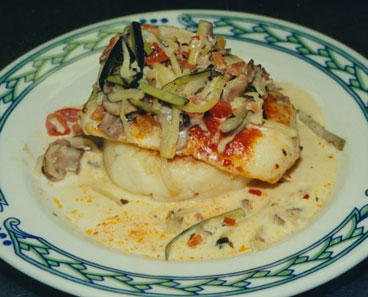
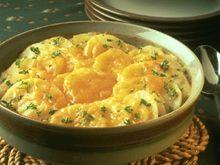
Dishes tend to be more of the "spa cuisine" variety, with less reliance on heavy creams and fats and more exploitation of the island's abundance of fresh produce. Some of the dishes still look heavy -- like the dishs shown above, cod sorrel (top) and colcannon (bottom) -- but light, alternative ingredients lessen the impact.

Ireland once had plenty of people and no money. Now, thanks to its leadership among European nations in the technological revolution, it has plenty of money and no people. To attract new ones and hold on to the ones it has, developing a modern, appealing cuisine has become an important task.

The island's two national food trade groups, Bord Bia (Irish Food Board) and Trade International Northern Ireland, are helping market Irish products worldwide and soliciting foreign investment in the industry under the promotional title "Ireland: The Food Island."

Tourists are being directed to culinary destination spots throughout the country, especially to the southern port city of Kinsale, a picturesque spot that has emerged as the country's gastronomic capital.

As Muirish Kennedy, Bord Bia's client services director, told Irish Connections magazine, "Ireland has changed drastically. ... The young sector is very much the driving force. The food companies here were started in the last 15 years. It's a young new generation that is much more aggressive, much more aware."

There is rarely a question about the quality of Irish agricultural and livestock products. Willing consumers abroad buy 90 percent of Ireland's annual output. The knock has been on what Irish cooks have done with those products at home.

Until the recent economic upsurge, dining out regularly was a rarity in most parts of Ireland, with fewer than 25 percent of people doing it compared to about 70 percent in the U.S. That mindset, which tends to discourage culinary experimenta tion, was perpetuated in the lives of Irish expatriates around the world. Thus, to many people the likes of Toad in the Hole still exemplifies Irish cuisine.

Couple the experiences younger, adventuresome Irish have had in traveling abroad with their higher wages and more disposable income and the demand for better food becomes even clearer.

The appetite for things Irish can be seen in a number of areas beyond industry trade shows. At the bookstores, for example, you can find titles that put to rest the foods of the famine and poverty years. Instead, we find "Elegant Irish Cooking: Recipes from the World's Foremost Irish Chefs," compiled by the noted Irish master chef Noel C. Cullen, now professor of culinary arts at Boston University. And, "The New Irish Table," a collection of recipes from restaurant and home cooks edited by Margaret M. Johnson who has written on Irish food for such newspapers as the Los Angeles Times and the Irish Echo.

In U.S. tourism, modern Irish food is on display beyond the stereotypical Irish folk festivals. A perfect example is the recent Kinsale, Ireland Festival of Fine Food in Newport, R.I. For some years now it has drawn large crowds anxious to sample the wares of local and visiting Irish chefs.

And, while they don't have the reputations of such world-renowned culinary schools as the Cordon Bleu in France or the Culinary Institute of America, Irish cooking schools are enjoying a growing reputation.

Noted chef Darina Allen's Ballymaloe Cooking School, operated at her Ballymaloe House Hotel in County Cork, is perhaps the brightest example. It has been the catalyst for several well-received cookbooks and the work of hundreds of graduates who took advantage of the organic farm and extensive gardens on the property.

The world of New Irish Cuisine is not limited to the Republic of Ireland. In Northern Ireland, where tourism is comparatively strong despite the continued violence in an around Belfast, 70 miles from there in County Fermanagh the Belle Isle School of Cookery is a big draw for residential or one-day classes.

It's situated on a wooded island in Lough Erne, a rural lake that is home to 11 islands owned by the same nobleman, the Duke of Abercorn.

To prove some things about Irish eating and drinking habits never change, the school's brochures brag about its proximity to many attractions -- particularly the Old Bushmills Distillery, at age 400 this year the oldest licensed distillery in the world, where the renowned Bushmills whiskey is produced.
ON THE WEB
On the Road In Search of My Darby Duck
Dowd's Guides

Ian Fleming, Agent 100

May 28 marks the 100th anniversary of the birth of Ian Fleming, creator of James Bond.

What does that mean to a traveler, besides trying to emulate 007's preferences for cocktails and wines?

Glad you asked. A year-long program of events is under way to celebrate his life and the impact his superspy creation has had on popular culture around the world.

Fleming, a onetime journalist, introduced the public to James Bond in the early 1950s, inspired by his experiences and those of his colleagues at the British Admiralty during World War II when he was personal assistant to the director of Naval Intelligence, making him privy to many spycraft secrets.

More than 100 million copies of the 14 Bond titles, ranging from the first ("Casino Royale" in 1953) to the last ("The Living Daylights" in 1966).

A few examples of Fleming/Bond-related activities:

• Cunard Line's Queen Mary 2 will help celebrate the Fleming centenary with several Ian Fleming onboard offerings on the Oct. 10-17 crossing. Departing from Southampton, England, the special voyage will include 007-themed activities, an exhibit and a panel of guest authors, speakers, and experts.

• On Oct. 18, "Bond Bound: Ian Fleming and the Art of Cover Design" will open at Bonhams in New York. The exhibition will chart the role of artists and designers in creating and defining the Bond look over the past 50 years. It also will cover all Ian
Fleming's other books, including "Chitty Chitty Bang Bang" and "Thrilling Cities," and his collected travel journalism.
ON THE WEB
Ian Fleming Centenary
Imperial War Museum Exhibition
Dowd's Guides

Hotel chain counters American Airlines bag fee

I've had more luggage sent astray and probably had more delays while flying American Airlines than with any other carrier, foreign or domestic. In fact, I've often thought that if I had kept a log of it, it would show that my luggage has racked up more air miles than I have.

As a result, I try to avoid American when at all possible. And its latest announcement, that it would charge $15 for a checked suitcase -- not an extra piece of luggage, mind you, but the first non-carry-on, solidified my antipathy to the airline.

However, thumbs-up to the Loews Hotel chain. Reacting to American's questionable new charge, the hotelier launched a "Baggage Buy Back" incentive that will reimburse guests for their $15 checked baggage fee.

This not only is smart marketing, it is particularly good news since American's new fee no doubt will be copied by at least some competitors who now charge extra only for a second checked bag. Delta, for example, charged me an extra $25 for one on an international U.K.-to-New York flight last week.

How complicated is the program? Says a Loews spokesperson:

"Arriving guests need only present any airline bag fee receipt at the front desk to receive the rebate, which will be issued in the form of a credit to their bill at checkout. The ... rebate is available at Loews' 18 properties in the U.S. and Canada, beginning June 15 through Labor Day.

"Loews Hotels will offer credit for up to two bags for a maximum of $30 per occupied room per stay."
ON THE WEB
Avoid luggage checking
What you can carry on or check
Dowd's Guides

20080520

ROFLMAO (*)

William M. Dowd video & photos


LOUISVILLE, KY -- Well, at least these kinetic air-blown sculptures (in video above) were doing that to amuse visitors to the 21c Museum Hotel in the heart of downtown.

21c (for 21st Century) combines support for present-day artists with a first-class hotel and dining establishment that is the forerunner of several more to be constructed. It also is a perfect spot for the visitor not up to a lot of walking, whether due to laziness, preference or disability. That's because there is art everywhere in the 91-room hotel.

The hotel's 9,000-square-foot contemporary art museum, funded and managed by the International Contemporary Art Foundation, and its restaurant/bar Proof On Main make it an ideal spot for a leisurely stop in an otherwise bustling neighborhood.

Steve Wilson and Laura Lee Brown, local investors and contemporary art collectors, conceived and bankrolled the property which opened in April 2006, and they're extending the idea to other locations as well, beginning with a project in Austin, TX. When it opens in 2011, it will contain a luxury hotel, high-end condominiums, a contemporary art museum, a restaurant, and artist lofts.

The original is, as I heard one person describe it, "a hoot." From the moment you enter, you're hit with in-your-face art. A sculptured family gathered around a sculpture dinner table, a film of a sleeping -- albeit restless -- couple is shown on the floor, projected from a ceiling device.

And, speaking of ceilings, if you look up you'll see what appears to be a mountain climber on the ceiling of the lobby.

Original art adorns the walls of each of the comfortable rooms, as well as the public spaces and meeting rooms throughout the complex.

(* - Internet shorthand for "rolling on the floor, laughing my ass off.)


ON THE WEB

Louisville.com
Churchill Downs
Dowd's Guides

Haggis address 101

William M. Dowd photos


Chef David Graham and his staff watch piper Duncan MacGillivray deliver the "Address to a Haggis" before dinner


FEARN, BY TAIN, ROSS-SHIRE, Scotland -- Next year will mark a special promotion called "Homecoming Scotland," with government and tourism entities offering all sorts of inducements for tourists to visit Scotland for golf, distillery tours, sightseeing and so on.

One reason for the timing is that '09 will mark the 250th anniversary of the birth of the iconic poet Robert Burns. Among the many writings by the author of the poem "Auld Land Syne" (and "Comin Thro the Rye," "My Heart's In the Highlands, "To a Mouse," etc.) is the venerable "Address to a Haggis," delivered before the formal serving of the peculiar Scottish dish that consists of a variety of oatmeals, vegetables and innards cooked into a stewlike mass inside a sheep's stomach.

I was part of a group of visiting journalists treated at The Glenmorangie House (shown below) to the dish, as well as the fun and ceremony surrounding its serving, sponsored by the Distilled Spirits Council of the U.S. and the Scottish Whisky Association.

Here's the Burns epic, in modern English. For a look at it in the original Scottish dialect, go here.

Fair is your honest happy face
Great chieftain of the pudding race
Above them all you take your place
Stomach, tripe or guts
Well are you worthy of a grace
As long as my arm

The groaning platter there you fill
Your buttocks like a distant hill
Your skewer would help to repair a mill
In time of need
While through your pores the juices emerge
Like amber beads

His knife having seen hard labour wipes
And cuts you up with great skill
Digging into your gushing insides bright
Like any ditch
And then oh what a glorious sight
Warm steaming, rich

Then spoon for spoon
They stretch and strive
Devil take the last man, on they drive
Until all their well swollen bellies
Are bent like drums
Then, the old gent most likely to rift (burp)
Be thanked, mumbles

Is there that over his French Ragout
Or olio that would sicken a pig
Or fricassee would make her vomit
With perfect disgust
Looks down with a sneering scornful opinion
On such a dinner

Poor devil, see him over his trash
As week as a withered rush (reed)
His spindle-shank a good whiplash
His clenched fist.the size of a nut.
Through a bloody flood and battle field to dash
Oh how unfit

But take note of the strong haggis fed Scot
The trembling earth resounds his tread
Clasped in his large fist a blade
He'll make it whistle
And legs and arms and heads he will cut off
Like the tops of thistles

You powers who make mankind your care
And dish them out their meals
Old Scotland wants no watery food
That splashes in dishes
But if you wish her grateful prayer
Give her a haggis!


ON THE WEB

Glenmorangie House
Burns Country
Scottish recipes
Dowd's Guides

Champlain: It really is a great lake

Pedestrian-friendly Burlington.


BURLINGTON, VT -- There was a brief moment there when a move was afoot to add Lake Champlain to the assemblage known as the Great Lakes.

Technically, Champlain came under the descriptive umbrella of "Great Lakes'' for some federal technical water management programs in 1998. However, try to convince anyone who learned the mnemonic device H•O•M•E•S for Huron, Ontario, Michigan, Erie and Superior that they have to work a "C" into it.

And never mind that the watery gem shared mostly by New York and Vermont is a mere drop in the bucket sizewise when its 435 square miles - sixth largest in the U.S. - are compared to the largest of the original Great Lakes (Superior at 31,700). Or even the smallest (Ontario at 7,340).

While it may not be a true Great lake, it is a great lake, smack in the middle of a great place for a getaway. The best approach from the New York side is from the Albany/Saratoga Springs area known as the Capital Region, an excellent daytrip that can be extended into a leisurely overnighter runs up the I-87 Northway to the lake, east across by one of three ferries to Vermont, a visit to the Burlington area, then back down toward Bennington and back home. From Boston, it's pretty much just a reverse route

That doesn't cover all of Lake Champlain. After all, it is 121 miles long and extends several miles north into Canada. It does, however, cover the most heavily populated portion and the most spectacular views of the Adirondacks on the west side and the Green Mountains on the east.

It even has its own version of the Loch Ness Monster folk fable. This one is known as "Champ," and it has its own cult following as well as some scientific interest. here is just one "fan site" devoted to the legend.

EVENTS, ATTRACTIONS, ACTIVITIES

Outdoors activities -- As might be expected, they are myriad on both sides of the lake, from hiking to boating to camping to biking to climbing and anything else one might think of. One of the most comprehensive Web sites for the New York side is from the state Department of Environmental Conservation For the Vermont side, the Lake Champlain Regional Chamber of Commerce site has a section with helpful links.

• Ferry service -- (802) 864-9804: The rides themselves are attractions. They go between Essex, NY and Charlotte, VT, (20 minute ride), the run closest to the Capital Region; Port Kent, NY, and Burlington, VT (60-minute ride), and Plattsburgh and Grand Isle, VT. (12-minute ride). The season begins about a week before Memorial Day.

• Fort Ticonderoga, Ticonderoga Village, 585-2821 -- The 1775 stone fort was built by the French, then taken over by the British. Ethan Allen and the Green Mountain Boys from Vermont captured it during the Revolution. The complex of 40 restored buildings shows rural life in the 1790-1840 era. Open from May 10 through mid-October.

Church Street Marketplace, Burlington, VT, (802) 863-1648 -- This brick-paved area made for strolling and people-watching is the activity heart of the state's largest city (but at a population of 39,000 still quite small), with the Burlington Town Center mall, home to more than 75 specialty shops and 15 national retailers. It also is the site of festivals and street entertainment year-round and such summer events as the Burlington Discover Jazz Festival (May 30-June 8), the annual Marketplace Sidewalk Sale in July and the Champlain Valley Folk Festival, Latino Festival and Burlington Craft Fair in August.

College Cluster, Burlington, VT -- Burlington is home to the University of Vermont, Champlain College, Burlington College and the Community College of Vermont, plus St. Michael's is in nearby Colchester. That means lots of small cafes, bookstores and on-campus events.

Champlain Valley Exposition, 105 Pearl St., Essex Junction, VT, (802) 878-5545 -- The state's largest fair is held over 10 days in late August, but there also are events year-round.

Middlebury, VT -- Vermont still has numerous downtown-centric communities that have avoided the widespread move to suburban malls. This is one such, with a classic New England Main Street with numerous well-maintained late-18th and early-19th-century buildings. It also has the Vermont Folklife Center (88 Main St., 802-388-4964 or http://www.vermontfolklifecenter.org) Line is overdrawn with has numerous exhibits and research programs aimed at protecting the state's cultural traditions, and the Henry Sheldon Museum of Vermont History (1 Park St., 802-388-2117), the oldest chartered community history museum in the nation.

WHERE TO EAT

• Upper Deck Restaurant, Willsboro Bay Marina, 20 Klein Drive, Willsboro, NY, (518) 962-8271 -- This seasonal spot offers an international menu and a great waterview of the bay that juts off Lake Champlain.

Ri-Ra The Irish Pub, 123 Church St., Burlington, VT, (802) 860-9401 -- An upscale spot with both inspiration and decorating materials brought from Dublin. Traditional Irish and modern American cuisine, weekend entertainment.

• Vermont Pub & Brewery, 144 College St., Burlington, VT, (802) 865-0500 -- A brewpub in a Vermont college town. Talk about quintessential. A menu of handcrafted beers and ciders, plus all the usual pub food.

Dobra Tea House, 80 Church St., Burlington, VT, (802) 951-2424 -- The first Dobra opened in Prague in 1993. Ten years later, this Bohemian-style tea room followed. It offers imported teas from around the world, plus light fare.

• Basin Harbor Club, 4800 Basin Harbor Road, Vergennes, VT, (800) 622-4000 -- This resort complex, part of the Historic Hotels of America, has a range of dining options: from upscale in the main dining room to lunch in the casual Red Mill -- a renovated sawmill, al fresco on the Homestead lawn, or on the North Dock.

WHERE TO STAY

A looong list of possibilities, mostly on the Vermont side. Get the most up-to-date data online at Where to Stay for Vermont and for New York.

DISTANCE

Heading north: 137 miles from downtown Albany to Willsboro to get the Essex ferry to Vermont. Heading south: 130.5 miles from Burlington to Bennington. Drive time: 2 hours, 15 minutes, to Willsboro; 2 hours, 56 minutes, from Burlington to Bennington, 40 minutes from Bennington to Albany.
ON THE WEB
Dowd's Guides

20080519

'Liquid deli' products a Scottish hit

William M. Dowd photos

EDINBURGH, Scotland -- If you're ever in Edinburgh or Glasgow and looking for something truly different, may I suggest Demijohn or, at least, its products.

Demijohn is billed as the first "liquid deli" in the country, having opened the original here in 2004, and subsequently expanding to Glasgow. The place is inspired by Italian cantinas and Euro-style markets and offers a lengthy array of liqueurs, spirits, oils, vinegars and whisky either on-premises, by mail order or online.

I ran into their products during a visit to Iglu, a nearby Edinburgh spot that bills itself as an "ethical eatery." It is essentially a gastropub that pays attention to sustainable and local food and drink. It's doing so well after less than two years in existence that it won the "Scottish Gastropub of the Year" for 2006-07.

Among the Demijohn-supplied liquers available at Iglu from special glass wall containers (see above) are:

• Damson Gin 22%, made from Scottish Damson plums, to be ingested with a bit of ice as an aperitif or an after-dinner drink.

• Solas Blaeberry Liqueur 19%, and, no, that is not a typographical error. It is made with aged malt whisky, honey and real fruit.

• Lyme Bay Chocolate Orange Cream Liqueur 17% , made from a subtle blend of dark chocolate, real Devonshire cream, apple brandy and orange zest.

Demijohn recently came out with a pair of seasonal liqueurs to add to its longer list, including organic rhubarb and organic cucumber liqueurs.


ON THE WEB

Edinburgh & Lothian Tourism
Explore Edinburgh
Capital City Webcam
Dowd's Guides

20080514

Low tide in the Highlands

Top photo by William M. Dowd


ABERDEENSHIRE, Scotland -- Here I am, traveling in the Highlands of Scotland, where life seems to move at a snail’s pace, history is apparent all around you, and the place looks rock solid.

Literally, since nearly every structure is made of granite blocks or stone and their longevity morphs from one century to the next with little apparent difference.

Yet all the newspapers are dwelling heavily on only three topics:

1. How silly British Prime Minister Gordon Brown is being made to look because of a tell-all book from ex-PM Tony Blair’s outspoken wife, Cherie, who (shock and awe!) doesn't care for Gordon.

2. How rocky the financial situation is “north of the border,” which means Scotland itself where housing prices are skyrocketing, inflation is rising at a faster rate (3.5%) than anywhere else in the United Kingdom (which includes England, Wales and Northern Ireland), and unemployment is on the rise.

3. How bad the alcohol abuse is getting, a particular problem in a country where more than 40,000 people out of a total population of barely 5 million rely on the whisky industry for jobs — and that is not including people in the retail business of selling the stuff. (This problem really interested me, since I am here as a guest of both the Distilled Spirits Council of the U.S., or DISCUS, and the Scotch Whisky Association, both of which take great pains to push a "drink responsibly" campaign.)

Some of the solutions that are being suggested from various corners are as hysterical as the incessant reporting on them, except for the Gordon Brown thing which is great theater for the masses who love seeing the balloons of the high and mighty pricked sharply.

For the alcohol problem, the suggestions range from raising the drinking age beyond 21 to raising prices (even though Scotch whisky costs much more in Scotland than it does abroad, due to the regressive taxing policies) or even making public intoxication a higher crime.

As to the financial situation, the ideas range from strict price controls to more restrictive bank loan policies (they have the same problem with sub-prime mortgages we in the U.S. have), although no one wants to officially put forth a comprehensive plan for fear of commiting political suicide.

Oh, there has been one other item in the news. The idea of Scottish independence.

Of course, that one has been rattling around since the 18th Century, when the anti-English rebellion in support of Bonnie Prince Charlie fizzled out after a hideous defeat at Culloden on April 16, 1746. A battle that lasted less than an hour killed 1,500 Highlanders vs. a mere 50 or so English regulars. It effectively broke the back of the Jacobite movement, leading to the banning of such ethnic staples as the playing of the bagpipes and the wearing of the kilts and tartans.

Now there are calls from Sean Connery from the comfort of his homes abroad and other nationalists still residing in Scotland to push forward with a vote on splitting off from the U.K.

As an outsider, I have perhaps a more measured reaction to the idea than someone who is emotionally invested. I think it’s ridiculous. Given all the hoo-haw of financial woes and a bleak outlook for years to come, the last thing that would be needed is trying to establish a truly independent country.

Evidence? Take Scotland’s currency. The Scottish pound is issued by the government, but it also is issued by two different banks. Money from all three sources can be spent anywhere in Scotland, but only money issued by the government is worth anything outside the country's borders.

If they can’t get their act together on a simplified, unified currency recognized worldwide, imagine the problems of being a soveriegn nation with financial woes trying to be trusted financially in a global economy.
ON THE WEB

Scottish Tourist Board
Alba Na Gaidhlig (Gaelic Scotland)
Dowd's Guides

20080507

Caymans debuts an 'underwater' rum

Most people think "Caribbean" when they think of rum. But the Cayman Islands never could lay claim to its own such spirit.

That has changed with the debut of Seven Fathoms Premium Rum, the first commercially–made distilled rum made entirely in the Caymans.

Walker Romanica, a co-founder of Cayman Islands Distilleries with Nelson Dilbert, said the rum is made using an underwater aging process thought to be the first ever used with a spirit. After distillation, the rum is put into oak barrels, taken out to sea and dropped to a depth of 42 feet, or seven fathoms.

“By aging our spirits underwater, we are able to take advantage of the kinetic properties of the ocean tides and currents to create a very unique flavour profile and a remarkably smooth rum,” Romanica said at a press conference.

Dilbert brushed off any suggestion the aging process is a gimmick.

"It works very well with marketing, but there is actually science to it,” he told the Cay Compass newspaper. “The product is always moving and is also subjected to sound waves, which is excellent for the aging process. There is a Japanese company doing it with sake and the French are doing it with wine.”

As a result of the unique kinetic maturation process, he said, Seven Fathoms rum takes on characteristics of rums aged much longer using traditional methods. He added that the idea that motion could help in the aging process of rum goes back centuries. The rum produced in the Caribbean in earlier days was found to be quite harsh but mellowed while being transported across the Atlantic to England.

The 80-proof small-batch rum will be made in limited supply with limited distribution, mostly in the Caymans.

ON THE WEB
Welcome to the Cayman Islands
CIA World Factbook on Caymans
• Dowd's Guides

20080428

History and art mingle on Mass.'s 'other coast'

William M. Dowd photos

A tranquil scene in Rockport Harbor.

GLOUCESTER, MA -- It could have been called Cape Tragabigzanda. In fact, it once was.

Much of it remains rural, with salt marshes and small rivers everywhere. Gulls swoop about, and herons suddenly soar up from the grasses, startling a visitor and at the same time providing a perfect photo opportunity.

It is a place also dotted by stands of sturdy oak, far fewer in number than centuries ago but a reminder of what helped attract European settlers eager to establish communities and construct sailing ships to ply the cold waters of the Atlantic that lap up on the shores of three sides of this jut of land.

Its largest community is home to barely 32,000 souls, and many of the little neighboring towns and villages seem to be suspended in time, periodically awakening like Brigadoon, albeit once a year rather than once every hundred.

Welcome to Cape Ann, Massachusetts' "other cape.''

That's not a description locals tend to appreciate. While Cape Cod has far wider fame, Cape Ann has plenty to distinguish it, they will point out. Each of its main communities has its own pedigree.

Gloucester, its main city, is the nation's oldest fishing port, founded in 1623. Tiny Rockport, a city of less than 8,000, once was the granite mining center of the eastern seaboard, supplying building materials to cities and towns booming from the Industrial Revolution. Even tinier Manchester-by-the-Sea, 5,200 population, was settled in 1629 and became Boston high society's summer coast of choice after the distinguished poet Richard Dana built a seasonal home there in 1845. And, Essex, tinier still at 3,200, was a renowned shipbuilding center that supplied the maritime industry with fleet wooden schooners.

Cape Ann was named for Queen Anne of England after earlier attempts at naming it. The French explorer Samuel de Champlain briefly came ashore here, then, in 1606, made a return visit and a peaceful encounter with the 200 or so Agawam Indians who inhabited the area. He referred to it as Le Beau Port. The English explorer John Smith, who early in his life was held captive by the Turks, later fancifully renamed the New World land Cape Tragabigzanda after a Turkish princess. King Charles settled the matter when he named it after his mother, although it soon became spelled without the "e.''

But that was then. Now, Cape Ann's major claim to fame is as a tourist destination, not only for denizens of the Boston area just a half-hour drive to the southwest, but for hundreds of thousands of others.

It also has periodically attracted moviemakers, from 1937 when much of the Spencer Tracy film "Captains Courageous'' was shot here to 1997 when the George Clooney film "The Perfect Storm'' was set, and shot, here.

Sharp boulders dot the landscape of the Jones River Salt Marsh.


Road signs direct visitors coming from the south to several exits off Route 128 for Gloucester. Taking the one not mentioned, Exit 13, is a smart move.

It leads you to the Town Landing of the City of Gloucester, an oddly named place -- is it a city, or is it a town? -- that is an excellent spot for photographing or just gazing at the Jones River Salt Marsh.

The flat, rutted expanse is covered with marsh grasses and dotted with outcroppings of sharp boulders. It is a starkly beautiful part of the 17,000-acre Great Marsh that extends from Cape Ann northward into New Hampshire.

As the eye follows the curving sweep of the marsh toward the outskirts of Gloucester proper, it becomes obvious this is a community of the sea. Houses are built with window and deck views oriented toward the water, be it the Jones River, the Annisquam River, a broad marsh or Gloucester's deep water harbor.

All along the cape, broad, pristine beaches with fascinating names -- Wingaersheek Beach, Singing Beach, Chebacco Lake Beach -- are made for year-round strolling even if the non-summer months can be blustery and many of the shops and dining spots are open only seasonally.

Wingaersheek Beach, just up the road from the Town Landing, is a fine example of a beach for young and old alike. Although most of the dunes areas on Cape Ann are off limits to foot traffic due to a restoration project under way, large areas are good for sunbathing or strolling. Groupings of huge boulders and rocks smoothed off over millenia by the effects of the sea provide small sheltered nooks for beach chair loungers or imaginary fortresses to be climbed by nimble younger folk.

Back on Route 128, exit 15 takes you through Grant Circle, one of New England's iconic traffic rotaries, and into the city.

Winding streets housing clusters of shops and dining spots are a common sight in downtown Gloucester.


Gloucester, named for an English port city, is built on a slope that runs down to the waterfront and its famous harbor. That has made for some creative construction over its 384 years, with numerous winding streets and lots of tightly clustered small shops in the center of the city, yet a great openness by the water.

The oldest buildings tend to be of brick and granite, some of them survivors of two devastating fires -- one in 1830 that wiped out more than 70 structures, the other in 1864 when 103 buildings were destroyed.

On Stacy Boulevard, parallel to the shop-studded Main Street, visitors walk along the seawall or lounge on benches. The view toward the harbor is of busy ships making their ways back and forth. Or, of historic Ten Pound Island Lighthouse that sits at the end of a spit of land guarding the harbor entrance. The famous painter Homer Winslow (1836-1910) lived in rented quarters in the now-gone lightkeeper's house in the summer of 1880 and painted about 50 scenes of Gloucester Harbor.

In the middle of the pedestrian pathway is the famous "Man at the Wheel'' statue, the sailor steering his ship who is the dominant part of the Fishermen's Memorial Cenotaph installation dedicated, as the inscription from Psalm 107 on the statue says, to "They that go down to the sea in ships.'' Names of many mariners who died at sea are inscribed on stone installations there. A few yards away is another monument, this one to the wives and children of mariners.

Those who are more into commercialism shouldn't miss another iconic figure on Rogers Street -- the Gorton's of Gloucester fisherman, clad in yellow slicker and rain hat. He's been the trademark of the 158-year-old seafood company for years.

Driving back to the Grant Circle rotary, take a right turn and pick up Route 127 into Rockport, a few minutes' drive away. It's a charming little spot with its own cape, a neighborhood called Bearskin Neck, that is jammed with arts and crafts dealers and artists, as well as numerous eateries including The Fish Shack, one of the better tourist town restaurants I've tried and with a nice view of the harbor.

It's not all shops and galleries, however, despite its diminutive size. The Rockport Chamber Music Festival's season, for example, runs from June 7 to July 1, featuring visiting professional musicians. And, in typical maritime Massachusetts tradition, whale watch boat tours are a regular offering.

Reversing course and getting back on Route 128, you'll head for Route 133 and Essex, not much more than a bend in the road but filled with antique shops and a smattering of art galleries.

For those who believe such things, the year-round restaurant called Woodman's at Essex, founded in 1914, claims to have invented the fried clam in 1916. The dish gets high praise from all around, thanks primarily to the local clams taken from along the Essex River that runs northward into Ipswich Bay.

Then it's over to adjoining Manchester-by-the-Sea. It was just Manchester until 1990. But, Manchester is such a common name in New England that railroad conductors had taken to calling it by the longer name to distinguish it from the others and town residents voted to make the name official.

It is the quietest of Cape Ann's four main communities, but has its share of shops and dining spots. It also has the Trask House Museum, which provides a glimse into 19th century New England artifacts, decorative arts and furniture. And, the town is the home of Singing Beach, so-called because the sand makes a squeaking sound when walked on.

Throughout the cape, you'll find any number of opportunities to get out on -- or even under -- the water, ranging from whale watching, deep sea fishing charters and pleasure cruises, boat rides on the Essex River and sailing on antique-design schooners to river kayaking and scuba or snorkel diving.

For those interested in whales, the Whale Center of New England, located in Gloucester, has the skeleton of a humpback whale on display. It also offers information from marine mammal experts on the population, behavior, and biology of marine mammals in local waters.

Although various events are staged in Gloucester throughout the year, the major one is the St. Peter's Fiesta, this year set for June 27-July 1. As is the case in numerous other seaports, the event was started by Italian-American fishermen. This one began in 1927 when fishing captain Savatore Favazza, a Sicilian immigrant, had a lifesize statue of St. Peter erected in the Italian district. Very quickly, a religious festival was organized around it, and in the next few years the event grew in scope and variety to include events on land and water.

Since it is far more compact than that "other cape,'' you can do Cape Ann justice in a shorter visit. Then again, as I mused over a hearty and inexpensive breakfast at The Gull restaurant in a Gloucester marina the morning I was to depart, what's the rush?

The famous "Man at the Wheel" statue in Gloucester is dedicated to mariners who plied the waters off Gloucester.

Huge rock groupings at Wingaersheek Beach provide shelter for adults and climbing opportunities for kids.

The sand dunes at Wingaersheek Beach are off limits these days to strollers, due to a dune restoration project under way.

ON THE WEB

Cape Ann Chamber of Commerce
Cape Ann.com
Rockport Chamber of Commerce
Dive News
Cape Ann Historical Museum
Gloucester Harbor Web Cam
Whale Center of Cape Ann
Dowd's Guides

Otesgo County, a bit of Europe in New York

The average American, certainly the average New Yorker, probably has heard of Cooperstown. Maybe even Oneonta. But Unadilla? Cherry Valley? Fly Creek? Butternuts?

Not so much.

Welcome to Otsego County, population around 62,000, a picturesque chunk of Central New York, its rolling hills dotted by lakes, creeks and rivers. An area replete with museums, campgrounds, two colleges, one city, nine villages, a gajillion hamlets and even a couple of halls of fame that draw visitors from around the world.

It’s the sort of topography people might term “quaint” if they saw it in Europe, with large red-painted barns, verdant fields of corn and grain at certain times of year. The small towns, especially along Route 7 which slices diagonally through the county, have numerous examples of the French Second Empire architectural style that utilizes mansard towers, as well as the Italianate designs with their low-pitched roofs and numerous cupolas. Over the years I’ve come to simply refer to them as “Central New York Style.”

Anchored by picturesque Cooperstown to the north with its National Baseball Hall of Fame and Oneonta to the south, a blue collar town that is home to both SUNY Oneonta and Hartwick College as well as the Soccer Hall of Fame, it’s an easy area to traverse in a long daytrip or an easy overnighter.

Here's a quick guide to Otsego County:

Where to eat

Brook's House of Bar-B-Q, Route 7, Oneonta, (800) 498-2445:
Brooks’ ubiquitous traveling barbecue services are so unbiquitous in Upstate New York that many people might not know it started back in 1951 as a restaurant and still runs a 300-seater. Besides its barbecued chicken. St. Louis pork ribs, chicken, steaks and roasts, the restaurant offers a full menu.

Blue Mingo Grill, 6098 State Highway 80, Cooperstown, (607) 547-7496: This popular seasonal spot is located on Otsego Lake at Sam Smith's Boatyard, 2 1/2 miles north of town. It specializes in “creative grill cooking” that encompasses global cuisine.

• Events, attractions, activities

National Baseball Hall of Fame, 25 Main St., Cooperstown, (888) 425-5633:
The annual induction is held in late July each year. That’s the biggest event although the facility is open year-round.

Farmers' Museum, 5785 Lake Road (Route 80), Cooperstown, (607) 547-1450: New York state history, circa 1845, comes to life as daily chores are carried out at a working farm while period commerce flourishes at the Village Crossroad. Also home to the Empire State Carousel.

Fenimore Art Museum, 5798 Lake Road (Route 80), Cooperstown, (607) 547-1400: The collection includes outstanding examples of American landscape, history and genre paintings, American folk art, photography and American Indian art.

National Soccer Hall of Fame, 18 Stadium Circle, Oneonta, (607) 432-3351: Besides the expected displays, the facility has hands-on interactive stations where visitors can test, and improve, their skills.

Glimmerglass State Park, north of Cooperstown on Otsego Lake off Route 31 in the East Springfield area, (607) 547-8662: Fishing, hiking, camping and boating. The Hyde Hall Mansion, Covered Bridge and Beaver Pond Nature Center draw thousands of visitors each year.

Glimmerglass Opera, Alice Busch Opera Theater, (607) 547-2255: The summer facility offers four productions each season. This year's lineup features four operas linked to William Shakespeare: Porter's "Kiss Me, Kate," July 5-Aug. 23; Wagner's "Das Liebesverbot," July 19-Aug. 22; Handel's "Giulio Cesare in Egitto," July 6-Aug. 23; and Bellini's "I Capuleti e i Montecchi," July 26-Aug. 24.

Miscellany: Golf, farmers markets, art shows, seasonal festivals and much more are continually updated on the Kaatskill Life online site. The State University College at Oneonta and Hartwick College, a private liberal arts school, share the hillsides above Oneonta and add to the region's activities with sports, theater and other programs.

• Where to stay

Besides various chain hotels (Clarion, Holiday Inn, Howard Johnson, etc.) and the Otesaga Inn resort, bed-and-breakfasts are an attraction. The Innsmart Guide lists some online.
ON THE WEB
Dowd's Guides

20080404

Scenes from a Whisky Fest


The time: April 2, 2008
The place: The Puck Building, Manhattan.
The occasion: Whisky Fest
The usual solid turnout for the sold-out event, sponsored by Whisky Magazine, drew patrons from several generations and all walks of life to what some refer to as "the Will & Grace building" to sample whiskies from the U.S., Ireland, Scotland and Japan.

The golden statue of the impish creature known as Puck adorns the exterior of the sprawling brick building at the southeast corner of Lafayette and Houston streets, an icon used in many scenes of the "Will & Grace" sit-com to make it appear as if the show's stars lived there.

Inside, rather than a series of apartments, you'll find a series of loft-like exhibition rooms. In this instance, Whisky Fest took up several of them to accommodate pouring tables, buffet stations, and a band stage, among other things.

Here are a few shots by photographer April L. Dowd that caught the spirit of the evening.


ON THE WEB
Drinks Events Calendars
Drinks Recipes from NYC Chefs
Dowd's Guides

20080329

The ultimate 'carding'

From the Canadian Press:

EDINBURGH, Scotland — An Internet campaign to ban Britain's treasury chief from the country's pubs seems to be striking a chord.

Earlier this month, treasury chief Alistair Darling (seen at right) raised taxes on cars and cigarettes. But it is his new alcohol duties -- which raised the price of a pint of beer -- that have Britons' backs up.

So, when a pub landlord here in Darling's hometown barred the chancellor from his establishment, drinking holes across the country followed suit. Many are posting pictures of the white-haired, bespectacled treasurer above the big red word "barred."

Bar manger Andrew Little at the Utopia pub, which kicked off the campaign, says the poster is "tongue in cheek." But, he says, it seems to have "touched a nerve."

Hundreds have joined Internet groups devoted to running Darling out of every pub in the country, and establishments from the Tap & Spile in the north England town of Lincoln to the Plough Inn in Finstock, near Oxford, said Darling would not allowed to partake of their booze.

The government has raised taxes on alcohol by 6% above the rate of inflation, which translates to an extra four pence (about eight cents Canadian) for a pint of beer, 13 pence (around 26 cents) for a bottle of wine and 55 pence (around $1.12) a bottle for spirits such as whisky.

The duties are scheduled to rise by another 2% above inflation in each of the next four years.
ON THE WEB
Dowd's Guides

20080325

Street art that looks good enough to eat

It does get awfully hot in the summer on the streets of Adelaide, South Australia, but this?

It's street art of a very convincing sort -- an ice cream truck experiencing a grand meltdown.

No word on whether this was the work of some publicity shy artist(s), but it doesn't seem to be an advertisement for any company since no logo or signage were included.

ON THE WEB
Guide to Adelaide
Atlas of South Australia
Australian Explorer.com
Dowd's Guides

Obama beer, when you're having more than 1

When Jimmy Carter occupied the White House, his n'er-do-well brother, Billy, took advantage of his nearness to greatness to come up with his own beverage, a little something called "Billy Beer."

With Barack Hussein Obama getting close to snaring the Democratic Party nod to make the same leap as Jimmy Carter, a Brooklyn brewery is using his nearness to greatness to peddle "Hop Obama" ale in both New York and Massachusetts.

Sixpoint Craft Ales has just begun distributing the limited-edition beer. The 30-keg supply is estimated to be large enough to last only through the rest of the Democratic primary activities, which run through April 22.

Sixpoint brewmaster Shane Welch said that, in keeping with the Illinois senator's unifying theme, the "Hop Obama" is an indefinable ale that doesn't adhere to traditional style guidelines. The 5.2% ABV creation contains five different kinds of European crystal malt and three different kinds of Pacific Northwest Hops. It also includes a Scottish yeast strain for fermentation.

"Although we do not intend this beer to be a direct Sixpoint endorsement of Obama," Welch said, "we believe the delicious and refreshing quality it represents reminds us of the senator's successful grassroots campaign that positively blossoms each and every day."

The Brooklyn brew no doubt will be merely a tiny footnote in brewing and political history -- unless, of course, Obama becomes president and Sixpoint continues making the brew.

Billy Carter became a tiny footnote when his beer venture went bust, he had to sell his house to pay off back taxes, and he went public with his alcoholism before dying of pancreatic cancer in 1988 at the age of 51.

Meanwhile, in Kenya, the ancestral land of Obama's father, sales and consumption of something called "Senator" beer are hitting records.

The brew, named for Obama after his visit to the African nation and his success in a string of U.S. primaries, is being downed at victory parties and in taverns all across the land.

Here's a CNN report on the African "Senator" beer phenomenon:


What of Obama opponent Hilary Rodham Clinton when it comes to alcoholic products? More of a sweet tooth thing, as I reported on this site a year ago.

ON THE WEB
Ministry of Tourism & Wildlife/Kenya
Impact of violence on Kenya tourism (video)
Dowd's Guides

20080321

'Bama beer battle hits legislature

In most states there is no restriction on the types of beers consumers can enjoy. "Most" being the key word.

In Alabama, for example, it is illegal to drink beer containing more than 6% alcohol. Violators face a $1,000 fine and up to a year in jail.

However, a bill in the state legislature would more than double the allowable alcohol content in beer. And legislators were recently treated to a beer tasting in Montgomery that offered numerous foreign and domestic beers well above the alcohol limit.

Stuart Carter, a Scotsman who heads a beer advocacy group called Free the Hops, says: "To people in Alabama it looks like there's a huge range of beers in the store already. They're saying, 'Wow, there's 300 beers.' From my perspective, being someone who came into Alabama more recently, I see 300 beers and think, 'Where's the beer?' "

National Public Radio has an interesting report on the topic. Go here to access it.

ON THE WEB
Alabama Breweries
Dowd's Guides

Colorado repeals Sunday spirits ban

Colorado has become the 35th state to repeal its ban on Sunday spirits sale. Thirteen states, counting the imminent Colorado change, have passed Sunday sales laws since 2002.

A bill co-authored by Sen. Jennifer Veiga and Rep. Cheri Jahn passed the Senate Thursday by a 24-9 vote. It now moves to the desk of Gov. Bill Ritter for final signature. If he approves it, the bill becomes law on July 1.

"This is a terrific victory for the benefit of consumer convenience, market modernization and free enterprise," said Peter Cressy, president of the Distilled Spirits Council of the United States (DISCUS).

He noted that this year marks the 75th anniversary of national Prohibition repeal that left behind it a ban on Sunday sales under so-called "Blue Laws" based on religious preferences for banning sales on the traditional day of worship.

A recent economic analysis shows that year-round Sunday sales of distilled spirits in Colorado alone would lead to an estimated retailer revenue impact range of $23 to $32 million and between $1.8 and $2.6 million for the state in additional sales tax revenue.

ON THE WEB
• Colorado Taverns and Bars
Dowd's Guides

20080315

Everyone in Waco is a Pepper this weekend

Waco, TX, is the gathering point for fans and collectors of all things Dr Pepper this weekend.

The nation's oldest major soft drink company, founded in 1885 when the soft drink was invented at a Waco drugstore, is being celebrated at the Waco Convention Center during the 24th annual convention.

Dr Pepper collectors are in town to show off their favorite Pepper memorabilia at the soft drink's 24th annual convention.

According to the Dr Pepper Museum, the drink was first offered to the public at Morrison's Old Corner Drug Store. Charles Alderton, a young pharmacist working at Morrison's, is believed to be the inventor of the now-famous drink.

"Alderton spent most of his time mixing up medicine for the people of Waco," the museum says, "but in his spare time he liked to serve carbonated drinks at the soda fountain. He liked the way the drug store smelled, with all of the fruit syrup flavor smells mixing together in the air. He decided to to create a drink that tasted like that smell. He kept a journal, and after numerous experiments he finally hit upon a mixture of fruit syrups that he liked.

"To test his new drink, he first offered it to store owner Morrison, who also found it to his liking. After repeated sample testing by the two, Alderton was ready to offer his new drink to some of the fountain customers. They liked it as well. Other patrons at Morrison's soda fountain soon learned of Alderton's new drink and began ordering it by asking him to shoot them a 'Waco.'

"Morrison is credited with naming the drink Dr. Pepper (the period in Dr. was dropped in the 1950s). Unfortunately, the origin for the name is unclear."

ON THE WEB
• Waco Tourism Information
Dr. Pepper Museum
Dowd's Guides

Huge coffee cafe debuts in Paris

The world’s largest Nespresso boutique has joined the Champs-Elysées, Paris's famous and historic boulevard.

Actress Sharon Stone presided over the unveiling of the 16,150 square foot bi-level establishment.

It boasts such elements as the Barista Bar, the Gallery of the Senses where temporary exhibitions take place, the Collection Gallery for limited edition series and accessories, the Dressing Room, an artsy space where clients can customize their machines, and the Lounge for relaxation with an electro-jazz atmosphere.

Nespresso is a division of Nestlé, concentrating on the high-end of the coffee market. Its products include patented coffee-capsule technology and the associated machinery, to coffee capsules.

ON THE WEB
The Champs-Elysées
Dowd's Guides

20080312

In NY, the drinks are on Eliot

It didn't take long for the well-known humorous spirit of Brooklyn to emerge in the Spitzer scandal.

In anticipation of the resignation of Gov. Eliot Spitzer in the midst of a prostitution case, Teddy's, a longtime popular watering hole, began offering Spitzer-related drink specials such as the "Spitzer Spritzer" and the "Hypocrite's Delight."

Now that the governor has announced he'll step down on Monday, the bar is continuing the special offerings. If you're in the city and want to check out Teddy's, it is located at 96 Berry Street, between 8th and 9th streets, in Brooklyn's Williamsburg section.
ON THE WEB
• Dowd's Guides

20080310

Peekaboo technology to scan travelers

From the BBC:

A camera that can "see" explosives, drugs and weapons hidden under clothing from 25 meters has been invented.

The ThruVision system could be deployed at airports, railway stations or other public spaces.

It is based on so-called "terahertz," or T-ray, technology, normally used by astronomers to study dying stars. Although it is able to see through clothes it does not reveal "body detail" or subject people to "harmful radiation," according to the designers.

"It is totally and utterly passive. It receives only," said a spokesperson for Thruvision.

The portable camera, which has already been sold to the Dubai Mercantile Exchange and Canary Wharf in London, will be shown off at the Home Office scientific development branch's annual exhibition later this week.

Go here for the complete story.

ON THE WEB
Homeland Security Travel Safety & Procedures
Dowd's Guides

Taking 'hospital food' to a new level

Can't wait to dig into a plate of hospital food?

If you're on Taiwan, lucky you. The D.S Music Restaurant in the island nation's capital city of Tapiei has put together a medical them for its restaurant and bar.

Customers are seated around a hospital bed as drinks drip into their glasses from a IV-style container hanging from the ceiling.

This isn't the only such place in Asia. At a bar in Shenzhen, China, staffers dressed as nurses provide drinks from syringes and test tubes.

Mmmm, mmm.

ON THE WEB
CIA Factbook: Taiwan
Shenzhen Travel Guide
• Dowd's Guides

Brit pubs on endangered list

The iconic image of pubs as a part of England that will always endure is in trouble.

The number of pub closings last year hit a rate 14 times higher than the prior year, according to a new report just released by the British Beer and Pub Association (BBPA).

The BBPA says 1,409 pubs closed in 2007, a rate of 27 per week.

The Campaign for Real Ale (CAMRA) has published its own survey showing a slightly slower pace -- 57 a month -- but notes that 31% of those closed are being demolished, 36% are converted to shops, cafes and restaurants and 33% are converted to some other use, mostly residential.

It is this changeover that is concerning people who want to preserve the country's pub structure. CAMRA is pushing for changes to planning laws to prevent pub demolitions and change of use without planning permission.

So, what is causing the phenomenon?

BBPA Chief Executive Rob Hayward said he blames rising costs, falling sales and the impact of the smoking ban.

“These figures show the reality of the pub trade today," he said, "in contrast to the hype surrounding the myth of '24 hour drinking'."

BBPA statistics say beer sales in pubs are at their lowest level since the Depression in the 1930s. Today's pubs are selling 14 million fewer pints a day than they did when sales were at their peak in 1979.

ON THE WEB
• The British Pub Guide
• UK Good Food & Ale
Dowd's Guides

20080307

When my baby smiles at me I go to Rio

If you weren't in Rio de Janiero for the recent Brazilian Underwear Day, here's some of what you missed:

When is a pint not a pint?

If you've ever traveled in the United Kingdom and wondered whether the pint drawn for you at one pub was a different sized "pint" than at another, you're not alone.

Paul Rowen, a member of Parliament (MP) from Rochdale, is demanding pubs serve full pints of beer and stop shortchanging customers. In fact, he has signed a Parliamentary motion expressing concern that bar staff are legally permitted to sell a glass containing as little as 95% liquid as a full pint.

The motion, signed by more than 40 MPs, supports a drive by the Campaign for Real Ale (CAMRA) to push the government to legislate for a pint to be defined as 100% liquid.

CAMRA estimates short pours cost consumers more than $2 million US on a daily basis.

ON THE WEB
CAMRA: Campaign for Real Ale
Dowd's Guides

Blog Archive