20050211

Buffalo: New York's Midwest Gateway

BUFFALO, NY -- This place some call the Queen City is somewhat isolated from the rest of Upstate New York, but its location between two of the five Great Lakes makes it a unique place.

Most of America knows it as the home of horrendous blizzards and the Buffalo Bills.

There's a lot more.

People in other parts of the state often jokingly say Buffalo, well west of the other upstate metro areas, actually is part of the Midwest; or, at least, New York's Gateway to the Midwest.

The city sits on the eastern shore of Lake Erie, with Niagara Falls just above it, and the Canadian border just to the northwest. A bit to the northeast is Lake Ontario. With all this water in the area, maritime activities abound: boating, fishing, water skiing, diving -- and, of course, all the frozen-water pursuits in winter, such as ice boating, skating and the like.

Buffalo and environs also is a center for academic and medical institutions, as well as all the usual arts and cultural amenities common to cities of size.

Of course, it wouldn't be fair to ignore the Bills -- or the National Hockey League's Sabres, or the University of Buffalo, Canisius College, Buffalo State and other sports teams, along with such athletic facilities as the Bills' Rich Stadium in suburban Orchard Park or the Marine Midland Arena in the city.

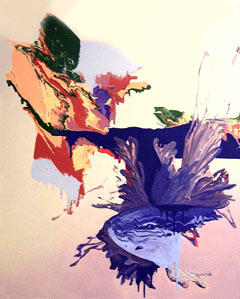
Buffalo also is known for its museums and science centers. The Albright-Knox Art Gallery, for example, is known for its collections and touring exhibits of modern art. Pictured above, at its Collectors Gallery -- where customers have the opportunity to view, rent, or buy original works of art -- is "Sliear Lhean (Witches Hil), acrylic on canvas by Jane Callister.
ON THE WEB
• Albright-Knox Art Gallery
• Roger Tory Peterson Institute of Natural History
• Buffalo Restaurant Guide
• Lucy-Desi Mueaum, in nearby Jamestown, home of Lucille Ball
• University of Buffalo
• Dowd's Guides

20050203

New York's Thruway Cosmopolis

Upstate New York is dominated by a quartet of metropolitan areas connected by the New York State Thruway and a series of suburban and rural regions between each.

From the capital city of Albany at the northernmost point of the Thruway, the route runs west to Syracuse, then Rochester, then Buffalo at the edge of Lake Erie and Niagara Falls.

Check here for the best information and links to each area.
ON THE WEB
• The Capital Region
• Syracuse
• Rochester
• Buffalo/Niagara Falls

20041108

Island In the Slum

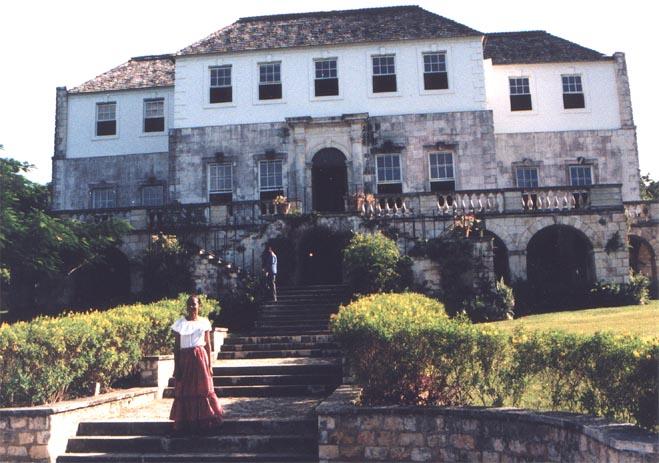
William M. Dowd photo


KINGSTON, JAMAICA -- This Caribbean island, fabled in swashbuckling tales and rhythm-accented music, has a long and storied history since the advent of European contact shortly after Columbus' late  15th Century voyages of exploration.

Much of its history is violent -- from the oppressive slavery of indigenous people forced to work on sprawling sugar plantations to today's high rates of crime and violence, even in the capital city of Kingston. Visitors to the famous plantation mansion Rosehall (above) can see the lair of one of the most oppressive and powerful female landowners of colonial days.

The 1999 and 2000 gasoline price riots remain a fresh memory and poverty, inflation and unemployment continue unabated. Armed guards are common sights in front of many businesses; travelers are advised to travel in sizeable groups and preferably only in daylight.

That said, and even though tourism has taken a marked dip in recent years, construction of new hotels continues and some of the more established retreats around Negril and Montego Bay have been refurbished and expanded. They offer all the expected tropical amenities, some including golf.
ON THE WEB
CIA World Factbook: Jamaica
• Dowd's Guides

20040910

Syracuse, much more than Orange

SYRACUSE, NY -- Few American communities are as connected to a color as this area is to orange.

The Orange of national collegiate sports power Syracuse University permeates the color palette of the region even though there is a lot more to it than football, basketball and lacrosse. The university itself is known for its Maxwell School of Business and Newhouse School of Communications as well as its undergraduate programs.

The community is home to numerous other colleges and professional schools (see the hot links listing on this page to visit them), museums and art galleries, as well as boating, fishing, camping and other outdoor recreational activities -- particularly in nearby wooded and lake areas. The Oswego area is one such hotspot.

The city of Syracuse also has a history of cultural activities, perhaps most famous among them being Syracuse Stage, a prominent "out of town" tryout spot for new productions eventually destined for the Broadway theater district.
Beyond that, a variety of museums and cultural institutions add to the ongoing cultural and societal activities, or just plain fun.

But, not everything is indoors despite the sometimes sever winter months dotted with lake-effect snowstorms coming off the Great Lakes.

Fair-weather outings at the many lakes in the region -- Onondaga, Oneida, Cross, Otisco and others -- as well as in the marshlandsand along the historic Erie Canal are popular among fishermen, campers and hikers.

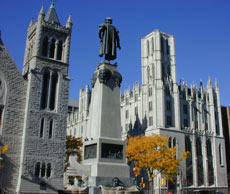
In the city of 160,000 residents, Armory Square is the center of non-university activities. The historic district offers shopping, dining and nightspots, as well as outdoor concerts and other events. It has its own Web site with a regularly-updated calendar of events throughout the year. It also has its own Columbus Circle (seen above) which gives it an offbeat architectural touch.

The city also has a domed stadium (the inflatable Carrier Dome at SU), a domed IMAX  theater, and the Great New York State Fair. The latter is the oldest continually-operating fair in the U.S.

As befits a town that revolves to a great deal around its educational institutions (see below), the most popular and successful eating places tend toward the casual. A great example is the Dinosaur Bar-B-Que, a funky, controlled chaotic place that has spawned offshoots in other cities, including New York.
ON THE WEB
• SUNY Environmental Science & Forestry
• SUNY Institute of Technology
• Syracuse University
• Herkimer Diamond Mines

20040811

Experiencing Abundance In the Napa Valley


NAPA, CA -- To the outsider, the Napa Valley image is wall-to-wall grapes. To anyone traversing the valley on Route 29 or the parallel Silverado Trail, that is merely part of the inventory.

The moderate climate, affected by low mountains on either side and by the narrow Napa River that meanders through the cleft, nurtures brilliant clumps of lilies, oleander and roses, as well as stands of camphor, valley oak, cedar, magnolia and olive trees.

Despite its relatively diminutive size -- 30 miles long and one to five miles wide -- the Napa Valley's undulating topography creates a series of microclimates. Temperatures can differ by 10 or more degrees from one end to the other.

Swaths of browned-out vegetation form the floor of the woods and fields, in marked contrast to the deep blue-greens and brilliant emeralds of the numerous copses of trees dotting the landscape from this little city at the valley's southern edge to the village of Calistoga and its mineral and mud baths up north.

In February and March, the valley gets its share of precipitation. In summer and early autumn, rain is so rare the natives can tell you on what day in what year they last recall seeing a downpour.

"It was five years ago, on Aug. 16 ... No, it was on the 15th," the noted wine writer Dan Berger told a couple of visitors over breakfast one day. "Just enough to really be a pain."

Clever viniculture methods and irrigation systems have nevertheless made this spot an hour's drive northeast of San Francisco arguably America's premier wine producing area.

Such popular names as Robert Mondavi, Beringer, Stags Leap, Louis Martini, Chimney Rock, Franciscan, Coppola, Domaine Chandon and Sterling are among the 200 wineries in operation today, marked by their distinctive main-building architecture that ranges from Victorian farmhouse to French chateau to Tuscan villa to the "Star Wars" look of Mondavi's Opus One operation across the road from its main fields.

The valley's growing tourist popularity has fueled the rebirth of Napa, the anchor city of 53,000, and made the region home to such hospitality industry facilities as the Culinary Institute of America's West Coast branch, opened in 1995 in the former Greystone Cellars complex near the village of St. Helena.

Perhaps the most unusual facility in the valley, however, is something called COPIA, named for the Roman goddess of abundance who carried a cornucopia, the horn of plenty. The capitalization of its name serves to underscore that.

COPIA's subtitle is "The American Center for Wine, Food & The Arts." It's a not-for-profit cultural center and museum that has been open to the public less than two years. But, it got its start in 1988 when the legendary vintner Robert Mondavi and other Napa community leaders began kicking around the idea of a place to honor and explore the culinary and wine- making arts.

In 1996, Mondavi donated a 12-acre parcel of land in the city of Napa plus $20 million of the $55 million startup funding. The next year, Peggy Loar, who had been president of the United States International Council of Museums, was hired as director and began putting together her staff.

COPIA includes sprawling herb, flower and tree gardens, as well as several restaurants in the 80,000-square-foot building on the banks of an oxbow bend in the Napa River.

Daphne L. Derven, a native of Schenectady, NY, and a graduate of Skidmore College in Saratoga Springs, NY, is the curator of food and assistant director for programs.

"We're a non-collecting museum," she said, "and that keeps us on our toes to continually come up with new ways to educate and entertain our visitors.

"We've had showings of extensive collections of wine glasses over the years, for example, and right now we have 'Eating and Drinking in Splendor,' a collection of Georgian silver tableware and artifacts on display through the end of September."

Derven spent several decades as an archeologist in the field, with a particular interest in the impact of food on culture and vice-versa. Her experience is put to use in helping create the displays and programs at COPIA.

"It's a wonderful way of blending my years in the field with my institutional interests to help the public enjoy a visit," she said.

In addition to exhibition and event space, the center, open year-round, has many clever ways of appealing to visitors of all ages. The programs, guests and styles of entertainment are geared toward virtually any demographic group.

Formal or self-guided walking tours in the extensive herb and vegetable gardens -- home to an amazing 100 kinds of tomatoes and 40 kinds of lavender, for example -- show how the institution helps keep heirloom plant species alive.

Celebrity appearnces for book signings and demonstrations are commonplace, most recently from the likes of famed chef Jacques Pepin, TV's "Naked Chef" Jamie Oliver, and the iconic Julia Child, for whom one of the public restaurants here is named.

A fair-weather outdoor concert series offers music from salsa to West African to zydeco to New Age. Films in the "Friday Night Flicks" series range from French comedies to war zone documentaries to Tunisian belly dancing.

Wine tastings, beer tastings, food sampling and open displays that offer foodstuffs to sniff, feel and look at help explain why people's reactions to the same substances vary wildly.

COPIA may be in the heart of California wine country, but its venue is the world. Many visitors take full advantage of being plopped down in the middle of this temple dedicated to the senses.

A long, winding staircase leads from the first-floor atrium space to a floor divided among a formal exhibition of pre-Christianity wine vessels from Iran, an open- space display of turn-of-the-20th Century advertising artwork extolling the virtues of California products, and -- the most popular of all -- a large walled-off area called "Forks In the Road: Food, Wine and the American Table."

That's where kids and adults alike tend to flock when they're not involved in some formal program, lecture or film. It's a hands-on area replete with exhibits of cooking vessels, short films, electronic quiz stations sure to please youngsters reared on Xboxes, even a film loop splicing together famous movie mealtime scenes.

Want to hear oral histories of ethnic food in America, cooking for the military, making wine at home? Interested in the rise of convenience foods? It's all here. Visitors also can hear classic food songs, test their sense of smell, try to identify strange kitchen gadgets. They also can contribute their own thoughts on current topics in food, or share food-related stories which will be recorded.

Curious which states have wineries? They all do, now, and an interactive display lets you select which ones you want to know about.

The one trait all humans share is the need for food and drink. At COPIA, its history and its present are celebrated and experienced, going well beyond the struggle for survival to the exultation of the senses.

ON THE WEB

• Official COPA site
• California Wineries Directory
• California Wine Country Events
• California Cuisine
• Napa Valley.com
• California Wine Regions

20040711

The 2 Faces of Niagara Falls

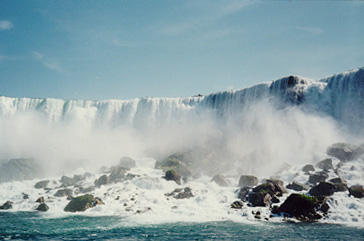
World famous Niagara Falls, destination point for honeymooners, barrel-riders, artists and photographers -- straddles the U.S./Canadian border just north of Buffalo.

Its attractions range from the natural wonders of the falls to a honky-tonk atmosphere in some of the shopping areas.

Daytime views of the Falls are fun to see, and light shows focusing on the cascades at night are worth angling for good vantagepoints.

Pedestrian traffic across the bridge to the Canadian side once was  fairly casual. Now, under increased security, vehicle and pedestrian traffic can sometimes be held up by Customs inspections.
ON THE WEB
• Niagara Falls Visitors Guide (Canada)
• Niagara Falls Visitors Guide (U.S.)
• Niagara University (U.S.)
• Dowd's Guides

19990908

Paris On the Nevada Desert


LAS VEGAS, NV -- The Vegas experience captivates people in a variety of ways.

Some come here to see the bright lights, glittering celebrities and architectural excesses. Some come here determined to view it as merely a monument to schlock and glitz and then go home to tell their friends and neighbors how tacky it all is. Some come here to get rich quick (a brief list of the successful ones' names available upon request).

The key element to all that, however, is that they do, indeed, come here by the millions.

And many stay. Las Vegas is the fastest growing metropolitan area in the United States. Never mind that half the year temperatures flirt with or exceed 100 degrees. (The simplest job here is being a TV weather forecaster: "The three-day outlook is 100-100-100 daytime, 70-70-70 nighttime, and clear around the clock.'')

And never mind that you are, after all, sitting in the middle of the desert and the thought keeps running through your mind that the bazillion gallons of water needed each day to keep this place alive might disappear suddenly.

Take someone like Kemis Dengler.

After selling off a successful Buffalo-area auto dealership and then running the Northern Chautauqua, NY, Chamber of Commerce for six years, Dengler decided that escaping the Lake Erie winters was more desirable then sticking them out. So, two summers ago he and his wife "retired'' and moved here.

"It was our dream place,'' Dengler said. "The atmosphere, the lack of snow, the excitement of Vegas.''

It was that excitement that finally got to him as more than a part-time attraction. He got antsy sitting around the house, so when it was announced that a version of Paris (yes, the city in France) was going to be built on Las Vegas Boulevard better known as The Strip. "I made an appointment with their human resources people to see what was available.''

His business background eventually landed him the job of manager of the Eiffel Tower portion of Paris. It was in that capacity that he was busy running around the new resort complex during the hectic Labor Day weekend grand opening.

The Strip's latest undertaking cost an estimated $785 million to create a 3,000-room hotel, a glittering casino, upscale shopping area, restaurants and scale models of several Parisian landmarks.

Mind-boggling as it is, it still is a bit understated by modern Vegas standards. Right across The Strip from Paris is the Bellagio, the richly appointed Italian-style complex that opened last year with a $1.4 billion price tag and a museum full of rare fine art by Van Gogh, Monet, Manet, Renoir, Cezanne, Matisse.

And since Labor Day of last year, the Mandalay Bay resort has opened along with expansions and renovations of several older hotels and new work begun on the likes of the new Aladdin complex.

In all, since midsummer 1998, about 10,000 hotel rooms have been added to the Vegas panoply, and still the visitors keep coming. Over the recent Labor Day Weekend, the local Chamber of Commerce announced a phenomenal 92 percent room occupancy overall.

"Some people say the bubble has to burst any day now,'' Dengler said, "but I don't see any signs of it. People keep buying or building houses, businesses keep moving in, casino resort complexes keep opening up or expanding, jobs are plentiful, attendance is climbing ...''

Dengler kept being interrupted as his earpiece crackled with messages and questions from his staff of several dozen who tirelessly roamed around the Tower area of Paris, directing visitors, running elevators to viewing levels, preparing for the evening's dinner rush.

Large crowds had been expected for the first weekend of the town's latest wonder, and even the added human pressure of a holiday crowd was expected. But at least three times during the long weekend the city fire marshal's office had to turn back the throngs flocking to see Paris.

To even the most jaded, it is something special to see.

Ground was broken in April 1997 for the project, owned by the Hilton Hotels chain. The original announcement of the project was a year earlier, when Bally unveiled its plans. But shortly after that, Hilton purchased Bally, and development plans had to be re-evaluated.

Themed resort hotel/casino complexes have become the norm here, and they boast elements of world-class proportion. Since Vegas broke out of its original concentration around Fremont Street, several miles north of the current expansion area, and began stretching its borders with family-oriented attractions as well as the ubiquitous casinos, we have seen completion of some astounding projects:

New York, New York (2,020 rooms) replicates in scaled-down size a chunk of the Big Apple skyline complete with Brooklyn Bridge, Coney Island roller coaster and the Statue of Liberty.

The pyramid-shaped Luxor (4,407 rooms) is the world's third-largest hotel. It is 36 stories high, has a 29 million cubic foot atrium (the world's largest), and emits what is believed to be the world's brightest beam of light, comprising 45 Xenon lights.

The Excalibur (4,008 rooms), with its silk and swords Arthurian-era theme, has just added, incongruously, a 16,000-square-foot Nitro Grill eatery with a pro-wrestling theme.

The French Riviera-themed Monte Carlo (3,002 rooms) has the $27 million Lance Burton Theater built as a permanent home for the master magician.

Treasure Island (2,900 rooms) is best known for its huge Buccaneer Bay outdoor pirate battles that draw crowds 10-deep every 90 minutes.

The aforementioned Mandalay Bay (3,700) has a South Seas atmosphere and an 11-acre sand-and-surf beach.

Last year, the big noise was Bellagio (3,005 rooms) with its man-made 12-acre lake and computer-controlled dancing fountains. It's still heavily visited, but having Paris right across the street has eased the congestion a bit.

All this action has resulted in a gradual spruce-up of the old town, centered around Fremont Street. That's the Vegas of the old Sinatra Rat Pack and the Elvis movies. Many of the old casinos are gone, and those that stay are being reinvented.

The venerable Golden Nugget (which has been awarded a AAA "Four Diamond'' designation every year since 1974) still sits as the queen of Fremont Street. A two-block pedestrian area is now covered by a metal canopy across which flashes a laser light show every night, and which in the daytime provides shade for strollers. The area should be seen, if only for comparison to what's new.

But that isn't the only area trying to keep pace with the competition. Even such established Strip stalwarts as the MGM Grand Hotel and The Mirage are hard at work updating what doesn't look outdated.

The MGM, for example, just opened a new indoor lion habitat with a glass passageway visitors can use to walk through the habitat while the lions walk above, below and next to them. And The Mirage, home to Seigfried & Roy and their famous white tigers, is planning some upgrades in the next few months.,

Paris' offerings trump it all, however. They include a 50-story version of the Eiffel Tower, a two-thirds-size replica of the Arc de Triomphe (the original was built in 1805 to honor soldiers who fought in the Battle of Austerlitz), plus replicas of the 34-story Hotel de Ville (the real Paris' city hall), the Paris Opera House, the renowned Louvre museum (the original houses the Mona Lisa and the Venus de Milo), and several landmark fountains (one shown above).

The Eiffel Tower is, predictably, perhaps the most eye-catching part of the complex. It is located above the casino, with three legs poking inside and the fourth outside on Las Vegas Boulevard. There's a French restaurant on the 11th floor, and an observation deck on the top floor. Its construction coincided with the centennial anniversary of the original, built for the World's Fair to celebrate the 100th anniversary of the French Revolution.

France is known for many things from epic battles under Napolean to epic surrenders in 20th-century wars; for raising gracious living to an art form to living with the stereotype of endemic rudeness to Americans; from ... well, you get the idea. But, ahh, the food. A legitimate stereotype, and Paris has eight count 'em, eight restaurants in the new complex.

The Eiffel Tower Restaurant offers view from 100 feet up. Le Provencal is an Italian-French restaurant with singing waiters. LaChine is a Hong Kong-style restaurant. The luxury is sublime.

But what about the moneymaker, the place that subsidizes all else? The casino.

The Bonne Chance is a fascinating 83,000-square-foot space, designed to look as if you're strolling the streets of Paris at twilight assuming the city has suddenly had 2,000 slot machines plunked down outdoors.

A faux sky, cobblestone pathways, wrought-iron street lamps and period architecture set the mood. There are more than 100 gaming tables, plus the slots set among the Tower legs extending through the ceiling. There also is a special section for high-stakes games.

"As you can see,'' Dengler pointed out, "this is not a nickle slot place. It's for how can I put this? people with more disposable income than a lot of other places draw.''

You can enter from the street, or from the Vegas version of the Rue de la Paix and its meandering streets lined with shops, wine bars, boutiques and restaurants. Again, we have the faux sky providing a feeling of airiness and all storefronts look as if they're outdoors.

The Opera House area includes a 1,200-seat theater for nightly Vegas-style entertainment, but there also are laid-back areas, such as Le Cabaret Lounge, a bistro with live music, and Napolean's, a lush upscale club bar.

Oh, yes. The place isn't finished. A Vegas version of Notre Dame cathedral is expected to be added to the complex shortly after the new year begins.

Judging from the strong start, as long as the visitors want it they'll always have Paris.

ON THE WEB

• Las Vegas Convention and Visitors Tourist Authority
• Entertainment Guide
• Chamber of Commerce
• Las Vegas Leisure Guide
• History of the Las Vegas Trip

Blog Archive