20050408

Alcohols of the Americas

National pride can be wrapped up in so many things. Science, food, sports, music. And then there is the spirit world.

Not the John Edward, talking-to-the-beyond-on-television kind of spirits, but the earthier ones found in amber bottles, cut-glass decanters and crystal tumblers.

Most countries point with pride to a "national drink." The French have champagne; the Greeks, ouzo; the Russians their vodka. They are not alone.

In the United Kingdom, for example, we readily find the single malts and gins of Scotland and England. Now even Wales, that forgotten little country that shares the British mainland with them, is getting back into the swing after being without a native distillery since 1894.

On March 1 this year, the 3-year-old Welsh Whisky Co. introduced its first product, Penderyn single-malt whiskey, created from barley malt and Welsh spring water. It retails for about $40.

The privately owned distillery, which operates in the Brecon Beacons National Park, revives a Welsh industry that had provided experienced whiskey makers who were among the founding fathers of the American bourbon industry. In Penderyn, the American link lives on. The whiskey is aged in Jack Daniels and Evan Williams bourbon casks shipped from the United States before being finished in Wales in rare Madeira barrels.

In the United States, we've long enjoyed "national" drinks brought to our shores from elsewhere in our hemisphere -- the rums of Jamaica and Puerto Rico, and the tequilas of Mexico, for example. Now, a trio of previously little-known alcohols from the Americas recently discovered by U.S. tourists is beginning to make inroads in our domestic market.

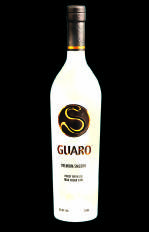
From Central America comes S Guaro, introduced in the United States just this year. It's made in Costa Rica from pure sugar cane with no additives.

Right now, S Guaro is essentially a California drink, with a marketing campaign by distributor S Spirits of Malibu that began by creating a word-of-mouth buzz by serving it at parties orbiting the Golden Globes, Grammy and Academy Awards shows.

The campaign is similar to one launched last year in the New York area by the distributor of Hpnotiq, a pale-blue French concoction of cognac, vodka and fruit juices. Movie premieres, nightclubs and celebrity parties in the city and in The Hamptons were successfully targeted, and the pale-blue drink quickly caught on.

"We're trying that grass-roots thing, too, before we try to go nationwide," said Shari F. Levanthal, marketing director for S Spirits. "Funny thing is that if you mix Hypnotiq and S Guaro, you get a great combination drink."

Guaro tastes more like a vodka than it does anything else, and its distributors recommend it as part of a mixed drink rather than straight.

On the Caribbean isle of St. Martin/Sint Maarten, the indigenous guavaberry that centuries ago was turned into liquor by the Amer-Indian people is today distilled into a unique "folk liqueur," even though the fragile berries are difficult to cultivate and harvest.

My first experience with guavaberry liqueur was a colada served in a Philipsburg hotel bar on the Dutch side of the island. It's a deceptively smooth drink, reminiscent of blackberries and dark cherries, sweet but not overly so, thanks to the slightly woody, spicy taste of the liquor.

Despite the name, the guavaberry (GWAH-va-BER-ry) has nothing to do with the guava fruit. The liqueur -- easily available online for $19.50 -- is made from oak-aged rum, cane sugar and the berries that grow wild in the warm hills in the center of the island.

Farther south, in Brazil, a form of brandy called cachaca (ka-CHASS-ah, Portuguese for firewater) has taken the South American nation by storm in the past few years. Odd that it took so long, considering it has been around since the 1500s.

Cachaca is distilled from unrefined sugar-cane juice fermented in a wood or copper container for three weeks, then boiled down three times to a concentrate, giving it a rumlike flavor. The more expensive versions are aged in wood casks that provide a caramel color and take the edge off the raw alcohol taste.

Brazil has some 4,000 brands of cachaca (Pirapora, Pitu and Velho Barreiro Gold among them, priced in the $24-to-$30 range), making it second only to beer among alcoholic drinks consumed there.

Like tequila, which moved from being a blue-collar drink to upscale status in Mexico and the United States in recent years, cachaca has taken the same path. It got an extra boost when bartenders at trendy tourist spots in the Brazilian metro areas of Rio de Janiero and Sao Paolo looking for something novel began using it as the basis for a line of cocktails.

The most popular is a simple one called the caipirinha. It's made by crushing slices of fresh lime in a glass, sprinkling sugar over them, filling the glass with chilled cachaca and popping in a few ice cubes.

Ah, what a hemisphere!
ON THE WEB
Dowd's Guides

20050322

A Night In a Shaker Village


HANCOCK, MA -- In most dining places, an invitation to step back in time means someone thought a Laura Ashley decor or a bunch of old bric-a-brac would create a certain mood.

Here at the Hancock Shaker Village, you literarally are treading historic boards.

The offering of a candlelight Shaker dinner and tour lured me to this
charming spot on Route 20 midway between New Lebanon, NY, and Pittsfield, MA, a half-hour drive east of Albany, New York's capital city.

The village was one of 18 established as religious communities by the
Shakers in eight states after the death in 1784 of sect founder Ann Lee, who is buried near the site of the present Albany International Airport.

At its apogee, this 2,000-acre community had about 250 members. The movement declined after the late 1800s, and the last Shakers left the village in 1960. (A group of less than a dozen Shakers still lives in the Sabbath Day Lake community in Maine.)

At that point, a group of local people purchased the community and its 21 remaining buildings. It now is run as a not-for-profit educational organization. The village itself has been designated a National Historic Landmark.

The candlelight dinner series, held throughout the summer and fall, is anything but an eat-and-run affair. Plan for a fascinating 3 1/2-hour session of talks that will take you into the lives of the Shakers at various stages of the movement, tours of different aspects of the village, a communal dinner in the Believers'  Dining Room, and a music program after dinner.

The round stone barn is often used as the icon for the village promotions, but the Brick Dwelling is the key structure, an impressive multi-storied one, built in 1830 to house nearly 100 Shaker brothers and sisters.

The celibate community kept the sexes separate but fully equal, and the dwelling duplicates nearly all living functions -- one side for women, the other for men in a fascinating mirror image architectural style. For the candlelight dinner, the sexes mix at the long tables, 16 to a table with four tables in the room; but, in Shaker days men sat on one side of the room, women on the other.

The food for these events is prepared by local specialty caterers and brought to the village for serving. The caterer's kitchen modifies some of the Shaker recipes for modern preferences as needed, but stays as true as possible to the originals.

The affair begins in the Meeting Room, sometimes called the chapel, of the Brick Dwelling with iced tea and  an orientationby the two guides -- one male, one female, of course. The group is split into two mixed groups for walking tours, then participants reassemble in the kitchen of the Brick Dwelling to chat about what they've seen, over iced tea or excellent hard cider from the West County Winery at at Pine Hill Orchards in nearby Colrain, MA.

The dinner menu, served family-style, varies each week. For my visit, it consisted of a light garden salad wirh a basic vinaigrette, followed by a peppery herb broth, robust with cilantro, dill, summer savory, oregano,  parsley, thyme and rosemary; and baskets of moist, yeasty bread accented by lemon zest.

The main course was Sister Clymena's Chicken Pie, accompanied by herbed rice, glazed carrots and green beans with dill weed. The chicken pie was a delight, although the serving size was skimpy -- tender chunks of breast meat and button mushroom slices in a tarragon-heavy cream sauce with a hint of brown sugar, all contained in a flaky crust.

Other weeks, the main item may be pot roast with cranberries, ham baked in cider, or roast lamb with ginger and cider. An alternative low-fat item is available if ordered in advance. The night I visited, it was a breaded, broiled chicken breast entree.

The meal finishes wirh slabs of dense honey cake topped with vanilla ice cream, and coffee or tea. That night, the coffee was a bit weak and not very hot. But, that is hardly enough to quibble about in the totality of a good meal.

After dinner, we returned to the Meeting Room -- once again segregated by gender -- to learn about the Shaker religious services and to hear a capella songs (the Shakers did not use musical instruments) and participate in a few activities with some visitors volunteering to execute Shaker dance steos under staff supervision.

I could have gone on for another hour.

ON THE WEB

• Our 2005 New England Dining Guide
• Our 2005 Cape Cod Dining Guide

20050309

'Time Share' In Paradise

April L. Dowd photo


PHILLIPSBURG, St. Maarten -- This 37-square-mile Caribbean island is the smallest land mass in the world shared by two sovereign powers. In this case, the Netherlands and France, and they've been sharing it for 350 years.

Sint Maarten, located 150 miles east-southeast of Puerto Rico, is a small volcanic part of the Leeward Islands, a mixture of independent island nations as well as land owned by the Dutch, the French and the British.

Although the terrain is much the same across the island -- Paradise Point, at an elevation of 1,400 feet, is a high volcanic peak in the central area, sloping down to sandy beach and settlement areas -- life is a bit different depending on which side you see.

The Dutch side is marked by a busy center of commerce  -- dominated by more than 80 jewelry shops and numerous duty-free enterprises -- particularly in the crowded business sector of the capital of Philipsburg. The French side is a bit more laid-back, shown by the daily open-air market on the town dock and fish mart (shown above) in the capital of Marigot, overseen on a steep hill by the old Fort St. Louis.

The airport -- Princess Juliana International, where you can only land and take off in daylight because there are no lights -- is on the French side. All the casinos are on the Dutch side, but the beaches are fairly well sprinkled around the island.

Cuisine ranges from resort hotel continental to fine French food (Grand Case is a small town on the French side considered one of the top dining spots in the Caribbean) to one of the many "lolos" -- outdoor barbecue spots that dot the countryside. And don't miss trying the native liquer, called guavaberry liquer. It's like a mild raspberry, and is often found in guavaberry coladas and has a comparatively low alcohol content.

As you check out these and other attractions, don't be concerned about the border. It's an open one, and the only real way you can tell when you cross from one side to the other is by seeing discrete little stone markers.

And if you don't speak French or Dutch, no problem. English is spoken by virtually everyone. If you want to practice any other language it's not at all uncomon for shopkeepers, hotel staff and the like to nimbly jump from one language to another -- sometimes in mid-sentence -- as the need arises.

Severe hurricane damage several years destroyed or damaged many buildings and eradicated much mature plant growth. In recent years, the island has been battling to regain its share of the Caribbean tourist trade, so bargain packages are plentiful. And for convenience's sake, the U.S. dollar is the preferred currency everywhere.

Day trips to nearby islands are popular: St. Bart's, Anguilla, Saba, Ilet Pinel and Caye Verte, the latter two particularly attractive to snorkelers. But if your tastes run more to land activities -- say, golf -- you have only one choice: the 18-hole course at Mullet Bay.

The island abounds with typically tropical beaches as well as bustling shopping areas. Above, a view of Marigault, the capital of the French side, and at left a shot of its main street. Below left, the shop-lined main drag in Phillipsburg, capital of the Dutch side.
ON THE WEB
• Island Hopping Guide
• French Caribbean International
• Friendly Caribbean
• Arthur Frommer's Budget Travel
• Official St. Maarten Home Page
• St. Martin Weather Forecast
• The daily newspaper
• Hospitality & Trade Association
• Special travel guide
• Restaurant Guide

20050211

Buffalo: New York's Midwest Gateway

BUFFALO, NY -- This place some call the Queen City is somewhat isolated from the rest of Upstate New York, but its location between two of the five Great Lakes makes it a unique place.

Most of America knows it as the home of horrendous blizzards and the Buffalo Bills.

There's a lot more.

People in other parts of the state often jokingly say Buffalo, well west of the other upstate metro areas, actually is part of the Midwest; or, at least, New York's Gateway to the Midwest.

The city sits on the eastern shore of Lake Erie, with Niagara Falls just above it, and the Canadian border just to the northwest. A bit to the northeast is Lake Ontario. With all this water in the area, maritime activities abound: boating, fishing, water skiing, diving -- and, of course, all the frozen-water pursuits in winter, such as ice boating, skating and the like.

Buffalo and environs also is a center for academic and medical institutions, as well as all the usual arts and cultural amenities common to cities of size.

Of course, it wouldn't be fair to ignore the Bills -- or the National Hockey League's Sabres, or the University of Buffalo, Canisius College, Buffalo State and other sports teams, along with such athletic facilities as the Bills' Rich Stadium in suburban Orchard Park or the Marine Midland Arena in the city.

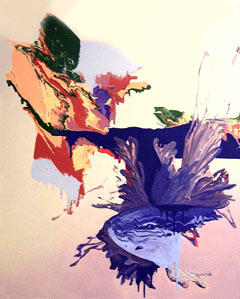
Buffalo also is known for its museums and science centers. The Albright-Knox Art Gallery, for example, is known for its collections and touring exhibits of modern art. Pictured above, at its Collectors Gallery -- where customers have the opportunity to view, rent, or buy original works of art -- is "Sliear Lhean (Witches Hil), acrylic on canvas by Jane Callister.
ON THE WEB
• Albright-Knox Art Gallery
• Roger Tory Peterson Institute of Natural History
• Buffalo Restaurant Guide
• Lucy-Desi Mueaum, in nearby Jamestown, home of Lucille Ball
• University of Buffalo
• Dowd's Guides

20050203

New York's Thruway Cosmopolis

Upstate New York is dominated by a quartet of metropolitan areas connected by the New York State Thruway and a series of suburban and rural regions between each.

From the capital city of Albany at the northernmost point of the Thruway, the route runs west to Syracuse, then Rochester, then Buffalo at the edge of Lake Erie and Niagara Falls.

Check here for the best information and links to each area.
ON THE WEB
• The Capital Region
• Syracuse
• Rochester
• Buffalo/Niagara Falls

20041108

Island In the Slum

William M. Dowd photo


KINGSTON, JAMAICA -- This Caribbean island, fabled in swashbuckling tales and rhythm-accented music, has a long and storied history since the advent of European contact shortly after Columbus' late  15th Century voyages of exploration.

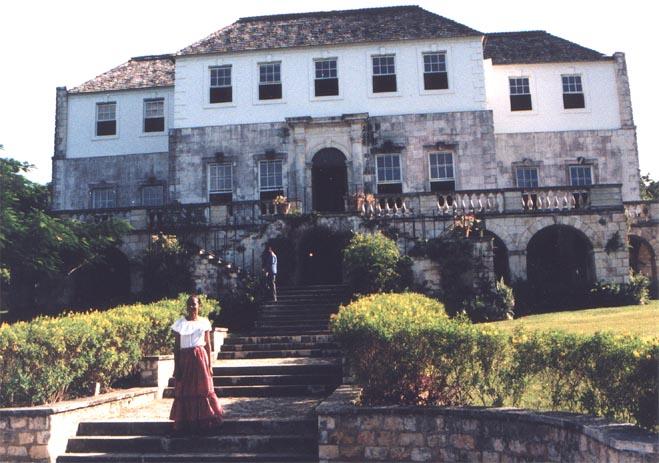
Much of its history is violent -- from the oppressive slavery of indigenous people forced to work on sprawling sugar plantations to today's high rates of crime and violence, even in the capital city of Kingston. Visitors to the famous plantation mansion Rosehall (above) can see the lair of one of the most oppressive and powerful female landowners of colonial days.

The 1999 and 2000 gasoline price riots remain a fresh memory and poverty, inflation and unemployment continue unabated. Armed guards are common sights in front of many businesses; travelers are advised to travel in sizeable groups and preferably only in daylight.

That said, and even though tourism has taken a marked dip in recent years, construction of new hotels continues and some of the more established retreats around Negril and Montego Bay have been refurbished and expanded. They offer all the expected tropical amenities, some including golf.
ON THE WEB
CIA World Factbook: Jamaica
• Dowd's Guides

20040910

Syracuse, much more than Orange

SYRACUSE, NY -- Few American communities are as connected to a color as this area is to orange.

The Orange of national collegiate sports power Syracuse University permeates the color palette of the region even though there is a lot more to it than football, basketball and lacrosse. The university itself is known for its Maxwell School of Business and Newhouse School of Communications as well as its undergraduate programs.

The community is home to numerous other colleges and professional schools (see the hot links listing on this page to visit them), museums and art galleries, as well as boating, fishing, camping and other outdoor recreational activities -- particularly in nearby wooded and lake areas. The Oswego area is one such hotspot.

The city of Syracuse also has a history of cultural activities, perhaps most famous among them being Syracuse Stage, a prominent "out of town" tryout spot for new productions eventually destined for the Broadway theater district.
Beyond that, a variety of museums and cultural institutions add to the ongoing cultural and societal activities, or just plain fun.

But, not everything is indoors despite the sometimes sever winter months dotted with lake-effect snowstorms coming off the Great Lakes.

Fair-weather outings at the many lakes in the region -- Onondaga, Oneida, Cross, Otisco and others -- as well as in the marshlandsand along the historic Erie Canal are popular among fishermen, campers and hikers.

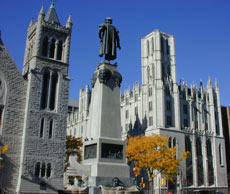
In the city of 160,000 residents, Armory Square is the center of non-university activities. The historic district offers shopping, dining and nightspots, as well as outdoor concerts and other events. It has its own Web site with a regularly-updated calendar of events throughout the year. It also has its own Columbus Circle (seen above) which gives it an offbeat architectural touch.

The city also has a domed stadium (the inflatable Carrier Dome at SU), a domed IMAX  theater, and the Great New York State Fair. The latter is the oldest continually-operating fair in the U.S.

As befits a town that revolves to a great deal around its educational institutions (see below), the most popular and successful eating places tend toward the casual. A great example is the Dinosaur Bar-B-Que, a funky, controlled chaotic place that has spawned offshoots in other cities, including New York.
ON THE WEB
• SUNY Environmental Science & Forestry
• SUNY Institute of Technology
• Syracuse University
• Herkimer Diamond Mines

20040811

Experiencing Abundance In the Napa Valley


NAPA, CA -- To the outsider, the Napa Valley image is wall-to-wall grapes. To anyone traversing the valley on Route 29 or the parallel Silverado Trail, that is merely part of the inventory.

The moderate climate, affected by low mountains on either side and by the narrow Napa River that meanders through the cleft, nurtures brilliant clumps of lilies, oleander and roses, as well as stands of camphor, valley oak, cedar, magnolia and olive trees.

Despite its relatively diminutive size -- 30 miles long and one to five miles wide -- the Napa Valley's undulating topography creates a series of microclimates. Temperatures can differ by 10 or more degrees from one end to the other.

Swaths of browned-out vegetation form the floor of the woods and fields, in marked contrast to the deep blue-greens and brilliant emeralds of the numerous copses of trees dotting the landscape from this little city at the valley's southern edge to the village of Calistoga and its mineral and mud baths up north.

In February and March, the valley gets its share of precipitation. In summer and early autumn, rain is so rare the natives can tell you on what day in what year they last recall seeing a downpour.

"It was five years ago, on Aug. 16 ... No, it was on the 15th," the noted wine writer Dan Berger told a couple of visitors over breakfast one day. "Just enough to really be a pain."

Clever viniculture methods and irrigation systems have nevertheless made this spot an hour's drive northeast of San Francisco arguably America's premier wine producing area.

Such popular names as Robert Mondavi, Beringer, Stags Leap, Louis Martini, Chimney Rock, Franciscan, Coppola, Domaine Chandon and Sterling are among the 200 wineries in operation today, marked by their distinctive main-building architecture that ranges from Victorian farmhouse to French chateau to Tuscan villa to the "Star Wars" look of Mondavi's Opus One operation across the road from its main fields.

The valley's growing tourist popularity has fueled the rebirth of Napa, the anchor city of 53,000, and made the region home to such hospitality industry facilities as the Culinary Institute of America's West Coast branch, opened in 1995 in the former Greystone Cellars complex near the village of St. Helena.

Perhaps the most unusual facility in the valley, however, is something called COPIA, named for the Roman goddess of abundance who carried a cornucopia, the horn of plenty. The capitalization of its name serves to underscore that.

COPIA's subtitle is "The American Center for Wine, Food & The Arts." It's a not-for-profit cultural center and museum that has been open to the public less than two years. But, it got its start in 1988 when the legendary vintner Robert Mondavi and other Napa community leaders began kicking around the idea of a place to honor and explore the culinary and wine- making arts.

In 1996, Mondavi donated a 12-acre parcel of land in the city of Napa plus $20 million of the $55 million startup funding. The next year, Peggy Loar, who had been president of the United States International Council of Museums, was hired as director and began putting together her staff.

COPIA includes sprawling herb, flower and tree gardens, as well as several restaurants in the 80,000-square-foot building on the banks of an oxbow bend in the Napa River.

Daphne L. Derven, a native of Schenectady, NY, and a graduate of Skidmore College in Saratoga Springs, NY, is the curator of food and assistant director for programs.

"We're a non-collecting museum," she said, "and that keeps us on our toes to continually come up with new ways to educate and entertain our visitors.

"We've had showings of extensive collections of wine glasses over the years, for example, and right now we have 'Eating and Drinking in Splendor,' a collection of Georgian silver tableware and artifacts on display through the end of September."

Derven spent several decades as an archeologist in the field, with a particular interest in the impact of food on culture and vice-versa. Her experience is put to use in helping create the displays and programs at COPIA.

"It's a wonderful way of blending my years in the field with my institutional interests to help the public enjoy a visit," she said.

In addition to exhibition and event space, the center, open year-round, has many clever ways of appealing to visitors of all ages. The programs, guests and styles of entertainment are geared toward virtually any demographic group.

Formal or self-guided walking tours in the extensive herb and vegetable gardens -- home to an amazing 100 kinds of tomatoes and 40 kinds of lavender, for example -- show how the institution helps keep heirloom plant species alive.

Celebrity appearnces for book signings and demonstrations are commonplace, most recently from the likes of famed chef Jacques Pepin, TV's "Naked Chef" Jamie Oliver, and the iconic Julia Child, for whom one of the public restaurants here is named.

A fair-weather outdoor concert series offers music from salsa to West African to zydeco to New Age. Films in the "Friday Night Flicks" series range from French comedies to war zone documentaries to Tunisian belly dancing.

Wine tastings, beer tastings, food sampling and open displays that offer foodstuffs to sniff, feel and look at help explain why people's reactions to the same substances vary wildly.

COPIA may be in the heart of California wine country, but its venue is the world. Many visitors take full advantage of being plopped down in the middle of this temple dedicated to the senses.

A long, winding staircase leads from the first-floor atrium space to a floor divided among a formal exhibition of pre-Christianity wine vessels from Iran, an open- space display of turn-of-the-20th Century advertising artwork extolling the virtues of California products, and -- the most popular of all -- a large walled-off area called "Forks In the Road: Food, Wine and the American Table."

That's where kids and adults alike tend to flock when they're not involved in some formal program, lecture or film. It's a hands-on area replete with exhibits of cooking vessels, short films, electronic quiz stations sure to please youngsters reared on Xboxes, even a film loop splicing together famous movie mealtime scenes.

Want to hear oral histories of ethnic food in America, cooking for the military, making wine at home? Interested in the rise of convenience foods? It's all here. Visitors also can hear classic food songs, test their sense of smell, try to identify strange kitchen gadgets. They also can contribute their own thoughts on current topics in food, or share food-related stories which will be recorded.

Curious which states have wineries? They all do, now, and an interactive display lets you select which ones you want to know about.

The one trait all humans share is the need for food and drink. At COPIA, its history and its present are celebrated and experienced, going well beyond the struggle for survival to the exultation of the senses.

ON THE WEB

• Official COPA site
• California Wineries Directory
• California Wine Country Events
• California Cuisine
• Napa Valley.com
• California Wine Regions

20040711

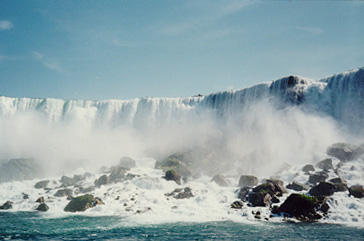
The 2 Faces of Niagara Falls

World famous Niagara Falls, destination point for honeymooners, barrel-riders, artists and photographers -- straddles the U.S./Canadian border just north of Buffalo.

Its attractions range from the natural wonders of the falls to a honky-tonk atmosphere in some of the shopping areas.

Daytime views of the Falls are fun to see, and light shows focusing on the cascades at night are worth angling for good vantagepoints.

Pedestrian traffic across the bridge to the Canadian side once was  fairly casual. Now, under increased security, vehicle and pedestrian traffic can sometimes be held up by Customs inspections.
ON THE WEB
• Niagara Falls Visitors Guide (Canada)
• Niagara Falls Visitors Guide (U.S.)
• Niagara University (U.S.)
• Dowd's Guides

19990908

Paris On the Nevada Desert


LAS VEGAS, NV -- The Vegas experience captivates people in a variety of ways.

Some come here to see the bright lights, glittering celebrities and architectural excesses. Some come here determined to view it as merely a monument to schlock and glitz and then go home to tell their friends and neighbors how tacky it all is. Some come here to get rich quick (a brief list of the successful ones' names available upon request).

The key element to all that, however, is that they do, indeed, come here by the millions.

And many stay. Las Vegas is the fastest growing metropolitan area in the United States. Never mind that half the year temperatures flirt with or exceed 100 degrees. (The simplest job here is being a TV weather forecaster: "The three-day outlook is 100-100-100 daytime, 70-70-70 nighttime, and clear around the clock.'')

And never mind that you are, after all, sitting in the middle of the desert and the thought keeps running through your mind that the bazillion gallons of water needed each day to keep this place alive might disappear suddenly.

Take someone like Kemis Dengler.

After selling off a successful Buffalo-area auto dealership and then running the Northern Chautauqua, NY, Chamber of Commerce for six years, Dengler decided that escaping the Lake Erie winters was more desirable then sticking them out. So, two summers ago he and his wife "retired'' and moved here.

"It was our dream place,'' Dengler said. "The atmosphere, the lack of snow, the excitement of Vegas.''

It was that excitement that finally got to him as more than a part-time attraction. He got antsy sitting around the house, so when it was announced that a version of Paris (yes, the city in France) was going to be built on Las Vegas Boulevard better known as The Strip. "I made an appointment with their human resources people to see what was available.''

His business background eventually landed him the job of manager of the Eiffel Tower portion of Paris. It was in that capacity that he was busy running around the new resort complex during the hectic Labor Day weekend grand opening.

The Strip's latest undertaking cost an estimated $785 million to create a 3,000-room hotel, a glittering casino, upscale shopping area, restaurants and scale models of several Parisian landmarks.

Mind-boggling as it is, it still is a bit understated by modern Vegas standards. Right across The Strip from Paris is the Bellagio, the richly appointed Italian-style complex that opened last year with a $1.4 billion price tag and a museum full of rare fine art by Van Gogh, Monet, Manet, Renoir, Cezanne, Matisse.

And since Labor Day of last year, the Mandalay Bay resort has opened along with expansions and renovations of several older hotels and new work begun on the likes of the new Aladdin complex.

In all, since midsummer 1998, about 10,000 hotel rooms have been added to the Vegas panoply, and still the visitors keep coming. Over the recent Labor Day Weekend, the local Chamber of Commerce announced a phenomenal 92 percent room occupancy overall.

"Some people say the bubble has to burst any day now,'' Dengler said, "but I don't see any signs of it. People keep buying or building houses, businesses keep moving in, casino resort complexes keep opening up or expanding, jobs are plentiful, attendance is climbing ...''

Dengler kept being interrupted as his earpiece crackled with messages and questions from his staff of several dozen who tirelessly roamed around the Tower area of Paris, directing visitors, running elevators to viewing levels, preparing for the evening's dinner rush.

Large crowds had been expected for the first weekend of the town's latest wonder, and even the added human pressure of a holiday crowd was expected. But at least three times during the long weekend the city fire marshal's office had to turn back the throngs flocking to see Paris.

To even the most jaded, it is something special to see.

Ground was broken in April 1997 for the project, owned by the Hilton Hotels chain. The original announcement of the project was a year earlier, when Bally unveiled its plans. But shortly after that, Hilton purchased Bally, and development plans had to be re-evaluated.

Themed resort hotel/casino complexes have become the norm here, and they boast elements of world-class proportion. Since Vegas broke out of its original concentration around Fremont Street, several miles north of the current expansion area, and began stretching its borders with family-oriented attractions as well as the ubiquitous casinos, we have seen completion of some astounding projects:

New York, New York (2,020 rooms) replicates in scaled-down size a chunk of the Big Apple skyline complete with Brooklyn Bridge, Coney Island roller coaster and the Statue of Liberty.

The pyramid-shaped Luxor (4,407 rooms) is the world's third-largest hotel. It is 36 stories high, has a 29 million cubic foot atrium (the world's largest), and emits what is believed to be the world's brightest beam of light, comprising 45 Xenon lights.

The Excalibur (4,008 rooms), with its silk and swords Arthurian-era theme, has just added, incongruously, a 16,000-square-foot Nitro Grill eatery with a pro-wrestling theme.

The French Riviera-themed Monte Carlo (3,002 rooms) has the $27 million Lance Burton Theater built as a permanent home for the master magician.

Treasure Island (2,900 rooms) is best known for its huge Buccaneer Bay outdoor pirate battles that draw crowds 10-deep every 90 minutes.

The aforementioned Mandalay Bay (3,700) has a South Seas atmosphere and an 11-acre sand-and-surf beach.

Last year, the big noise was Bellagio (3,005 rooms) with its man-made 12-acre lake and computer-controlled dancing fountains. It's still heavily visited, but having Paris right across the street has eased the congestion a bit.

All this action has resulted in a gradual spruce-up of the old town, centered around Fremont Street. That's the Vegas of the old Sinatra Rat Pack and the Elvis movies. Many of the old casinos are gone, and those that stay are being reinvented.

The venerable Golden Nugget (which has been awarded a AAA "Four Diamond'' designation every year since 1974) still sits as the queen of Fremont Street. A two-block pedestrian area is now covered by a metal canopy across which flashes a laser light show every night, and which in the daytime provides shade for strollers. The area should be seen, if only for comparison to what's new.

But that isn't the only area trying to keep pace with the competition. Even such established Strip stalwarts as the MGM Grand Hotel and The Mirage are hard at work updating what doesn't look outdated.

The MGM, for example, just opened a new indoor lion habitat with a glass passageway visitors can use to walk through the habitat while the lions walk above, below and next to them. And The Mirage, home to Seigfried & Roy and their famous white tigers, is planning some upgrades in the next few months.,

Paris' offerings trump it all, however. They include a 50-story version of the Eiffel Tower, a two-thirds-size replica of the Arc de Triomphe (the original was built in 1805 to honor soldiers who fought in the Battle of Austerlitz), plus replicas of the 34-story Hotel de Ville (the real Paris' city hall), the Paris Opera House, the renowned Louvre museum (the original houses the Mona Lisa and the Venus de Milo), and several landmark fountains (one shown above).

The Eiffel Tower is, predictably, perhaps the most eye-catching part of the complex. It is located above the casino, with three legs poking inside and the fourth outside on Las Vegas Boulevard. There's a French restaurant on the 11th floor, and an observation deck on the top floor. Its construction coincided with the centennial anniversary of the original, built for the World's Fair to celebrate the 100th anniversary of the French Revolution.

France is known for many things from epic battles under Napolean to epic surrenders in 20th-century wars; for raising gracious living to an art form to living with the stereotype of endemic rudeness to Americans; from ... well, you get the idea. But, ahh, the food. A legitimate stereotype, and Paris has eight count 'em, eight restaurants in the new complex.

The Eiffel Tower Restaurant offers view from 100 feet up. Le Provencal is an Italian-French restaurant with singing waiters. LaChine is a Hong Kong-style restaurant. The luxury is sublime.

But what about the moneymaker, the place that subsidizes all else? The casino.

The Bonne Chance is a fascinating 83,000-square-foot space, designed to look as if you're strolling the streets of Paris at twilight assuming the city has suddenly had 2,000 slot machines plunked down outdoors.

A faux sky, cobblestone pathways, wrought-iron street lamps and period architecture set the mood. There are more than 100 gaming tables, plus the slots set among the Tower legs extending through the ceiling. There also is a special section for high-stakes games.

"As you can see,'' Dengler pointed out, "this is not a nickle slot place. It's for how can I put this? people with more disposable income than a lot of other places draw.''

You can enter from the street, or from the Vegas version of the Rue de la Paix and its meandering streets lined with shops, wine bars, boutiques and restaurants. Again, we have the faux sky providing a feeling of airiness and all storefronts look as if they're outdoors.

The Opera House area includes a 1,200-seat theater for nightly Vegas-style entertainment, but there also are laid-back areas, such as Le Cabaret Lounge, a bistro with live music, and Napolean's, a lush upscale club bar.

Oh, yes. The place isn't finished. A Vegas version of Notre Dame cathedral is expected to be added to the complex shortly after the new year begins.

Judging from the strong start, as long as the visitors want it they'll always have Paris.

ON THE WEB

• Las Vegas Convention and Visitors Tourist Authority
• Entertainment Guide
• Chamber of Commerce
• Las Vegas Leisure Guide
• History of the Las Vegas Trip

Blog Archive