20061009

Best beer spots in the U.S.


If you're on the road and looking for outstanding places to have a beer, Beer Advocate.com has drawn up a list of what it says are the best "50 Places to Have a Beer in America."

The list is a result of site users' comments on BeerFly. It includes both brewpubs and beer bars. Here's the top 15, with the whole list available here:

1. The Moan and Dove, Amherst, MA

2. The Publick House, Brookline, MA

3. Spuyten Duyvil, Brooklyn, NY

4. Toronado, San Francisco, CA

5. The Map Room, Chicago, IL

6. Cock & Bull Pub, Sarasota, FL

7. Papago Brewing, Scottsdale, AZ

8. O'Brien's Pub, San Diego, CA

9. Stuffed Sandwich, San Gabriel, CA

10. Capital Ale House, Richmond, VA

11. Six Pax & Dogz, Swissvale, PA

12. Mahar's, Albany, NY

13. Selin's Grove Brewing Co., Selinsgrove, PA

14. Capital Ale House At Innsbrook, Glen Allen, VA

15. Brick Store Pub, Decatur, GA

20061003

Big Apple gets the TV-food link


NEW YORK -- The city is headed into prime tourist season, that bustling time between Labor Day and New Year's Eve when the world comes to the Big Apple.

A couple of familiar faces will be plying their trade in person, furthering the growing connection between TV and food.

Anne Burrell, who you see as celeb chef Mario Batali's sous chef on various "Iron Chef" segments, will be cooking at the new modern Italian restaurant Centro Vinoteca. It is scheduled to open at 74 Seventh Ave. S. in November.

And, we segue from a quiet TV performer to a bombastic one. Manic Brit Gordon Ramsay ("Hell's Kitchen") will make his American real-life debut with a restaurant named for himself, planned for a November opening at The London NYC Hotel. It's located in the former Rihga Royal Hotel at 151 W. 54th St. His new adjacent bar/lounge, The London Bar, will offer a small-plates concept.

20060908

Discovering Mauritius (and its rum)


Unless you're fond of map reading for pleasure, even the most traveled world tourist can be excused for not knowing the location of Mauritius.

If, however, you're a fan of fine rums, check your globe. The island nation off the east coast of Africa -- actually off the east coast of Madagascar which, itself, is off the east coast of Africa (see map)-- is showing signs of coming into its own as an international purveyor of fine rums.

Some months ago, as a judge in the first International Cane Spirits Competition, held in Tampa, FL, I had the opportunity to sample Starr African Rum, perhaps the best Mauritius has to offer. The judges awarded it a gold medal in the white rums category (including spirits aged less than a year).

The three other gold medalists in that category were more mainstream labels -- Santa Teresa Blanco, from Venezuela; Prichard's Crystal Rum, from the U.S., and Ron Botran White Rum, from Guatamala.

My tasting notes for the event called the Starr African Rum "peppery; floral; and, with a long finish." There are hints of cardamom and citrus, all of which work well in various rum punches.

Now, Mauritius will be expanding its sales in India as part of a new trade agreement signed between the two countries. (About 70% of Mauritius's population is of Indian descent.) The agreement allows Mauritius to triple its rum exports to India.

The change is part of a steady growth in the presence of Starr African rum. It received a "Superb 90-95 (Recommended)" rating from Wine Spectator last year, then the godl medal in Tampa, and has been popping up at various "beautiful people" events at which clever PR types have been managing to link the names of show biz luminaries.
When that happens, mainstream success probably can't be far behind.

If you ever plan to visit Mauritius, what can you expect?

Well, there is more to Mauritius than one might think. The republic includes the main island as well as the islands of St. Brandon, Rodrigues and the Agalega Islands. (Mauritius actually is part of a grouping known as the Mascarene Islands, which includes the French island of Réunion 125 miles to the southwest.)

Mauritius (pronounced mah-REE-shus) is known for its scenic beauty. Mark Twain, in "Following the Equator," wrote of it, "You gather the idea that Mauritius was made first and then Heaven, and that Heaven was copied after Mauritius."

Although frequently visited by mariners from many nations, it was not inhabited until the Dutch colonized the island in 1638. It was later governed by France, then Great Britain, achieving independence in 1968 as part of the British Commonwealth, then became a republic in 1992.

It comes by rum making naturally, since about 90% of the cultivated land area is given over to sugar cane, which accounts for 25% of export earnings.

English is the official language, although French is heavily used in the business sector and in the media.

ON THE WEB:

Discover Mauritius
Mauritius.com
CIA World Factbook
HRW World Atlas

20060902

A true whisky club under way in Scotland


While Americans were busy resting from their work and enjoying the long Labor Day wekend, workers in Ladybank, Scotland, were just beginning a unique construction project.

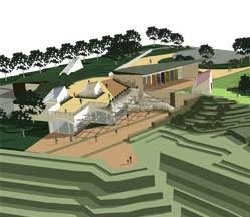
Scotland's first "private club" whisky distillery (shown here in an architect's sketch) began its $1.9 million first-phase construction at a location near St. Andrews on Thursday, the project funded by subscriptions from a global network of whisky fans.

The Ladybank Company of Distillers Club was dreamed up by James Thomson, 46, who ran a whisky distilling school at Bladnoch in Dumfries and Galloway. It is located on a former farm, and is expected to produce just under 9,500 gallons a year. It is planned that the membership will be closely involved in production decisions such as length of aging and type of casking, affecting the taste of the product.

Thomson, in an interview with local media that seemed part Q&A, part anti-establishment polemic, said the idea for a "co-creative" distillery came from his disillusionment with the distilling and production practices of an industry dominated by "inflexible multinational conglomerates," and his experience of training enthusiasts in the art of distilling.

The Distillers Club is limited to 1,250 members. Participants or their heirs are entitled to six bottles of whisky per year for the next 30 years. The 300 founding members each paid a one-time $6,000 for membership. Subsequent members will pay a higher fee.

Thomson plans to produce gin and other spirits along with single malt Scotch whisky. He said the total project cost is projected at $4.8 million.

20060901

Cape Cod Beer x 2


HYANNIS, MA -- Heavy tourism areas usually have their own food or drink that people remember year-round and can't wait to have during the next visit.

Cape Cod Beer, brewed in this mid=Cape city, is such a beverage. The brewery (motto: "A Vacation In Every Pint") opened its new facility in March, then found its product so successful it had trouble meeting demand during the summer.

Technology to the rescue: Three new fermentation vessels have been installed, doubling the facility's production capacity. Two tanks came from China and one from the Czech Republic. They were ordered some time ago, but there have been shortages in the stainless steel industry, creating a tight market.

Beer Advocate.com has a full report on the Cape Cod operation.

Cape Cod Beer offers tours of and tastings at its 1336 Phinney's Lane facility. Details: (508) 790-4200. Prior to moving there, owner/brewmaster Todd Marcus had been making his brews in shared Main Street quarters with the Hyport Brewing Company Restaurant until that business closed.

Marcus produces two standard offerings: Cape Cod Red and Cape Cod IPA, plus seasonal brews such as Berry Merry Christmas Ale, Spiced Red Ale, Stellwagen Stout, and Cape Cod Summer.

20060828

The Great Foie Gras War


CHICAGO -- If you like foie gras and are heading to the Windy City, don't get your tastebuds set for the pricey delicacy.

Chicago has become the first city in the nation to place a legal ban on the sale of the goose or duck liver product opponents claim is made from maltreated fowl.

The state of California already had a foie gras ban pending, but it won't become effective until 2012. Bans are under discussion in other states, such as New Jersey and Hawaii, and come up periodically in New York and elsewhere.

The artificial fattening process used to produce the duck or goose liver has the birds being force-fed starting at the age of 12 weeks through metal tubes pushed down their throats. After two to four weeks of feeding, when their livers are up to 10 times normal size, they're slaughtered.

20060827

Asia's largest beer festival planned


Interested in a beerfest in an exotic locale? The largest beer festival in Asia has been scheduled for Feb. 2-4, 2007, in Singapore.

The organizers of Singapore International Beer Festival 2007 hope "to attract brewers from around the world to showcase their products to buyers and distributors in Asia, and at the same time, to create wider consumer awareness about the quality and diversity displayed by the various beers of the world."

At the moment, brewers have signed up from the United States, Russia, China, South Korea, Japan, Taiwan, Hong Kong, Vietnam, India, Pakistan, Sri Lanka, Thailand, Malaysia, Philippines, Indonesia, Singapore, Australia and New Zealand.

The three-day event, to be held at the Singapore Expo, also will feature live entertainment, a dance competition and, of course, a beer drinking contest without which no brewing event can be held, apparently.

Details are available online, by e-mail or by phone at (65) 62263818.

Other international beerfests:

International Berlin Beer festival

Qingdao International Beer Festival

San Francisco International Beer Festival

20060826

Don't card this guy in a bar


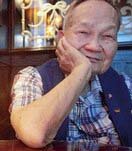
NEW YORK -- Most visitors to the city like to take home tales of seeing its oldest sights. For those who like to frequent famous watering holes, Hoy C. Wong may be the best thing to see.

Wong has been working at the legendary Algonquin hotel in Manhattan as a bartender for the past 27 years. But, he has plenty of other experience on his resume. He should. He's 90 years old.

Management at the Algonquin, where writer Dorothy Parker and other wits of the 1920s-40s held forth at their famous "Round Table" dinners, think he is the city's oldest active bartender.

Fame is nothing new to Hong. In the 1970s, he was featured on the cover of Life magazine as the best of America's great bartenders.

"I like this job because one man behind the bar can make everybody happy," Wong said at the time.

The Daily Record in Morris County, NJ, just across the river from New York, offered this profile of Hong that I found quite informative.

20060824

Long Island's bargain dining week


Restaurant weeks are becoming the
big thing in New York State. In addition to such industry co-op events in Manhattan, Albany and the Hamptons, visitors now can experience a full-scale Long Island Restaurant
Week, which will debut in a Sunday-to-Sunday period, Nov. 5-12.

The time span was picked because it is the end of the harvest season when numerous local items are available to participating restaurants.

Each establishment will offer its own version of a three-course prix fixe for $21.95 all night, except Saturday when it will be offered only until 7 p.m.

As restaurants are added to the list of participants, they will appear in regional groupings online.

Organizers say the inspiration for the event came from the successful New York Restaurant Week that runs annually in Manhattan every January and is modeled after the Hamptons Restaurant Week that takes place on the South Fork of Long Island. In the past four years of Hamptons Restaurant Week, restaurateurs there reported a major surge in business, some by more than 50% during the promotion.

20060818

Sizing up your travel destinations


If you're the type of traveler who likes to visit places with special distinction, we have a few for you here, both domestic and foreign.

Sam’s Bar in Colorado Springs currently holds the title of smallest bar in the world, according to the Guinness Book of World Records.

However, its 109 square feet seem positively cavernous compared to the 64 square feet of space taken up by the Signal Box, a tiny pub in the English seaside town of Cleethropes that just opened in a century-old, 8-by-8-foot structure that used to be a railroad signal box for the Cleethorpes Coast Light Railway.

The box now is a four-seat pub that is open from 11 to 11 each day, serving customers --preferably skinny ones -- inside as well as at the 30-seat outdoor beer garden adjacent to it. Owner Andrew McCall says he will submit his site for inclusion in the Guinness book.

"We're so small some drinks companies won't fit equipment for us because they think we won't do enough trade. But business is booming," McCall said.

In an interview with the Yorkshire Post, McCall, who runs the pub alone, said, "I would have to refuse to serve someone if the bar and garden were full, and if there is trouble I can just push them out of the door – it's not too far."

On the other end of the spectrum, the Heartland Brewery has opened the largest beer garden in New York, at Pier 17 at the South Street Seaport. The temporary waterfront beer garden is being set up for Spiegeltent, an entertainment extravaganza that runs through Oct. 1. The beer garden includes cabanas, tents, daybeds and night lighting, with views of the East River, the Brooklyn and Manhattan bridges, Fulton Landing and Governor’s Island. The 600-seat venue will be open from noon to 2 a.m. seven days a week.

Heartland, a microbrewer of such items as Apricot Ale, Cornhusker Lager and Indiana Pale Ale, has created a new brew for the event – Spiegel Light, made with Belgian yeast, orange oil and coriander.

20060817

A book of stamps, an address form and ... some vodka, please


In the remote Republic of Tatarstan -- yes, there is such a nation -- the post office has gotten into the vodka business.

The autonomous nation within the Russian federation has pretty much run out of the traditional alcohol. In July, state legislation forced individual vendors and traders to either obtain a license to sell alcohol or close up shop. Faced with the overwhelming bureaucracy and the new cost of doing business, many folded.

The demand for vodka, however, has not diminished. It has just made the alcohol a de facto unit of currency in the barter-dependent economy.

"Vodka has been established as a very good currency," explains Alsu Kurmasheva of the Tatar-Bashkir Service unit of Radio Free Europe/Radio Liberty.

Rustem Arslanov, deputy head of Tatarstan's State Alcohol Inspectorate, says, "The lack of places selling alcohol in the villages is leading to illegal trade -- that's to say, trade has begun in bootleg alcohol. So, we need places that are licensed to sell alcohol."

The village post office serves many needs in rural Tatarstan -- post office, library, general goods store, and general meeting place. Olga Kuznetsova, director-general of the nation's postal service, says, "We have 58 shops and we are selling alcohol in 24 of those. When we have shops, they sell everything: milk, bread, and alcohol."

She plans to expand alcohol sales to 1,058 post offices around the country.

20060726

One more state joins re-corking brigade


Several days ago I reported on Rhode Island passing legislation to allow re-corking of restaurant wines purchased as part of a meal. Today I can tell you that, come Jan. 1, 2007, you can count Illinois among the growing number of states allowing such a practice.

More than 30 states now allow restaurants to re-cork unfinished portions of wine bought by customers. Gov. Rod Blagojevich signed legislation Monday that will allow patrons to take one partially consumed bottle with them, providing all laws involving transportation of alcohol are followed.

In most cases, that means the bottle must be recorked, put in a secure bag, and carried in a locked glove compartment or trunk of the vehicle. Otherwise, the Illinois Vehicle Code still prohibits transportation of alcoholic beverages in open containers.

John Cullerton, D-Chicago, who sponsored the legislation in the state senate, said he did so because it may reduce the number of drunken drivers because diners would no longer feel the need to drink the entire bottle before they leave the restaurant.

20060724

Hold the fries, PLEASE


If you're headed for the Foxwoods Resort & Casino in Mashantucket, CT, you may want to consider walking part way just to build up an appetite.

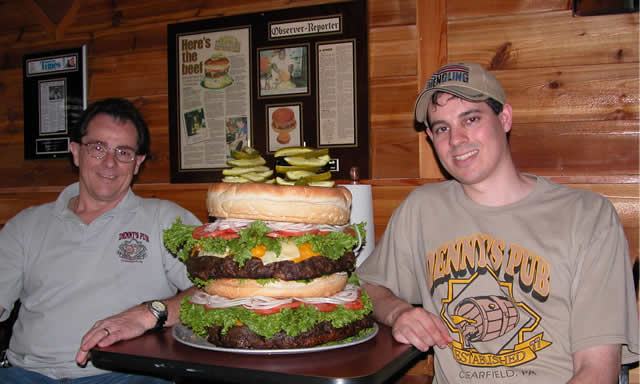
Fuddruckers restaurant at Foxwoods holds the Guinness Book of World Records title for largest hamburger, a 29.5-pound behemoth. (Guinness reps are seen weighing the monster in the accompanying photo.)

However, that title may be shortlived. The 50-pound Beer Barrel Belly Bruiser (pictured below) from Denny's Beer Barrel Pub in Clearfield, PA, has its claim pending. Denny's has held the title before and is obviously serious about getting it back.


A FOOTNOTE: Since this original posting above, one more gigundoburger has weighed in. See it here, then check out the details in the "comments" section below.

20060717

Rhode Island joins recorking movement

I recently reported on new laws approved in Maryland and Ohio to allow restaurant patrons to carry out unfinished portions of wine purchased by the bottle.

Add Rhode Island to the list.

Gov. Donald Carcieri has signed into law what statehouse denizens in providence have been referring to as a "merlot-to-go" bill. It lets restaurants recork and seal unfinished bottles of wine. Supporters of the law say it should reduce drunken driving because people will no longer feel that they must finish a bottle of wine.

As in the 30 other states allowing such activity, the bottles need to be recorked and transported in an inaccessible area, such as a car's trunk or behind the last upright seat in a van.

Tequila's home is sacred ground


Planning a trip to the many historical sites in Mexico? Consider adding one more area to your itinerary.

UNESCO, the U.N. Educational, Scientific and Cultural Organization, has named the agave growing area of Mexico's mountainous Jalisco state a World Heritage site.

Agave, the basis of the production of tequila liquor, has helped fuel the local and national economy. The state is dominated by distilleries, breweries, cantinas and liquor stores. The majority of the 60,000 residents work in the drink industry or in its spillover tourism industry.

"We are very emotional. There is a lot of joy among people here because we have been waiting for this for a long time," said Yadira Gaytan, assistant mayor of Tequila.

UNESCO's World Heritage Committee, which met last week in Lithuania, is responsible for implementing the 1972 U.N. Convention on the protection of cultural and natural sites around the world.

The specified area is located between the foothills of the Tequila Volcano and the Rio Grande river valle. It includes an archaeological site nearly 2,000 years old and colonial distilleries going back to the 16th Century.

"We are very happy," Ramon Gonzalez, director of the Tequila Regulatory Council, told Agence France-Presse. "It will help about 10,000 families in the region whose livelihood depends directly of the agave root."

Gonzalez said local authroities hope to turn the area into a major tourist attraction similar to California's wine Napa Valley or the wine Rioja route in northern Spain.

It is one of numerous World Heritage sites in Mexico. The others:

* Agave Landscape and Ancient Industrial Facilities of Tequila
* Ancient Maya City of Calakmul, Campeche
* Archaeological Monuments Zone of Xochicalco
* Archeological Zone of Paquimé, Casas Grandes, Chihuahua
* Earliest 16th-Century Monasteries on the Slopes of Popocatépetl
* Historic Centre of Mexico City and Xochimilco
* Historic Centre of Morelia, MichoacĂ¡n
* Historic Centre of Oaxaca, Oaxaca, and Archaeological Site of Monte AlbĂ¡n
* Historic Centre of Puebla, Puebla
* Historic Centre of Zacatecas, Zacatecas
* Historic Fortified Town of Campeche, Campeche
* Historic Monuments Zone of Santiago de Querétaro
* Historic Monuments Zone of Tlacotalpan
* Historic Town of Guanajuato, Guanajuato, and Adjacent Mines
* Instituto Cultural Cabañas, Guadalajara, Jalisco
* Luis BarragĂ¡n House and Studio
* Pre-Hispanic City of El TajĂ­n
* Pre-Hispanic City and National Park of Palenque
* Pre-Hispanic City of ChichĂ©n ItzĂ¡
* Pre-Hispanic City of Teotihuacan
* Pre-Hispanic City of Uxmal
* Rock Paintings of the Sierra de San Francisco
* Sian Ka'an biosphere reserve, Quintana Roo
* Whale Sanctuary of El Vizcaino
* Franciscan Missions in the Sierra Gorda of Querétaro
* Islands and Protected Areas of the Gulf of California

Here are links to some good sites for Mexican travel information:

Let'sGo2.Mexico
Lonely Planet's Mexico
Mexico Travel 101
Interactive Mexico Travel Resource

20060619

Wine centers aimed at the tourists

COPIA photo

See event and contact information below.

Wine tourism has become commonplace now that every one of the United States has at least one winery, and most of them many more.

The majority of states have created wine trails to entice tourists to tour various vineyards and wineries. Pamphlets for self-guided tours are usually free and areas are marked with unique signage to keep motorists from wandering too far off course.

But certain wine-intensive areas in the U.S. and elsewhere are taking advantage of the global boom in wine consumption to push interest to a higher level by creating centers to educate and entertain the masses.

The New York Wine & Culinary Center project, for example, opened this month after a whirlwind 10-month construction schedule.

As the facility, located on the shores of Canandaigua Lake near Rochester, begins its opening programs, a similar facility is under way on the West Coast with a projected May '07 opening.

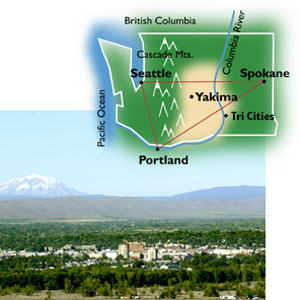
It's the Walter Clore Wine and Culinary Center, a $9.2 million project located in Prosser, Wash., in the Yakima Valley wine region.

The Washington facility's backers foresee it as both a destination for tourists and a place for winemakers to gather. It will have a 17,500 square-foot building, vineyards, organic gardens and a public park.

The main building will have a restaurant, exhibition galleries, a theater, a demonstration kitchen, wine bar and a retail shop.

The center's namesake is the late Walter Clore, regarded as the father of Washington wine. The state is the No. 2 producer of premium wine in the United States, trailing only California.

To the south, in California's storied Napa Valley, is the 10-year-old Copia against which all other wine-centric facilities are measured.

Neighbor to such commercially popular wineries as Robert Mondavi, Beringer, Stags Leap, Coppola, Domaine Chandon and Sterling, Copia and the nearby West Coast branch of the Culinary Institute of America have helped make the region an eating-and-drinking mecca that helped fuel the rebirth of Napa, the valley's anchor city of 53,000.

Copia's subtitle is "The American Center for Wine, Food & The Arts." It's a not-for-profit cultural center and museum that has been open to the public for about four years. It includes sprawling herb, flower and tree gardens (seen above), as well as several restaurants, museums and galleries in am 80,000-square-foot building on the banks of an oxbow bend in the Napa River.

"We're a non-collecting museum," said Daphne L. Derven, curator of food and assistant drector for programs. "That keeps us on our toes to continually come up with new ways to educate and entertain our visitors."

Two years ago, on the other end of New York state, Stony Brook University came up with a different model by establishing its Center for Wine, Food, and Culture.

The idea is to split its efforts between its main campus on Long Island and its facilities in Manhattan, offering wine- and food-tasting classes, cultural lectures, and interdisciplinary symposia.

The Canandaigua wine and culinary center is more of a destination place, like its California cousin Copia, although decidedly smaller.

While the exterior is on the plain side and the landscaping news and, therefore, undersized for now, the interior has an impressive upscale Adirondack-style design, utilizing multi-hued, handworked wood wainscoting, stair railings, display shelving and counters. A 36-station kitchen and views of the lake are other highlights of the roughly $7 million project.

Director Alexa Gifford said the final look will include entrance landscaping geared toward representations of indigenous plants from the region.

William M. Dowd photo

"We'll have local flowers and shrubs, grape vines and the like that will set the mood for visitors," she said. "Americans in general are used to pulling into a parking lot that leaves you right up to the door. We'll be guiding people along a path that creates a mood, and then they'll walk into this beautiful facility that will build on that atmosphere."

The 15,000 square-foot center will offer hands-on courses in culinary science; interactive exhibits on New York State agriculture, foods and wines; demonstration space; and a live garden outside of the building. And, it has a tasting room with a
rotating selection of wines from New York's major regions (Niagara/Lake Erie, Finger Lakes, Hudson Valley and Long Island), a wine and tapas bar for light meals and wine-and-food pairings, a theater-style demonstration kitchen, a training kitchen for hands-on cooking classes, and industrial kitchens for credited culinary classes and corporate training.

No wine is sold at the facility, but visitors can use a computer right there to order directly from New York wineries.
ON THE WEB
Dowd's Guide to American Wine Trails
Dowd's Drinks Events Calendar
• Copia: The American Center for Wine, Food & The Arts
New York Wine & Culinary Center
Stony Brook University Center for Wine, Food & Culture

20060605

Sip transit glorious Finger Lakes


One of the problems with the rapidly expanding number of wineries in New York's Finger Lakes is tourism.

Not that the area doesn't want visitors. Just the opposite. Trouble is, too many of them are potentially dangerous drivers as they move from winery to winery, tasting their wares.

Some enterprising types have been offering a combination of a rental car complete with driver, and even a linkup to a bed-and-breakfast with that service. However, that doesn't do much for the many boaters who pull up to shore and want to visit more tha one winery but have no wheels.

Thus, the Seneca County Chamber of Commerce has begun offering weekend bus tours to local wineries -- four wineries on the west side of Cayuga Lake on Saturday, and four on the west side of Seneca Lake on Sunday.

"The wine tour was in response to boaters coming in not being able to get a limousine or a rental car because they were booked up for the weekend. So they were stuck in the harbor," said Dominic Christopher, the Chamber's executive director. "We're ready for big groups anytime."

Traffic is particularly heavy during the summer months when boaters show up at the state's canal system harbor in Seneca Falls. For $25, they now can take the bus right at the harbor. Of course, the weekend tours, which began June 3 and will run through Oct. 8, aren't limited to boaters. They're available to anyone on a space-available basis.

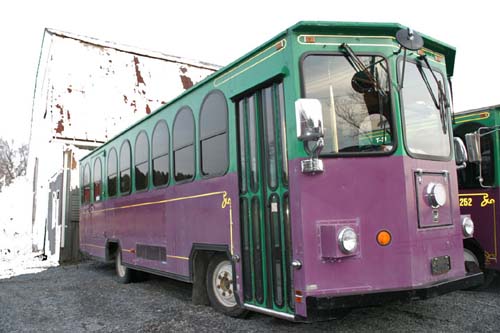
Meanwhile, a trackless Wine Tour Trolley will also be offering a similar service for visitors in the Geneva area starting Saturday, June 10.

Mike Fitzgerald, who owns a limousine and private tour coach service, bought the trolley which had been used in tourism businesses in New Orleans and Buffalo. Tours on the 26-seat vehicle will cover five wineries in a six-hour period through Dec. 2 at $45 per person.
ON THE WEB
Finger Lakes Tourism and Travel
Dowd's Guide to American Wine Trails
Dowd's Guides

20060603

NY Wine center opening day set

The New York Wine & Culinary Center will open to the public on Saturday, June 17.

Executive Director Alexa Gifford calls the $7.5 million facility perched on the shore of Canandaigua Lake the "physical and electronic gateway to New York's food, wine and agriculture.

20060531

Canada's no-smoking area expands


Visitors to Quebec liken it to visiting France without all that pesky trans-Atlantic travel.

One other big difference now is evident. Today -- Wednesday, May 31 -- a no-smoking rule went into effect in what one Montreal writer calls "the unofficial smoking section of North America."

Businesses won a brief reprieve from a province-wide smoking ban when the Minister of Health pushed back the start date of the ban from Jan. 1 to May 31.

The ban on smoking is effective in all public places, including restaurants, bars, brasseries, taverns and bingo halls. Hotels can reserve up to 40% of their rooms as "smoking permitted" rooms.

Meanwhile, next door in Ontario province, a "transition" to a no-smoking society got under way today.

Bars in Ontario that let smokers light up after a provincewide ban takes effect Wednesday will get off with a warning for a first offence.

"With any law, there tends to be a transition period," Ontario Health Promotion Minister Jim Watson said of the new ban on smoking in all restaurants, bars, casinos, bingo halls and virtually every other indoor public space. "We think a reasonable approach is the phased-in approach, with the education, warnings and then fines."

Most municipalities across the province already have local anti-smoking bylaws. Watson, a former mayor of Ottawa, which five years ago implemented a strict municipal smoking ban, acknowledged there will likely be those proprietors who either aren't clear about how the law impacts their particular establishment or who openly defy it. Those who consistently break the law will pay the price, he said.

New Brunswick, Newfoundland, Saskatchewan and Manitoba have already banned smoking in public places. Nova Scotia's ban takes effect at the end of the year.

20060530

Texas speed limit hits 80


In some parts of Texas, it now is legal to drive at 80 mph.

Really.

Here's the story, as published in the May 30 edition of The Washington Times.

DALLAS -- One of the fleetest critters in western Texas, so they say, is the kooky-looking bird called the chaparral, or "roadrunner." The main tourist attraction in Fort Stockton is a huge statue of an 11-by-22-foot roadrunner called Paisano Pete, who greets visitors from atop the town's "Welcome" sign.

But on parts of Interstate Highways 10 and 20 around Fort Stockton -- heading west toward El Paso and east toward San Antonio and Dallas -- the gawky bird no longer will be the fastest thing going.

Last week, state highway officials in Fort Stockton unveiled the first 80-mph speed limit sign -- reportedly the fastest posted speed limit in the nation.

Rep. Pete Gallego, who represents a district bigger than Connecticut, New Hampshire, Massachusetts and Rhode Island combined and sponsored the bill, said it will only add to the comfort of drivers who travel the desolate highway.

"Probably the only difference might be that police write fewer speeding tickets," he said.

Some safety officials and energy conservationists predict the additional speed allowance can mean nothing but more fatal accidents.

"People don't survive crashes at that speed," said Tom Smith, director of the Texas office for Public Citizen, a consumer advocacy organization.

"This will result in more deaths," said Russ Rader, spokesman for the Insurance Institute for Highway Safety. "You get somewhere faster, but at what cost?"

Mr. Gallego said Texas Department of Transportation specialists had studied the situation and found that in the three years since the speed limit in that area was increased from 70 to 75 mph, the number of fatalities had actually dropped.

The highways, among the most remote in the U.S., are generally four-lane, well-maintained and straight as an arrow mile after mile. It is often 10 to 15 miles between exit ramps. The affected highways total about 400 miles.

Although much of the traffic on these east-west thoroughfares is heavy freight-bearing trucks, the limit remains 70 mph for them. The speed limit at night for all drivers is 65 mph.

State transportation officials say they tested the effects of the new law before it was even passed in the Legislature and found that 85 percent of drivers traveling in that area already were driving between 76 and 79 mph.

Told that some opponents say that most American drivers routinely drive 5 to 10 miles over the marked speed limit and that police officers generally allow at least a 5 mph leeway, Mr. Gallego laughed:

"Doesn't work that way out here. We've got some really lonely stretches of highways out here. If the speed limit is 65 and they catch you going 66, they'll stop you, just to have somebody to talk to."

20060403

New York wine & food center on a very fast track

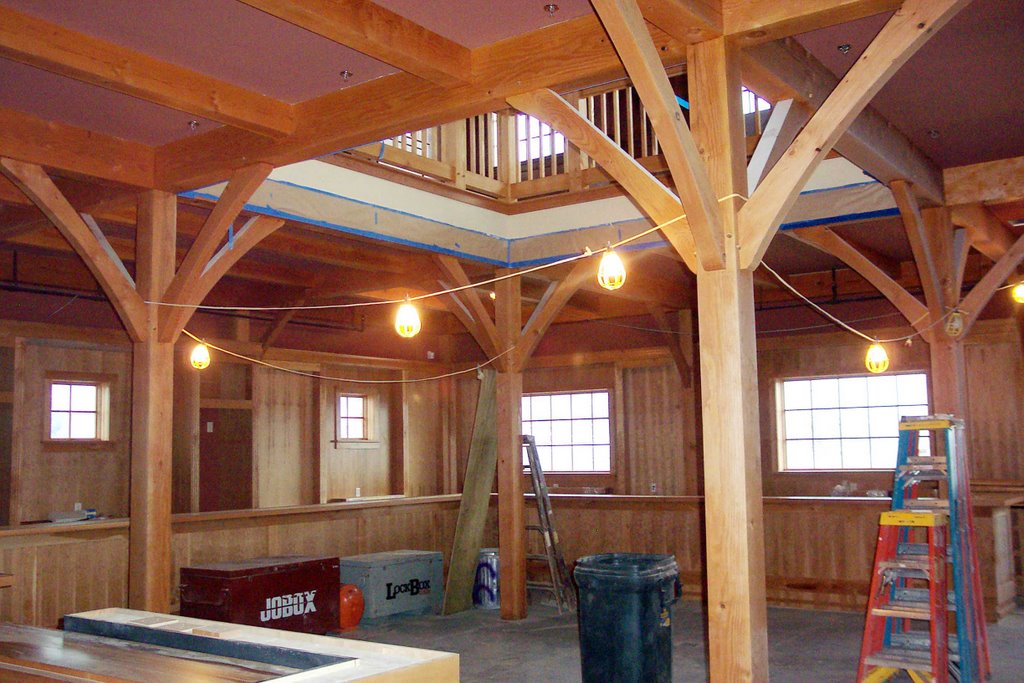
FROM THIS ...


... TO THIS ...


... IN JUST SEVEN MONTHS,

William M. Dowd photos


CANANDAIGUA, NY -- The New York Wine & Culinary Center project has gone from groundbreaking ceremony in August 2005 to under roof and 10 weeks from a projected soft opening.

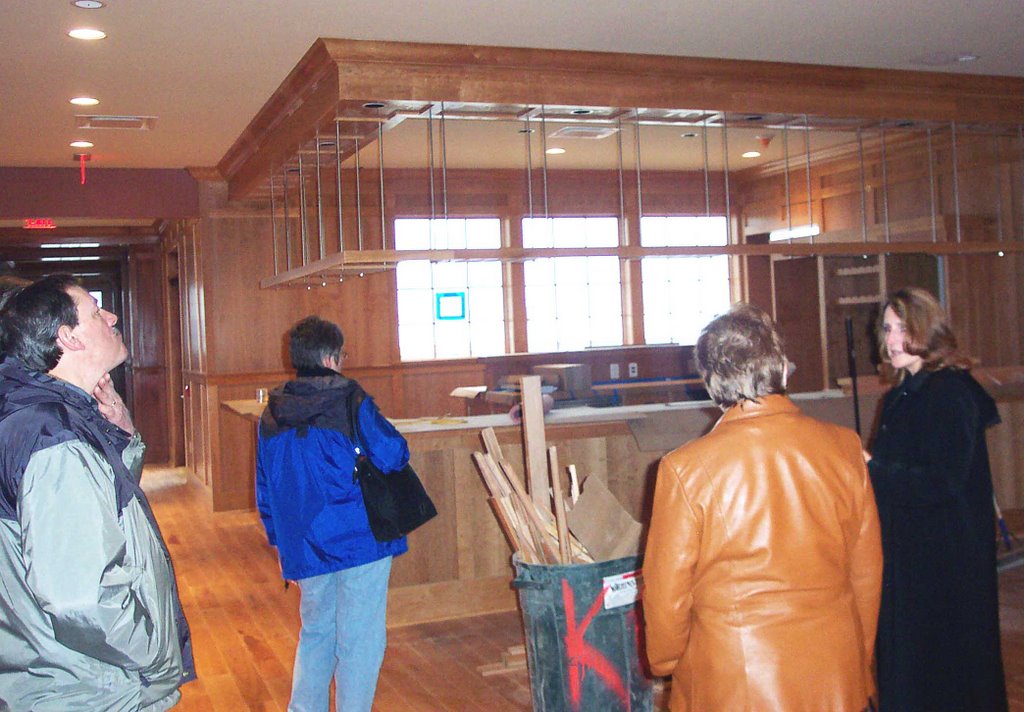
I toured the facility, on the shores of Canandaigua Lake near Rochester, NY, this weekend and -- confession time -- was amazed at the rapidity of construction.

Walking through construction-dust-coated corridors, offices and public spaces, the impressive upscale Adirondack-style design was unveiled -- from multi-hued, handworked wood wainscoting, stair railings, display shelving and counters to a 36-station kitchen, slate-floored rest rooms and views of the lake, the roughly $7 million project is coming together at a pace that some doubters, me included, have difficulty believing.

The center, noted director Alexa Gifford, will include entrance landscaping geared toward representations of indigenous plants from the region.

"We'll have local flowers and shrubs, grape vines and the like that will set the mood for visitors," she said. "Americans in general are used to pulling into a parking lot that leaves you right up to the door. We'll be guiding people along a path that creates a mood, and then they'll walk into this beautiful facility that will build on that atmosphere."

The center is being financed by $2 million in state funding and the rest from various private funds. The major private backers are Centerra, formerly known as Constellation Brands, the locally-headquartered company that is the world's largest manufacturer and distributor of alcoholic beverages; Wegman's Food Markets, a five-state chain based in Rochester, and Rochester Institute of Technology's Hospitality and Service Management School.

The mission of the Center will be to foster knowledge in the wine, agriculture and culinary arts industries across New York State. To do so, the Center will offer hands-on courses in culinary science; interactive exhibits on New York State agriculture, foods and wines; demonstration space; and a live garden outside of the building.

"We have been doing a lot of talking to various businesses and organizations that, understandably, are asking, 'What's in this for me? Aren't you competition?',' said Gifford. "We've been explaining that in no way will we compete with private businesses. We're here to enhance an understanding and support of New York's wonderful food and wine products. They like knowing that, and we're planning to work with schoolkids as well as tourists and businesses."

The 15,000 square-foot facility will include a tasting room with a rotating selection of wines from New York's major regions (Niagara/Lake Erie, Finger Lakes, Hudson Valley and Long Island), a wine and tapas bar for light meals and wine-and-food pairings, a theater-style demonstration kitchen, a training kitchen for hands-on cooking classes, and industrial kitchens for credited culinary classes and corporate training. It also will house the offices of the New York Wine and Grape Foundation.

Agriculture is one of New York's most vital industries, encompassing 25 percent of the state's landscape and generating more than $3.6 billion last year. It has 7.6 million acres of farmland with 36,000 farms and is the nation's third-largest wine-producing state after California and Oregon.

The project marks a major step in increasing the visibility of New York's wine industry to tourism and agribusiness interests. How significant the industry is to the state is shown in a just-released report from MKF Research, a California-based consulting firm analyzing New York's situation.

With 31,000 acres of vineyards, 212 wineries and 1,384 grape farms, New York is the nation's second largest wine producer after California and the third biggest grape grower behind California and Washington.

Wineries, grape producers and related businesses in New York, from liquor stores to makers of bottles, glasses and labels, account for almost 36,000 jobs and a $1.3 billion payroll, the state-funded study reported.

In addition, it said that wine sales alone generate $420 million in sales, but the state industry's multiplier impact on the economy came to $3.4 billion in 2004.

A FEW MORE VIEWS


Alexa Gifford discusses the Center's progress with Jim Trezise, head of the New York Wine & Grape Foundation.


20060330

Wine center under way in Washington


Wine tourism marches on. As western New York sees construction proceeding at a rapid clip on a center for wine and food near Canandaigua Lake that it hopes will draw tourists, ground has been broken in Washington state for the Walter Clore Wine and Culinary Center (seen here in architect's drawing).

It's a $9.2 million center, located in Prosser in the Yakima Valley wine region, that its backers foresee as both a destination for tourists and a place for winemakers to gather.

The facility, expected to open in May of next year, will have a 17,500 square-foot building, vineyards, organic gardens and a public park. The main building will have a restaurant, exhibition galleries, a theater, a demonstration kitchen, wine bar and a retail shop.

The center's namesake is the late Walter Clore, regarded as the father of Washington wine. The state is the No. 2 producer of premium wine in the United States, trailing only California.

20060329

Whiskey Trail views on display


WASHINGTON, D.C. – “Views from the American Whiskey Trail,” a collection of paintings by Scottish artist Ian Gray showcasing the culture and heritage of America’s distilled spirits, opened today at the National Press Club.

Gray’s collection of paintings captures scenes from America’s most celebrated and significant whiskey distilleries, many of which are National Historic Landmarks. The images focus on the distilling process and unique character of each distillery including Maker’s Mark, Jim Beam, Woodford Reserve, Wild Turkey and Jack Daniel’s.

“While touring the distilleries of Kentucky and Tennessee, I was captivated by the beauty and the legacy of the distilled spirits culture and heritage in America,” said Gray, whose paintings will be on display through Friday, April 7.

Views from the American Whiskey Trail will mark Gray’s first exhibit in the U.S. His work has been featured in galleries in London, Germany, Canada and Scotland. His unique style of art has been recognized worldwide for his mix media technique of photography of paints. Gray’s clients include German Parliament, the Singapore Government, Citibank, Scotch Malt Whisky Society, and Glenmorangie among others.

Take an online tour of Gray’s views from the American Whiskey Trail.

Rare treat at NYC's Tartan Week


A bottle of what is believed to be the oldest unopened bottle of Scotch whisky in the world could be yours. If, that is, you can outbid all others on April 4 when the Glenfiddich Rare Collection 1937 goes up for auction in New York's Grand Central Terminal as part of Tartan Week celebrations.

The annual week-long festivities celebrate Scottish culture and heritage. Glenfiddich is partnering with City Harvest, a New York-based charity, to auction one of the four remaining bottles of this exceptionally rare spirit.

Rare Collection 1937 comes from one cask at the Glenfiddich Distillery in Dufftown, Scotland, that yielded 61 bottles. Company officials explain that import laws required a special 750ml bottle to be made, so the item being auctioned is, therefore, the only 750ml bottle of this particular whisky ever produced. The spirit was cask aged for 64 years and bottled in 2001.

If you're interested in reserving a seat at the auction, call (212) 982.8300 ext. 111. Really.

20060321

Amsterdam museum reopening delayed


If a visit to Amsterdam's Rijksmuseum was on your list of spots to visit, move it down a few notches.

The reopening of the Netherlands' most famous museum has been postponed by a year for revisions to its renovation plans. For example, Dutch Culture Minister Reny van der Laan told parliament, security measures were being reviewed because of recent art thefts at several other European museums.

The museum was closed indefinitely in 2003 after an asbestos scare. Renovations estimated at $190 million are to begin early next year and include a cycling route under the building. The museum's collection has been on limited display since 2003 in the building's Philips Wing. Van der Laan said the main museum is tenatively to re-open by the end of 2009.

A collection of more than 400 works from the 17th century will continue to be on view under the title "The Masterpieces." The famous collection of dolls' houses, Delftware, as well as paintings by such masters as Frans Hals, Jan Steen, Vermeer and Rembrandt have been moved for the first time since being acquired by the Rijksmuseum. Rembrandt's "Night Watch," for example, has rarely left the main building designed by Pierre Cuypers since it opened in 1885.

The museum is taking the opportunity to show another side, literally, of the art world to visitors with its "Really Rembrandt?" program. As explained by the governors, "For the first time, the Rijksmuseum will be presenting paintings that were originally attributed to Rembrandt and were bought as such by the Rijksmuseum, but about which doubts have arisen over the years. In the Philips Wing of the Rijksmuseum.

"During the presentation, visitors will be shown what elements of a painting lead us to believe that it is, or is not a Rembrandt, using methods such as infrared- and X-ray images. The presentation will offer a behind-the-scenes look at the Rijksmuseum Rembrandt study, whereby new insights will also be revealed. In all, 13 works will be displayed at the presentation. "Really Rembrandt?" will give visitors the opportunity to learn about of the opinions of various experts, but most of all to have a look for themselves and to form their own opinions."

ON THE WEB

Amsterdam Museums & Galleries
Lonely Planet Guide to the Netherlands
Europe for Visitors: Netherlands
Netherlands Board of Tourism

20060316

Scotland wine and food center is open


DUNDEE, Scotland -- Tourist alert! Scotland's first food and wine center is now open.

The Tasting Rooms, as the center is called, was created by Scott's Wine World, a Dundee wine importer.

The center is international in scope, offering virtual wine tours, a deli, café, wine trading floor, corporate conference facilities and an art gallery. Director Graeme Scott said inspiration for the project came from visits to the wine warehouses of Australia and Hong Kong.

"There's a lot of investment here at the moment and the timing is just right," Scott said, explaining why Dundee (seen above) was selected as the initial Scottish site.

Events planned for The Tasting Rooms include specialized dinners pitched at the corporate market and featuring wine producers and celebrity chefs.

The complex blends the historical and traditional jute building with a rustic wine warehouse where people can wander, buy, relax, eat and learn.

“There’s nothing like this in the UK and there’s definitely nothing like it in Scotland,” Scott said. “We want to take the snobbery out of wine and make it more accessible. I experienced this when I was living abroad where it was all about tasting wine in a relaxed environment and in a more tactile way, and I wanted to bring that to the UK.”

Visitors to the Tasting Rooms can access virtual tours of vineyards around the world as well as tastings of the produce of some of those wineries from Italy, Spain, France, South America, Australia and New Zealand. Food is provided mostly by Scottish suppliers for the on-site deli counter and mezzanine café that overlooks the wine trading floor.

Scott, born and raised in Dundee, says of the city, “There’s a lot of investment here at the moment and the timing is just right. Currently our main focus is Dundee, but if it’s successful we have not ruled out similar concepts in other cities.”

ON THE WEB
Scotland.com
BBC Scotland Travel Guide
Bus & Coach Travel
Scotland's Golf Courses
Scottish Tourist Board
The Clans of Scotland
Scottish History & Culture
Distillery tours, tastings, information

Only the best in the world


As Bogie might have put it, out of all the whisky joints in all the towns in the world, what makes The Pot Still the best?

Whisky Magazine has named the Glasgow, Scotland, establishment the best whisk(e)y bar in the world, a title announced at the prestigious magazine's Icons of Whisky awards in London.

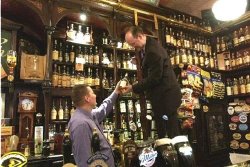
The Pot Still, with a history that dates to the 1870s, features walls of just about every whisky imaginable, such as the one seen here, with 483 bottles and adding. Whisky lovers from around the world have traveled to The Pot Still, some for the pub fare and ales on tap as well. So, if you're planning to visit teh ancient Scottish city, it seems only logical to include a stop at The Pot Still.

Of course, calling something the best in the world isn't something Whisky Magazine shys away from. For some examples, click here.

ON THE WEB

Whisky Distilleries of Scotland
Scotch Whisky Heritage Centre
Map to Scotch Distilleries
Whisky Tours of Scotland

New Texas wine region declared


Texas has added a viticultural area to its arsenal: the Texoma American.

It's an area along the Texas-Oklahoma border where horticulturist Thomas Volney Munson began cultivating grapes more than a century ago in what he referred to as a "grape paradise."

The federal government has designated a 3,650-square-mile area of sandy hills sloping to the Red River and Lake Texoma as the viticultural area.

"I don't know if it's 10 years or 20 years or 100 years, but the (region) will fill in and we'll have several thousands of acres of grapes around here," said Gabe Parker, owner of the Homestead Winery in Ivanhoe. "The land is appropriate for it."

The number of wineries in the Texoma area has grown from two to six in the past three years, and there now are 225 acres dedicated to vineyards in the fledgling area.

Texas has 109 wineries statewide, up from just 40 in 2000 to 109 this year, according to the Texas Wine Marketing Research Institute at Texas Tech University. The wineries' output makes Texas the nation's fifth-largest wine producing state.

ON THE WEB

Lake Texoma
Visiting Texas' Wine Trails
Texas Panhandle
Texas Travel

Yakima Valley: New wine destination


The Rattlesnake Hills, southeast of Yakima in central Washington, has become the state's ninth federally recognized wine grape-growing region.

The U.S. Tobacco Tax and Trade Bureau approved the Rattlesnake Hills for appellation status, effective March 20. The federal bureau awards appellation status to regions, also known as American Viticultural Areas, to recognize their distinct climate and soil features.

The 68,500-acre region lies within the Yakima Valley appellation, stretching from Union Gap, just south of Yakima, to north of Sunnyside about 45 miles to the east. Its loam soils hold moisture better than some other Washington areas and it historically is slightly warmer than the rest of the Yakima Valley appellation.

Gail Puryear, owner and winemaker at Bonair Winery in Zillah, and his wife, Shirley, were among proponents of the new appelation.

"We can ripen the warmest varieties, the sun-loving varieties like syrah and nebbiolo, but we have micro-climates because of the varying topography," he told the Associated Press. "Riesling does well in the cool micro-climates. We grow everything in between."

Dick Boushey, a Grandview grower who opposed the appellation request, told the AP the issue had become divisive in some corners. Half the 26 parties submitting comments to the government were opposed to the division of the current appellation.

"It just shows I don't really understand what it takes to be an AVA, and I guess I have a little bit less regard for what an AVA is," he said. "Whatever happens, we all need to work together. There probably will be more AVAs in the future, and I think we all want the same thing: to promote the area in any way we can."

If the application met all the criteria to be named an appellation, it just gives the Washington wine industry one more opportunity to market itself, said Robin Pollard, executive director of the Washington Wine Commission, a promotion agency funded by member fees on growers and wineries.

The Chelan area in north-central Washington and the Ancient Lake region near Moses Lake in central Washington have proposals for appellation status pending.

Washington is the No. 2 producer nationally of wine, after California. More than 350 wineries, 350 wine-grape growers and 30,000 vineyard acres support the more than $2.5 billion annual industry.

ON THE WEB
Yakima Valley Visitors & Convention Bureau
Virtual Yakima
Yakima Valley SunDome

20060307

Gorilla In the Mist


COLLINGWOOD, Ontario -- The 800-pound gorilla swirled the amber concoction around, sniffed it, tasted it, then delivered the verdict. "Well, Terry, this is ...uh ... crap," he said.

If that's the way he felt about my crestfallen colleague's efforts, there was no way I was going to let this guy sample any of the whisky blend I'd just created.

He was, after all, the master distiller and master blender for Canadian Mist, the second largest maker of Canadian whisky in the universe. I didn't need that kind of pressure.

But, let's back up a couple of days.

I was interested in more fully understanding the intricacies of the process that creates Canadian whisky (like Scotch, spelled without the "e" used in the U.S. and Ireland). Brown-Forman, the multinational alcoholic beverage behemoth, was just beginning a new campaign to push its Canadian Mist brand, so our mutual desires resulted in an invitation to visit the distillery here with several other adult beverage writers to learn about blending under the tutelage of Harold Ferguson, distiller and blender par excellence.

After a pleasant night in Toronto, and a feast at Canoe on the 54th floor ot the Dominion Bank Tower on Wellington Street West, it was off to this industrial city of 22,000 souls located about 90 miles northwest of the metro area.

Collingwood seems the right place for such an adventure. Its legacy ranges from the sublime (named for Lord Nelson's second in command at the Battle of Trafalgar) to the ridiculous (an annual Elvis impersonator festival).

Along the way, it became obvious not many local business owners were interested in such frills as names, witness The Beer Store, Joe's Store, Steakhouse Tavern, Real Estate Office, Pine and Oak Furniture, and The Law Store.

The sprawling Canadian Mist distillery complex sits a mere hundred yards or so from the beach on Nottawasaga Bay, the southern scoop of the huge Georgian Bay that itself is nearly as large as Lake Ontario.

As we pulled onto the distillery grounds, I noticed an adjacent factory owned by Nacan, the starch manufacturer. "If these two companies worked together they could give you a good stiff drink," I mused aloud. To stony silence from my obviously humor-impaired companions, I must point out.
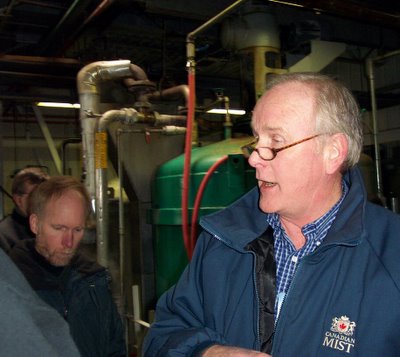

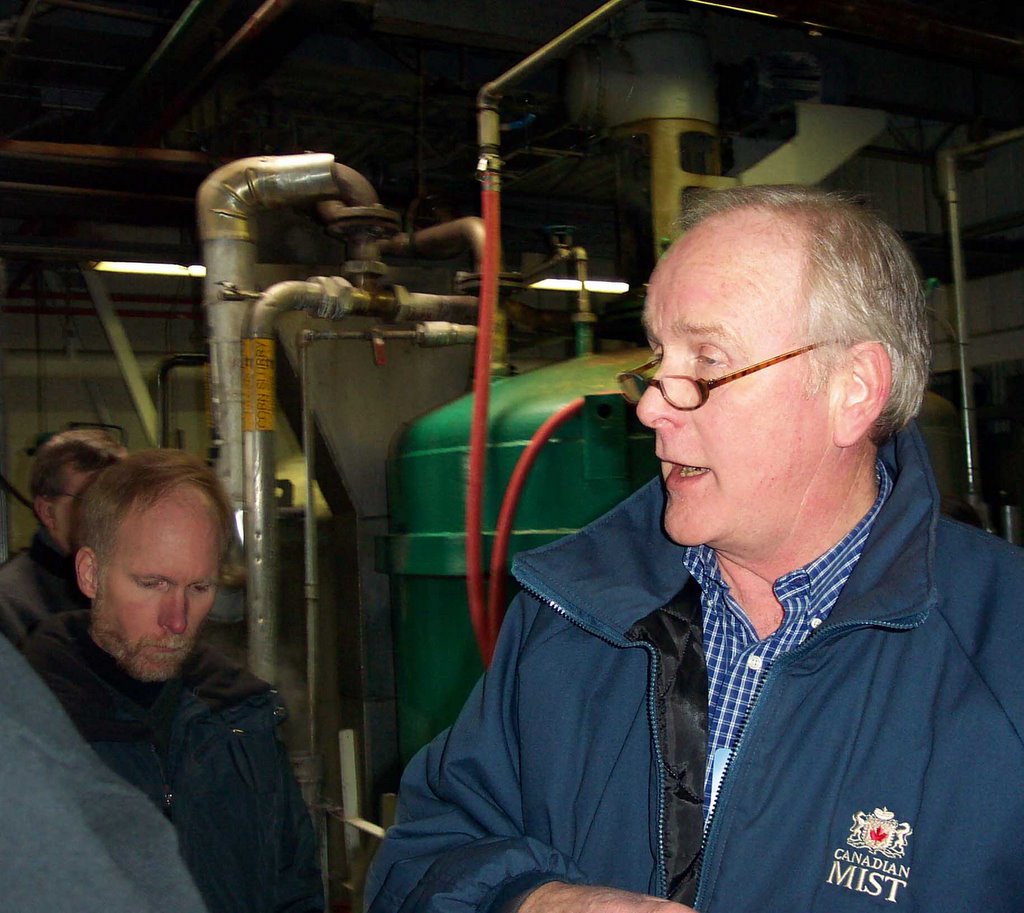
Then we were at the main door, being greeted by Harold Ferguson (above), the aforementioned 800-pound gorilla who joined Canadian Mist fresh out of college in 1969. The professorial-looking guru, with thinning sandy hair and eyeglasses perched low on his nose, is one of the best-known figures in his country's whisky business -- master distiller, master blender, vice president and general manager of the half-million square foot facility, board member of the Association of Canadian Distillers, and so on.

A tour of the distillery floor, the computerized quality control room, the barrel storage sheds and other nooks and crannies later, we assembled in an impromptu lab environment to try putting into practice some of the blending tips Ferguson had explained as we walked about.

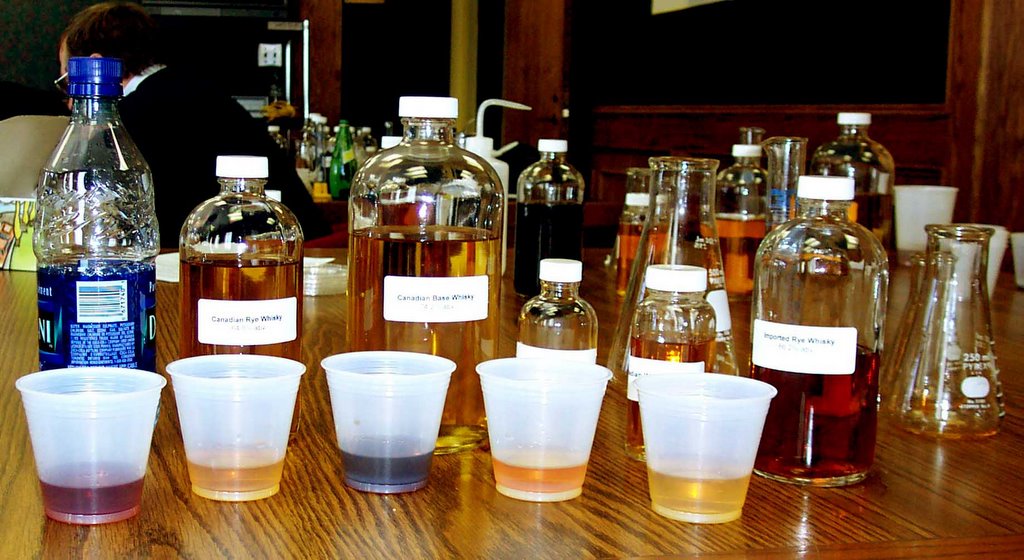
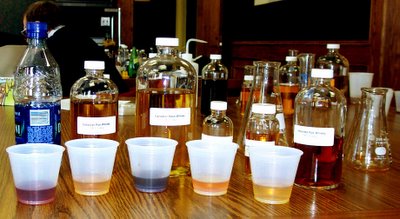
An array of bottles containing Canadian base whisky -- essentially, a refined moonshine with a pleasant vanilla nose, Canadian rye whisky and wheat whisky, domestic sherry and port blending wines, imported rye whisky and brandy stood before us. Flanking them were beakers and Ehrlenmeyer flasks, things I hadn't dealt with since college chemistry that seemed so long ago I'd swear the Periodic Table had only about a dozen elements then.

Since Canadian Mist manufactures only one thing, Canadian whisky made of rye, corn and malt, it is tempting to think Ferguson's responsibility isn't difficult. But, as he is quick to point out, "think how difficult it is to produce the same thing every day exactly the same without any deviation." Plus, Canadian Food and Drug Regulations for what can be labeled Canadian whisky are stringent. We had to work within those regulations to come up with our particular blends.

I'd had plenty of experience infusing vodkas and gins with herbs, fruits and vegetables, but that's a comparative snap to blending whisky and all these rules don't make it any easier.

Obviously, we weren't going to click on all tries and produce great whisky. We were working with completed products that gave us a headstart, but Canadian has to be aged in "small wood" -- as opposed to large tanks -- for at least three years; contain no less than 40% alcohol (80 proof); may be flavored but no more than 9.09%, and then only by using certain substances such as those Ferguson supplied to us, and even most of them are subject to their own aging requirements.

We were instructed to mix 40-milliliter concoctions of our own tastes. I whipped up five, noting the heat of the liquids we were trying at cask strength -- undiluted by the sparkling water from the Collingwood municipal supply taken from Georgian Bay. That would be up to Ferguson to add when he passed judgment.

I began with a cautious mix of Canadian base, imported rye and port. Too hot. Then a mix of base, brandy and wheat whisky. Too little heat.

It would have been nice in a Goldilocks sort of way to report that third blend was just right. It wasn't. And, neither was No. 4.

Last chance. Twenty milliliters of base, 10 of water and 5 each of brandy and wheat whisky. Shake, sample, pray.

Which brings us back to the unfortunate Terry experience. Would my creation suffer the same fate?

Ferguson squirted some Georgian Bay water in the flask, swirled it around to incoporate my offering, held it up to the light, then sipped.

"This isn't bad," he said quietly. Another sip. "You know, this is really rather good. Nice job."

Anything after this would have been anticlimactic. A 20% success rate in my first attempt at blending. And a pat on the shoulder from the 800-pound gorilla of the Mist.

It was worth the trip. But, truth be told, I'm now retired from the whisky blending game and back to sticking herbs in my vodka. Much less pressure.
20060222

Puerto Rico may butt out


Smokers headed for Puerto Rico, be alerted.

The commonwealth's Senate has passed a measure that would create an island-wide ban on smoking in restaurants, bars, casinos and other public workplaces.

The legislation now goes to the commonwealth's House of Representatives, where it is expected to be approved. The House previously had signed off on a similar version of the Senate bill.

Gov. Anibal Acevedo Vila is expected to sign the bill into law as soon as it reaches his desk.

20060216

Brits outlaw smoking in public places


If you're a smoker headed for England, enjoy lighting up in a pub, restaurant or any other public place for now. That activity will be banned in a year or less.

Parliament has voted, 384 to 184, for a total ban on smoking in indoor public places, something that will end the tradition of the smoky British pub.

Neighbor Ireland instituted the same ban in March 2004. The same will occur in Scotland and Northern Ireland over the next year, and factions in Wales are debating the issue.
Prime Minister Tony Blair's government had supported a partial ban that still would have allowed smoking in private members' clubs and pubs that do not serve food.
20060120

Safe eating guide to the Big Apple

The New York City Health Department has come up with a restaurant guide that might prove as popular as the commercial collections.

It's a new Web site that lists health code violation points.

Health Commissioner Thomas Frieden said his department is queried so often about code violations they decided to simplify access to it. The site had been getting an estimated 7 million hits a year. When the redesign was unveiled the other day it got so many hits it crashed. Access problems continue, so if you try to use it and can't get through, be patient. My call to the department revealed that access is intermittent as techies work on de-bugging the new site.

The site allows the public to search for restaurants by name, ZIP code, borough and neighborhood. It also allows users to sort restaurants by violation points.

Scores below 27 are deemed safe, 28 or higher not so safe. Officials said about 10 percent of the city's 20,000 eateries fail inspection each year and about 500 are closed.
ON THE WEB
Food & Dining In NYC
Dowd's Guides

20060113

Will it sell naming rights?


There are odder museums around the country. A few that come immediately to mind are the Jello-O Museum, the New York State Museum of Cheese, and even two Banana Museum locations, one in California and one in Washington.

In 2007, for those who plan vacation trips well in advance, you'll be able to drop in on the Advertising Icon Museum, currently under construction in Kansas City, MO.

It will feature 900 advertising icons in the forms of toys, dolls, signs, cups, figurines and any other mediuam you can think of. Not at all surprising, given the tremendous role advertising plays in our everyday lives.

The project, created by Robert Bernstein, will be located on the west side of the historic Country Club Plaza in Kansas City. The icons will range from a 1939 Heinz Aristocrat Tomato, complete with top hat and monocle, to a 7-foot tall Jolly Green Giant. Visitors will be able to view TV and print advertisements in which the icons first appeared and see the evolution of certain icons over time. Exhibits will also demonstrate how these icons mirror the social and cultural values of the eras that they represent.

Reason No. 286 we're a fat nation


If you're a globetrotting glutton, New York City may still be the place to go.

A few years ago, the race was on to create the most expensive burger in Manhattan. Now, it's time for dessert.

FAO Sweetz, the upscale ice cream parlor inside the legendary FAO Schwartz toy store on Fifth Avenue, is serving up "The Volcano." It's one scoop each of 12 different ice cream flavors inside a Belgian chocolate mountain, topped with cherries, whipped cream, chocolate rocks and seven different toppings. The price: $100.

It takes two waiters to deliver the treat, and customers are given tools to crack open the chocolate shell.

20060110

Irish hospitality extended


Don't be surprised if relatives begin showing up more often for visits at the St. Mary's nursing home in County Monaghan, Ireland, near the border with Northern Ireland.

The reason: The home now has a pub.

Actually, it's had a bit of a bar since the 1970s, but recently upgraded it to a real pub for the principal benefit of home residents, average age 85. Nursing home officials noticed a fair number of residents were able, and quite willing, to stroll down to the village pub, sometimes for a drink but sometimes just for coffee or tea and a chant.

The desire was obvious: to enjoy a non-institutional life experience as much as possible.

As Rose Mooney, associate director of nursing at St. Mary's, told an interviewer, " .. Most of our lives, you know, center around the pub or some kind of recreational activity, but definitely in Ireland social life revolves around the pub and all of a sudden, you know, we shouldn't allow that just to stop dead when people come into a care setting, whether it be maybe they're only here for two weeks or for you know, six weeks rehabilitation or for long-term care."

You can get the full details on the topic by checking this transcript of an Australian radio show interview with Mooney.

20051219

Save The Date


More than 300 investors have paid US$3,000 each for six bottles of single malt whisky a year for 50 years. But, they'll have to be patient before getting started.

To explain: Ladybank, a distillery that will be constructed on the site of an abandoned mill near Fife, Scotland, rounded up the first 330 backers of what it hopes will be a group of 1,250 financial supporters. According to The Times of London, the first product will be ready for consumption in 2017.

So far, $1.5 million of the $4.5 million expected to be spent has been raised. Investors also will have access to the guest rooms, dining area and library of the adjoining Ladybank private members' club, expected to be completed by 2007.

The Ladybank brochure describes the project (see illustration) as a “luxurious country club with one difference — here the activity is focused on the special mystique that is the production of fine single malt whisky.”

Founder James Thomson told The Times the empty old farm buildings at the end of a narrow track will not begin to be converted until next spring, and production will not start for another year after that.

Thomson said he envisions his members attending whisky-making classes in the converted 18th century mill or taking a stroll in an adjacent “secret Victorian garden,” with rockeries, grotto and a pond. Those especially pressed for time will be able to land their helicopters on the lawn.

Whisky production will be on a small scale, with about 25,000 litres distilled per year compared with between one million and two million for most whisky distilleries. The whisky will be shared among members and “VIP customers” with little, if any, sold commercially.

What will the whisky style be? "Our members will be able to decide how they want their whisky, whether they want it peaty or not too peaty, how they want it bottled," Thomson said.

20051108

They're No Pirates of the Caribbean


I must go down to the sea again,
To the lonely sea and sky.
And all I ask is a tall ship
And a star to steer her by.


If poet John Masefield (1878-1967) were still around and writing these days he'd probably modify his "Sea Fever" to reflect the realities of what's going on in the Indian Ocean.

I can't do down to the sea again,
Especially off Somalia.
Thar be pirates there, and I fear
They're not there to entertain ya.


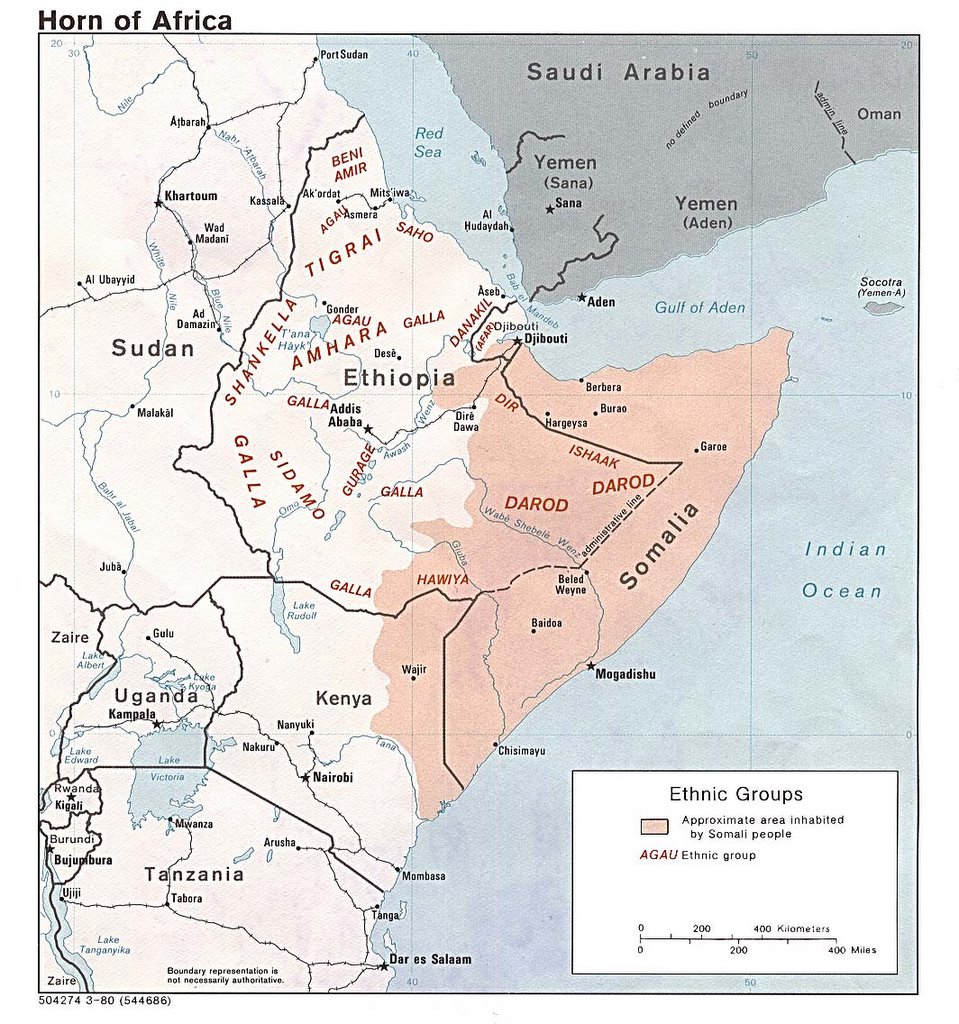
The east coast of Africa, particularly off lawless Somalia, has become a hotbed of piracy, with crews armed and led by Somalian warlords who have latched on to automatic weapons and shoulder-launched grenade and missile launchers. The other day a cruise ship owned by a subsidiary of Carnival Cruise Lines was attacked by two pirate ships but managed to turn tail and outrun them, thus keeping the 302 passengers from harm. Several cargo ships were hijacked just hours later, bringing to five the number of ships taken over in just the past four weeks.

The cruise ship attack certainly wasn't all business. Passengers say some of the pirates grinned as they aimed weapons at the deck and staterooms.

Andrew Mwangura, the co-ordinator of Seafarers Assistance Programme, a non-governmental organization focusing on shipping, urged the United Nations to impose an embargo on export of charcoal from Somalia. He said the warlords raised the money to buy arms by exporting 60,000 metric tons of charcoal to some foreign countries.

Much as we love to travel, the general unrest in the world -- the spreading French riots, the hideous weather, the pirates of the Caribbean and elsewhere -- this is a good time to stay closer to home.

20051103

Visit 2 Countries For the Price of One


It is, at times, difficult to remember that not all of today's "old" European nations have been around all that long in their current constructions.

Germany, for example, wasn't really Germany until around World War I. Before that it was a lot of separately-ruled Germanic states without a single government. Italy was known as the Kingdom of the Two Sicilies for a long time before it became the country we now know somewhere early in the 20th Century. The same goes for Spain, which we think of as a very old nation because of its powerful status during the subjugation of the Americas.

Historic length, however, is a very subjective thing. If you're old enough, you remember the ups and downs; if you're much younger, you remember only brief spans. One prime example: United Germany became divided Germany right after World War II when the Soviet Union laid claim to half of it. Now it's united again because the Soviet Union split up. Karma.

Spain has been in the news for years for the violent Basque separatist movement and the frequent shootings and bombings that punctuate that northern province's attempt to secede from Spain proper. A Basque independence plan was soundly defeated in parliament earlier this year.

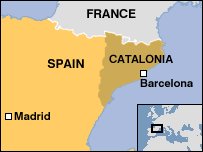
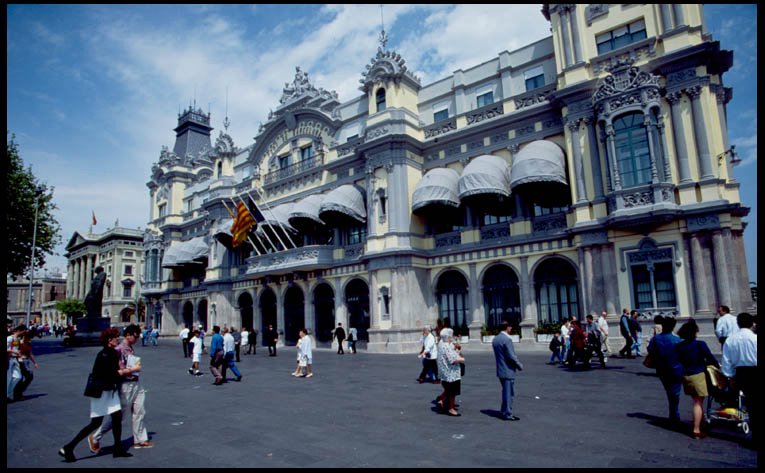
Things are different in the province of Catalonia, with its cosmopolitan capital of Barcelona and its sunny Costa Brava. There, a desire for more autonomy has succeeded. The Spanish parliament has just approved a proposal, 197 to 146, to let the affluent region in northeast Spain call itself a nation -- but still remain a part of Spain, control its taxation policies, and change laws passed by the national parliament.

That may mean a lot of changes for tourists drawn to the city and its cathedrals, Olympic venues, parks and fabled nightlife.

ON THE WEB
  • Tourism Catalonia
  • All About Catalonia
  • Barcelona Travel Guide
  • Catalonia Today (English language newspaper)
  • Costa Brava
  • Costa Brava Webcam


  • Barcelona Waterfront Museum


    Learn a New Language: Rosetta Stone

    Blog Archive