20080628

Photo grab bag: Waterford, NY

William M. Dowd photos

The pleasure boat "Bandwagon" emerges from under the Union Bridge on New York's Hudson River. In the background is Waterford, the oldest incorporated village in the United States.

It sits in the southeastern corner of historic Saratoga County, across the river from the city of Troy, and is located in the Town of Waterford at the junction of the Hudson and Mohawk rivers, and the junction of the Erie and Champlain canals. It is the home of the “Waterford Flight,” the highest set of lift locks in the world.

Broad Street, which runs through the center of the village, has a variety of antique shops and dining spots.

One of the monuments in Soldiers & Sailors Park

In honor of an iconic swimmer

ON THE WEB
The Village of Waterford
Waterford Tugboat Roundup
Champlain Canal Tours
Erie Canal
Dowd's Guides

Peru's Incan ruins under seige

Andean Travel Web photo

The ruined Incan fortress of Sacsayhuaman

If you've always had a craving to visit the ancient Incan wonders of Peru, better hurry. And, if you go, please watch your step -- in every sense of the word.

While the financially depressed South American nation has only recently begun being noticed for its upscale spa and resort facilities (see stories here and here), the effects of years of unthinking tourism have begun to be spotted as well.

The ruins of the famous Incan fortress of Sacsayhuaman, for example, have been defaced with a large accumulation of modern graffiti, much of it with indelible-ink pens.

"Its sad that these things happen," Park Director Washington Camacho told the newspaper El Comercio. "Our security covers 80% of the park and we're getting better at it, but there is also a lack of respect" from visitors.

The ruins are located on a hilltop above Cuzco, the ancient Incan capital. Archaologists say the fortress was built in the 1100s by the Killke culture and later enlarged during the Inca empire, which flourished from the 1400s until the arrival of Spanish conquistadors in the 1500s.

Cuzco is the center of Peruvian tourism today, a starting point for tours and individual visitors to begin their treks through the Andes mountains to the famous Machu Picchu jungle ruins.

David Sheppard, of the International Union for Conservation of Nature (IUCN), told the Reuters news agency, "Machu Picchu faces a lot of ... challenges relating to tourism, uncontrolled growth of urban settlements, landslides, fires, etc."

He said the IUCN wants Machu Picchu, built in the 15th Century, to be added to a list of about 30 endangered sites worldwide among a total of 851 properties overseen by the United Natrions Educational, Scientific and Cultural Organization (UNESCO). A danger listing can help mobilize donors but can be seen as criticism of current protection policies, Reuters noted.

"We haven't heard from Peru," he said. "We're not trying to blow a whistle. We're trying to identify the practical responses."

He cited an alleged lack of sufficient control over the number of visitor as well as building expansion of the town of Aguas Calientes in the valley below the Inca site among major threats.

"There needs to be a much tighter tourism management plan," Sheppard said. "Some of the urban planning needs to be much more tightly controlled."

Scattered citizen protests have popped up around Peru, opposing two new tourism laws that would ease restrictions on construction -- mostly hotels -- near archeological sites and historic zones.

The Congress responded in February by modifying the laws to allow regional and local governments more power in determining private development around cultural treasures, including Machu Picchu.
ON THE WEB
• Sacsayhuaman
Machu Picchu
Andean Travel Web
Dowd's Guides

Ecuador drops visa requirement

Ecuador has discontinued the need for foreign vsiitors to have a travel visa to enter its mainland and the Galapagos Islands.

President Rafael Correa ordered the change in an effort to promote tourism in the South American nation. Until now, citizens of 130 different nations, including the U.S., were required to have visas in addition to passports.

A statement from the Ecuadorian Foreign Ministry said the order will allow foreigners to stay in the country up to 90 days.

The change makes travel to the nation of 13.1 million people even simpler for American citizens since Ecuador several years ago began using the U.S. dollar as its official currency.
ON THE WEB
Ecuador.com -- The Official Gateway
Galapagos islands
• Dowd's Guides

Air travel baggage, surcharge woes grow

If you purchased a ticket on Delta Air Lines prior to April 9 but didn't fly until May 4 or after, you may be in line for a refund.

Delta is offering rebates on its $25 second-checked-bag fee to customers in such circumstances.

Said spokesman Kent Landers, the carrier "heard from enough customers that we decided this was the right thing to do. Since it was a new fee, we want to give people the benefit of the doubt."

Most airlines instituting the same policy gave a specific date in advance for when the fee would be applied. Delta, however, implemented it on April 9, the day it was announced.

However, that's merely a one-time quick fix for one group. Other Delta news is not very positive for consumers. The airline is adding a "fuel surcharge" for frequent-flier tickets -- $25 to redeem award tickets for U.S. and Canada travel, and $50 for international flights. That goes into effect Aug. 15.

Meanwhile, US Airways is ending curbside service at 34 airports and imposing a $15 fee for the first checked bag. And it, too, will add a processing fee in August on frequent-flier tickets -- $25 in the U.S. and Canada, $35 in Mexico and the Caribbean, and $50 for Hawaii and international destinations.

American Airlines already charges a $5 processing fee for award tickets handled in person, $20 if handled by phone. It earlier had imposed a $15 charge for the first checked bag.
ON THE WEB
Delta Air Lines
US Airways
American Airlines
Dowd's Guides

Algeria to police tourist beaches

Ever mindful of the impact of tourism on any nation's economy, the government of Algeria has announced plans to establish a 1,000-man police unit to protect tourist beaches and road safety.

Algerian Public Security Chief Commander Muhammad Hamiti was quoted in local media as saying the plan is to secure important security hubs and tourist destinations.

There have been no incidents on the North Africa nation's beaches, but there are fears about the threat posed by armed Islamist groups which oppose women wearing bathing suits in public.

Neighboring Morocco and Tunisia, which like Algeria have extensive Mediterranean coastlines, historically had the lion's share of Western tourism. However, a sharp decline in Islamist-group violence in recent years in Algeria has allowed the country to begin concentrating on the tourism industry.
ON THE WEB
CIA World Factbook: Algeria
• Arab Net: Algeria
Dowd's Guides

20080623

Lake Placid/Olympic Region has its own style

William M. Dowd photos

A white sand beach glistens on the shore of Mirror Lake.


Lake Placid village is on Mirror Lake.

Saranac Lake village is on Lake Flower.

Tupper Lake village is on Raquette Pond.

If all that doesn't evoke the image of a region of New York State that does things its own way, you haven't been paying attention.

Welcome to the Lake Placid area, or the Olympic Region, or the heart of the Adirondack Park. Whatever you choose to call it, it is an area with its own special character and attractions.

Just an easy 2½ hours north of Albany, the state capital, it's a straight shot up I-87, the Adirondack Northway, then hang a left for less than 30 miles to end up in downtown Lake Placid.

The area is one of only three in the entire world that has hosted the Winter Olympic games more than once. (St. Moritz and Innsbruck are the others.)

It will forever be known as home to the 1932 and 1980 Games, the latter probably the final time a community so small ever will host the gigantic undertaking that has financially ruined many a more prosperous place.

But the transient population actually is highest in the summer months when, for example, the numbers in the immediate Lake Placid area go from 3,000 hearty year-rounders who brave the lack of jobs and the excess of cold weather to 10,000 or more looking for a relaxed pace.

Everything from leisurely strolls through idyllic downtowns to more vigorous hikes, climbs and cycling activities attract the crowds to the heart of the 6-million-acre Adirondack State Park, which contains one-fifth of all the land in the state and is the largest park in the country.

Olympic ski jump towers loom above the woods.


Some of the attraction stems from leftover Olympic venues -- you can take a professionally handled sled down a bobsled run during the summer; skate at both indoor and outdoor spots in warm weather where shivering Olympians once competed; go up to the soaring ski-jump towers via chairlift or elevator to get a bird's-eye view of the area; ski the imposing slopes of Whiteface Mountain.

All depending on the season, of course.

But, long before there was the Olympics here, there were the High Peaks, 46 of the Adirondack mountains that present a special and varied challenge to climbers. They range from the formal, groomed snowshoe and cross-country ski trails in the Mount Van Hoevenberg Cross-Country Center in Route 73, to the less-formal but well-marked hiking trails, and informal spots that vigorous individualists like to use for rock-climbing, boating and camping.

A typically busy day in downtown Lake Placid.


Lake Placid is the only village of any real size. It likes to brag that visitors don't need to make the hour's drive to Plattsburgh to get their mall shopping fix, but they do.

While the village has a few name-brand stores (Starbucks, Izod, Ben & Jerry) it has mostly locally owned craft shops, antique dealers, bookstores (two are next to each other, just five doors down from the public library), real estate agencies, restaurants and lodgings.

However, it has come a long way since it was called the Plains of Abraham, moving into the big time in 1811 when the Elba Iron & Steel Manufacturing Co. was founded and swelled the population to 300. After that it was a mere 89 years until it became an incorporated village, and just another 32 to become an Olympic town.

THINGS TO DO

• Main golf courses
: Crowne Plaza Resort & Golf Club, Lake Placid, (877) 570-5891; Whiteface Club & Resort, Lake Placid, (518) 523-2551; Saranac Inn Golf & Country Club, Saranac Lake, (518) 891-1402. Go here for others.

Olympic Regional Development Authority, Lake Placid: Seasonal activity listings for summer (mountain biking, bobsled rides, gondola, skating, figure skating, hiking, etc.) and winter (cross-country skiing, skating, biathlete lessons, skiing, luge, etc.)

• Performing Arts (plays, dance, concerts): Pendragon Theatre, 15 Brandy Brook Avenue, Saranac Lake, (518) 891-1854; Lake Placid Center for the Arts, 17 Algonquin Drive, Lake Placid, (518) 523-2512.

Adirondack Museum, Routes 28 & 30, Blue Mountain Lake, (518) 352-7311: Open daily from May 23-Oct. 19, closed Sept. 5 and 19. Family-oriented facility that mixes exhibits with special events (barn raising, whimsy and play, harvest festival, rustic fair).

• Lake Placid Horse Shows, Route 73, North Elba, (518) 523-9625: The two-week equestrian competition is scheduled for June 24-July 6 this year on the sprawling grounds just outside the village. Also scheduled: jumping events, shows and children's events.

• The Wild Center: Natural History Museum of the Adirondacks, Tupper Lake, (518) 359-7800: A 31-acre complex offers live exhibits, hiking and exploring venues. With naturalist guides or self-guided treks. Family oriented.

PLACES TO EAT

• Charlie's
, 2543 Main St, Lake Placid, (523-9886): Open for breakfast, lunch and dinner indoors or on the lakeview deck. Particularly good fusion cuisine on the dinner menu, and a nice Adirondack-style cocktail lounge called T-Bar.

• Blue Moon Cafe, 55 Main St., Saranac Lake (891-1310): Comfy local spot for a snack, breakfast or lunch. Very reasonable prices.

• Milano North, 2490 Main St., Lake Placid, 523-3003: A 110-seat bistro patterned on the original Milano in Newton Plaza in the Albany suburb of Latham, this one is located above a Starbucks and an antiques shop. Good grilled Italian specialties, plus children's menu, and outdoor patio dining.

• Lake Placid Pub & Brewery, 813 Mirror Lake Drive, Lake Placid, 523-3818: The brewpub is upstairs and has a deck overlooking the lake. Downstairs is P.J. O'Neill's, an Irish-style pub. The pub, which gets its beers from the company brewing facility near Plattsburgh, is popular for locals and visitors alike and serves a wide range of craft beers.

PLACES TO STAY

• Golden Arrow Lakeside Resort
, 2559 Main St., Lake Placid, 523-3353: If you're environmentally aware, you'll be right at home at this iconic hotel that recently unveiled many changes that make it a true sustainable "green" experience: allergen-free rooms, recycled building materials, It's among a small handful of facilities in North America that hold the Audubon Societies' 4-Green-Leaf Eco Rating. From its comfy rooms to its white-sand lakeside beach and a 3,000-square-foot green roof that insulates the facility and acts as a storm water management system that catches pollutants as they drain off the roof, this is a clever hotel.

• Mirror Lake Inn Resort & Spa, 77 Mirror Lake Drive, Lake Placid, 523-2544: When you stroll on the long brick village sidewalk, you may be excused if you think you'll never get to the end of this sprawling inn. It includes a few lakeside buildings but 95 percent of it sits on a rise that allows an unimpeded water view. It has won about every luxury hotel honor available and advance bookings are strongly suggested.

Note: For listings of more than 300 regional lodging possibilities, go here.

A dilapidated barn adds to this rustic Olympic region scene.

Visitors spend a tranquil moment in a Lake Placid village pocket park.

ON THE WEB
• Land of Plenty
Raising the bar in Lake Placid
Dowd's Guides

Arts under pressure on Cape Cod

William M. Dowd photos

ORLEANS, MA -- The arts scene is as much part of the soul of Cape Cod as are its fishing fleets and sprawling beaches.

However, a bit of soul-searching unveils an insidious problem: The nationwide economic downturn coupled with the rising cost of living often inherent in a tourist haven is hurting established artists and scaring off the next generation of them.

From Sandwich, the first town a landlubber hits after leaving the mainland, to sandwiches at the iconic Portugese Bakery 75 miles away in Provincetown, there is no lack of creativity anywhere along this storied jut of land that extends from the lowlands of eastern Massachusetts into the stormy Atlantic.

P-town, as it is locally called, got its first formal hold on the arts world more than a century ago when painter Charles W. Hawthorne (1872-1930) established the first summer arts colony in the United States. That helped make the small fishing village a worldwide arts icon by the 1930s, with such painters as Edward Hopper, Willem de Kooning, Jackson Pollock and Robert Motherwell summering there.

Eugene O'Neill was involved with the Provincetown Players beginning in 1916 and wrote many of his earliest plays there. Best-selling novelist Mary Higgins Clark today maintains a home on the Cape. The likes of Bette Davis (Cape Playhouse in Dennis) and James Stewart (Falmouth Playhouse) got some of their early acting training locally.

But economics are chipping away at this heritage. Beginning artists are shying away from the pricey Cape to ply their work elswehere, perhaps in hopes of making an affordable somewhere else "the next Cape.''

"You can still make some money in the arts,'' said Joe Realbuto, a professional photographer who moved here from the Albany, NY, area a decade ago, "but the cost of living has gotten so high it really makes it a slim margin. It's scaring off a lot of younger artists who might otherwise have come here, especially if they don't have other means of income.''

Kely Knowles, a 20-year Cape resident who is well known as both a watercolorist and teacher, agrees.

"At arts meetings I attend I rarely see anyone who isn't in my age group, 50 and up,'' she said. "Maybe a couple of 40s, a rare one in their 30s.''

Realbuto, a board member and past vice president of the Artisans' Guild of Cape Cod, said the organization is considering changing its membership requirements to accept non-Cape residents to keep the organization viable.

Visitors may not immediately see a falloff in arts offerings. As a community, Cape Cod today has a huge investment in the arts with more than 300 galleries -- including the Cape Cod Museum of Art (top photo) in Dennis -- devoted to paintings, sculptures, glasswork, wood- and metal-craft, handicrafts, pottery and photography studios, art museums and community arts organizations whose periodic shows pepper the local social schedule.

Venues for theater, writing workshops, dance and the whole range of music from classical orchestral works to Irish pubs also abound, especially during the main tourist season from Memorial Day to the Labor Day weekend. Hands-on classes in many fields are available to residents and visitors alike. As just one example, the Truro Center for the Arts near Wellfleet offers arts and crafts lessons for adults and children. Other facilities cater to summer visitors anxious to dabble in the creative world.


The laid-back atmosphere of much of the Cape, the range of natural light affected by the flat horizons and light from both the Atlantic and Cape Cod Bay, and the rough beauty of the salt marshes, dunes, beaches and rocky shores remain a powerful lure for artists of all stripes to spend time here. In some cases, that time stretches to permanent residency.

Realbuto is a prime example. A decade ago, he and his family, longtime Cape visitors, moved to Pocasset on the Outer Cape as fulltime residents. While he still makes his living as an executive in the field of health care for the disabled, the move enabled him to embrace his passion.

"I'd been a photographer most of my life, and I always knew I would come to the Cape to be an artist,'' Realbuto said. "You can't find the beaches and this light anywhere else.

"Sometimes when I get that light, that incredible light, I just jump up and down,'' he said with a chuckle.

Realbuto has gotten heavily involved in the arts scene as a businessman with interests in several galleries and as a volunteer with the Artisans' Guild. The group acts to promote professional standards and growth, schedules professional arts events and awards scholarships. In fact, when the Guild needed a new logo, brochure and various other materials put together earlier this year, 30 graphic art students from Cape Cod Regional Technical High School submitted their ideas. Senior Ben Hughes, 18, of Dennisport won the contract.

That's just one example of real-world commercial success for the students, the next generation of local artists. Support from the Guild, the school and individual artists has helped nurture the small surge.

Adding up his fulltime work, his volunteer efforts and the time spent involved in digital photography and shows seems to come to more hours than there are in a day.

"I spend anywhere from 10 to 20 hours a week just shooting before the season because I like to add five to seven new images to my offerings every year.'' Realbuto said.

"Most people who are at the level I am in pursuing their art are semi-retired, so they have the time to do it. But, if you have the passion you can make the time.''

Knowles is another such passionate artist. She has owned the Rock Harbor Gallery in Orleans since 1995. She credits her husband, David Knowles, with helping make her endeavors work. Besides being an artist himself, he's a flooring contractor and a skilled builder who constructed her gallery.

"I'd love to be involved with other galleries as well,'' she said, "but there's not enough time to do that and run this place and find time to paint. Plus, I'm still teaching and teaching keeps me above water.

"To make things work financially, you have to do a lot of marketing, too. I know a lot of the younger artists don't know how to do that very well, and that hurts their chances to succeed.''

Nevertheless, there remain many persistent artists of all sorts on the Cape, perhaps laboring under the same mantra expressed by the late French writer/philosopher and Nobel Prize winner Albert Camus (1913-1960) who said, "It's not the struggle that makes us artists, but Art that makes us struggle.''


ON THE WEB
Cape Cod Museum of Art
Cultural Center of Cape Cod
Cape Cod Writers Center
Arts Foundation of Cape Cod
Cape Cod Dining Guide
A Chowder of Attractions
Dowd's Guides

20080610

Scottish whisky museum in trouble

From the Northern Scot newspaper:

DUFFTOWN, Scotland -- A showcase for Speyside’s proud whisky heritage could be under threat unless new museum premises can be found.

The Dufftown Whisky Museum is living on borrowed time and this summer is set to be the last in its present town centre location. The lease is up early next year and local promotion group Dufftown 2000, which currently pays a peppercorn rent for the former undertaker’s premises, has been told it will not be renewed.

The bombshell could not have come at a worse time with museum visitor numbers booming and two major events due in 2009.

The "Spirit of Speyside Whisky Festival," which is one of the museum’s main crowd pullers, will be doubled in size next year to 10 days and 2009 is the "Year of Homecoming" when visitors from all over the world will descend on" the country.

Go here for the rest of the story.
ON THE WEB
Spirit of Speyside Festival
Dufftown: Malt Whisky Capital of Scotland
Dowd's Guides

20080609

V.I. protest causes airline to retreat

American Airlines has announced it will not apply its new checked baggage fees to boxes of liquor purchased in the U.S. Virgin Islands.

The U.S.V.I. consist of St. Thomas, St. Croix and St. John.

Boxes of liquor bottles are a common take-home item for tourists taking advantage of the fact the Virgin Islands sells liquor at duty-free prices that are usually much less than in the mainland U.S. Because federal regulations prohibit carrying liquids into the cabins of passenger aircraft, boxes for the alcohol bottles must be checked.

Last month, when American announced it planned to charge all passengers for each checked bag, rathering than allowing one free bag as has always been commonplace in the industry, Virgin Islands officials "bristled at the potential impact it could have on duty-free liquor sales," reported the Virgin islands Daily News.

Go here for the remainder of the story.
ON THE WEB
U.S.V.I. Department of Tourism
• Virgin Island Travel Guide
Dowd's Guides

Slow Food Nation event fast approaching

Slow Food Nation, the largest celebration of American food in history, will take place in San Francisco over Labor Day weekend, Aug. 29-Sept. 1.

The event will bring together tens of thousands of visitors to experience a range of activities "highlighting the connection between plate and planet," as the public relations people like to put it.

The majority of the events will be free and open to the public. However, some events require tickets, which are available in advance online. Prices vary per event.

The event is more than just a stream of food vendors. As the press release notes, "Slow Food Nation will bring together local citizens and visitors, farmers and food artisans, political leaders, environmental advocates and health care experts, community educators and artists.

"Participants will savor food from across the U.S. at Taste, a 50,000 square foot pavilion; meet farmers and producers at a marketplace surrounding a 10,000 square foot newly-planted urban garden in the heart of the city; learn from visionary speakers; and engage in political discourse to shape a more sustainable food system. Slow Food Nation will also feature a music festival, workshops, films, dinners, hikes and journeys."

Anya Fernald, SFN executive director, isn't shy about sharing the organization's lofty goals:

"Slow Food Nation will catalyze a huge shift in how Americans perceive and prioritize food. Through the four-day event, we hope to build momentum and demand for an American food system that is safer, healthier and more socially just.

“Our founder, Alice Waters, has set the stage for a delicious revolution through decades of leadership and advocacy and our parent organization, Slow Food U.S.A., has built a wide membership base across America. By creating a framework for a deeper environmental and community-based connection to our food and farmers, Slow Food Nation will help participants learn how everyday choices affect our well-being, our culture and the health of the planet.”
ON THE WEB
Slow Food Nation official site
• Dowd's Guides

Raising the bar in Lake Placid

April Dowd photo

Cocktails guru Tony Abou-Ganim (left) and drinks writer Bill Dowd work out behind the bar during a Lake Placid workshop this week.

LAKE PLACID, NY -- Tony Abou-Ganim, the celebrity mixologist who helped the cocktail culture return nationwide with a rush over the past decade or so, was in fine form during an hour-long cocktail-making workshop at T-Bar on Thursday night.

T-Bar, a ritzy Adirondack-style cocktail lounge within chef Charlie Levitz's eponymous Charlie's restaurant on Main Street, was briefly turned into the kind of classroom no one wants to avoid.

Abou-Ganim splits much of his time between Las Vegas and New York -- he's a partner in the recently-opened Manhattan spot Bar Milano -- but pops up all over the country for trade shows, training events and special occasions. He'd just appeared at the annual Santé magazine industry trade show in Manchester, VT, and was returning to a place where he'd personally trained Levin's bartending staff a year ago in the fine points of cocktail making.

This workshop preceded a cocktail-pairing dinner prepared by Charlie's head chef Lendell Eaddy and Levitz, who oversees the Charlie's kitchen but spends much of his time at his other Lake Placid restaurant, Chair 6, and with his extensive catering operations.

During the show-and-tell, Abou-Ganim invited several onlookers to step behind the bar to help him make some basic drinks -- Cosmopolitans, Marqueritas, Martinis. He also challenged yours truly to a "Manhattan throwdown" since both of us are fans of the historic drink. I, in fact, consider it a food group.

He laid down the ground rules: The same recipe had to be followed — bourbon (we both liked the sweetness of Maker’s Mark), Martini & Rossi sweet vermouth, Angostura Bitters and a maraschino cherry. The catch was that Abou-Ganim preferred to shake his concoction over fresh ice — which I normally do for a straight-up cocktail — while insisting I stir mine with ice to properly chill each drink.

He shook.

I stirred.

We poured.

The audience voted on the cocktail with the most alluring appearance.

Modesty prohibits revealing the voters results. Let's just say I won't ask for a recount.
ON THE WEB
Lake Placid and the Adirondacks
The Olympic Region
Dowd's Guides

20080531

A world view? Don't bank on it


See those two banknotes? The top one is a 10-pound British note, the bottom one a 10-pound Scottish note. They have been legitimate currency around the world since long before the United States was even an idea.

As of the close of business Friday, each of them was worth $19.7920 in U.S. currency. It took me less than 30 seconds to ascertain that rate of exchange. It took me only a little more than that to thoroughly confuse three naive employees of the Pioneer Savings Bank's Brunswick, NY, branch office where I do a lot of business.

Perhaps I should say "did" a lot of business. After the rank ineptitude and dismissive attitude I witnessed, I'm seriously considering taking my business elsewhere.

The situation was simply this. I had five 10-pound notes left over from a recent trip to Scotland. That means I had roughly $100 worth of U.S. money tied up in banknotes I couldn't spend locally. So, I went to a bank to exchange the notes for good ol' Yankee greenbacks.

The first teller literally pulled back her hand when I presented the UK notes, as if I had tossed her a red-hot charcoal briquette.

"I don't know what to do with these," she stammered.

"Simple," I said. "Just look up the current rate of exchange and I'll see if I want to trade the notes today or wait till the rate is a little more in my favor."

Not a bad plan, I thought, since the exchange rate was 2.06 U.S. dollars for each British/Scottish pound last week when I got the notes in the Royal Bank of Scotland in Edinburgh -- without the slightest problem, I should add.

"I don't know how," she said, gesturing in a panicky fashion to a young man I took to be an assistant manager of some sort, although throughout my visit he never introduced himself or his title.

"Oh, we can't access that kind of information on these screens," he said, gesturing to the teller's screen and starting to walk away.

"May I suggest you try a computer with Internet access?" I said. "I know you have them here. It only takes a few seconds to get the current exchange rate."

He hemmed and hawed, then pointed in the direction of someone at another window. "She'll have to do this when she's finished with what she's doing," he said rather brusquely, then made a success of retreating to a small office across the lobby. "I have another customer I'm taking care of."

"She" was finished in about three minutes with whatever business she was transacting, then turned to me and asked how she could help.

"I merely want to exchange these five banknotes for U.S. currency. One is a 10-pound British note, and the other four are each 10-pound Scottish notes. But they're all worth the same amount," I explained, wondering why in the world I had to explain something so basic to supposed banking professionals.

She picked up the notes I'd spread on her little teller window ledge and walked to the office where the presumed manager of the moment had scurried. She waited at the doorway for about five minutes till he had completed his business with the other customer. I stood right behind her.

She walked in, put the notes on his desk and said to him, "I don't know what to do with these things. Are they checks, or what?"

"I don't know," he said. "We can't do anything with these anyway."

That was it for me. I walked in the office and, mustering up all the remaining patience I possessed, said, "They're called money. They're not checks, for heaven's sake. Just look at them. All I want is to exchange them back into U.S. currency. And all you have to do is look on the Internet at the currency exchange rate to know how much to give me."

"We can't do that," he said, beginning to sound more miffed than befuddled.

"Why not?" I replied. "This is a bank. You're supposed to, among other things, change money. Any bank in Europe does it for any currency. It's elementary banking."

"Oh, sure," he said with an "Aha!" look. "In Europe. But we're not allowed to do that here. What would we do with the foreign money you gave us?"

"You'd send it to your main office, and they'd exchange it at a favorable rate with a central bank," I said. "You mean to tell me you've never been taught how to make such a basic transaction?"

"Well, we just can't do that," he said, metaphorically -- and perhaps actually, although I couldn't see under his desk -- digging in his heels. "You'll have to go to some other bank."

So, I went home, seething and marveling at just one more example of U.S. insulation from the rest of the real world and wondering if that ever will change.

It's no wonder so many people in other countries think we're such rubes. Many of us are. And Pioneer Savings Bank has a whole cluster of them.
ON THE WEB
Universal Currency Converter
• Dowd's Guides

20080528

Straight up, Pisa's tower stabilized

After a decade of effort, eight centuries of leaning may have been stabilized for the famous Leaning Tower of Pisa.

A team of engineers and workers have been trying to stop the gradually increasing incline since the late 1990s, spending an estimated $40 million in the process.

The lead engineer this week claimed this is the first time in the tower's history that it has stopped moving. It took the excavation of 70 tons of soil from the northern side to get the tower to begin righting itself. In the past seven years, it became 19 inches straighter.

The tower, on which work began in A.D. 1173, was built as the bell tower of a cathedral. The construction continued, with two lengthy interruptions, for about 200 years. It started to lean during its construction despite various attempts to keep it perpendicular to the ground.
ON THE WEB
The Official Tower Website
Italy Guides: City of Pisa
Restaurants, Cafes in Pisa
Dowd's Guides

Name that city

This architect's rendering of a skyscraper to be built in a major city is set for:

(a) New York
(b) Dubai
(c) Rio de Janiero
(d) London
(e) Singapore
(f) None of the above

It's Warsaw, so the answer is (f).

The drawing was unveiled this week by architect Zaha Hadid for the Lilium Tower, a planned 790-foot residential skyscraper.

It will face the Stalinist-era Palace of Culture right in the heart of downtown Warsaw. It will join the likes of other modern skyscrapers already in place or in progress -- such as The Metropolitan office tower designed by Norman Foster and completed in 2003, and a large residential tower designed by Daniel Libeskind that is now being built.
ON THE WEB
Official Website of the City of Warsaw
Dining Out in Warsaw
Welcome to Warsaw
Great Buildings Collection
Dowd's Guides

'Must-see' spots for kids

Looking for the best spots to take kids on vacation? The editors at Hotel Insider have come up with a list of their top 10 suggestions.

Say the editors, "For children, vacations are a source of learning and growing while exploring the world around. These small excursions provide a lot of fun and relaxation to the child and also rejuvenate them to start afresh when the vacations are over. There are lots of places where the sights are breathtaking at any age and there is something extra special about seeing them as a child."

The top spot on the list is the Ellis Island Museum (above) in New York Harbor.

Go here to read the rest of the list.
ON THE WEB
• Travel With Kids (International)
• Travel with Kids (Domestic)
• Dowd's Guides
2 more reasons to visit Antigua

If your vacation plans call for a stop in the Caribbean islands-nation of Antigua & Barbuda, you may want to pick up a true rum rarity while you're there.

Antigua Distillery plans to send a pair of new bottlings of its English Harbour rum to market. The company has announced the release of a 10-year, slightly spicy reserve at $199, and a dark, smoky 25-year-old at $399, aged in ex-whiskey and ex-bourbon casks. There are only 90 bottles of the older rum available.

The premium product is named after the Antiguan naval port that now is home to numerous yachts and crusie liners as well as tourists looking for a little water action. If you're curious what the real English Harbour looks like, here's a great view of the spot that was the main anchorage for British Admiral Nelson's Caribbean fleet in the 18th Century:

April L. Dowd photo


ON THE WEB
A lemon frock and a cold Wadadli (Antigua first-hand)
Time and lava wait for no man
Dowd's Guides
20080523

Headed south to Mexico -- and Canada

William M. Dowd photos & video

Workers from the El Tesoro tequila plant relax before a weekend fiesta begins in Arandas.


So there I was, wondering how the hell I had gotten stuck, tired and thirsty, at 11 o'clock on a damp Saturday night in a stuffy bus jammed into a narrow four-way intersection in Arandas, a small Mexican city in the highlands of Jalisco state.

Oncoming traffic was beginning to stack up. Temperatures rose and tempers flared as the dazed driver tried to extricate the bus from a self-induced wedgie, stuck nose-first into a narrow, vehicle-blocked street and unable to back up because the other roads to the intersection all were dead ends or one-ways pointing in the wrong direction for him.

The abuelas from the street-level apartment the bus had nearly rammed were sticking their heads out the door, little gray-haired women who probably hadn't had such a lively Saturday night in a very long time. A young couple who had been coiled around each other in the shadows right down the street became so intrigued by our predicament they left off their mutual clutchfest to stroll up the street and join with everyone else in shouting good-natured suggestions at the driver.

Finally, it all came down to one way to widen the street. "Let's pick up that Chevy Blazer and put it on the sidewalk," someone said, half in jest but with enough enthusiasm to have the idea immediately accepted by the bus passengers and gawkers.

Quickly, a group of a half-dozen young men grasped the bumper of the vehicle and, with mighty grunts and tugs, got the wheels far enough off the pavement to move it to the sidewalk. A cheer went up from all involved, the bus driver came back to life, everyone got back on the bus, and away we went, barely grazing the second-floor balcony that jutted out over the street and just ahead of the flashing lights of the local police.

This little episode was in marked contrast to a mere two weeks earlier when I was a passenger of a different sort, on a multi-deck yacht crusing between Detroit, MI, and Windsor, Ontario, on the Detroit River just outside where its eastern end joins Lake St. Clair.

Approaching the causeway linking Detroit and Belle Isle. (See video version below.)

There, the yacht skipper knew every inch of his byway, staying toward the American side of the sparkling river as a flotilla of sailboats headed for the lake on the first leg of a weekly competition, then hugging the Canadian side as the racers came back, tacking around a lighthouse point and back into the river on their way to a trophy and hogging the public's attention which several days later would be switched to a NASCAR circuit auto race on nearby Belle Isle.

A gorgeous sight near sunset, accompanied by a pleasant river breeze and an endless supply of cold drinks and canapes and repeated reminders that in this part of the universe, the U.S. is north and Canada is south.

Welcome to both ends of North America, places I keep seeing and re-experiencing along with my own U.S. of A.

While it has long been fashionable in some circles to point to Canada as superior to the U.S and Mexico in terms of medical coverage and public courtesy and Mexico as inferior to both its North American neighbors in virtually every way except the production of tequila, I find that as with so many generalities it's all a matter of informed perspective vs. idle rhetoric.

Canada's lauded national health care is undergoing a series of challenges, battling excruciatingly long waits for hospital care and a severe limit on which doctors you can visit without paying for everything yourself.

Mexico's widespread poverty is more in evidence in the mega-sprawl of Mexico City and its shantytown suburbs as well as in some border communities than in such pleasant states as Jalisco (home to the country's No. 2 city, Guadalajara, as well as Tequila and its producers of the namesake liquor) and Guanajuato (historic center of Mexican independence and a tourist oddity known as the Mummies of Guanajuato.

Courtesywise, it's a tossup between the two countries. What I've come to realize as I travel North America as well as globetrot elsewhere is that despite local customs, styles and languages, truism that it is, people are people. Take them for what you find them to be, not for what someone else thinks they are.


ON THE WEB
Mexican resort adds new spa
Jalisco becomes a world treasure
Cancun erosion on the move
Cape Breton an island to drive for
Montreal converts wheel place to real place
Dowd's Guides

A taste of the 'New Irish Cuisine'

DUBLIN, Ireland -- One day into a motor tour of Ireland in search of something to overcome the negative stereotypes about Irish food and I was stumped.

I was here in the capital city, sitting with a traveling companion in the bar of the beautifully converted Clontarf Castle, site of one of the epic battles of the ancient Irish warrior king Brian Boru. We were trying to figure out where to find the best place for local food.

The hotel bell captain seemed a logical person to consult.

"Well," he said in all seriousness, "it depends on what sort of local food you're looking for. The best in the city is Italian, Thai or Chinese."

That was several years ago, and it's even truer today unless you're so far off the beaten path you're creating a new one. The difference is that the New Irish Cuisine, as it is capitalized in most Irish publications, also has begun making inroads into popular taste.

Much as I pride myself on my nearly 100 percent Irish heritage, I cringe -- as does my aorta -- when I think of some of the dishes that once were typically representative of Irish cuisine.

Finnan Haddie, a smoked fish and mashed potato dish. Dublin Coddle, featuring flour-coated pork sausage fried in bacon fat then cooked in cider with onions and potatos. Bacon and Egg Pie, which includes a half-dozen eggs and four ounces of lard. Carrageen Pudding, which is primarily dried seaweed and whipped heavy cream. Toad in the Hole, a bacon-wrapped sausage baked in mustard dough and covered in gravy. And endless platters and bowls of potatoes baked, mashed, fried, steamed, boiled, grilled, sauteed and whatever else one could think of to do with them.

But that was then. This is now, and my how things have changed.

Irish restaurants and modern Irish families are relying on such things as chicken, salmon, monkfish, lamb and vegetarian dishes in ever-increasing amounts, although the ubiquitous and versatile potato retains its place of honor in the Irish kitchen.

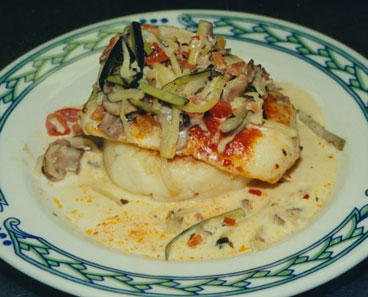
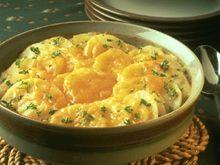
Dishes tend to be more of the "spa cuisine" variety, with less reliance on heavy creams and fats and more exploitation of the island's abundance of fresh produce. Some of the dishes still look heavy -- like the dishs shown above, cod sorrel (top) and colcannon (bottom) -- but light, alternative ingredients lessen the impact.

Ireland once had plenty of people and no money. Now, thanks to its leadership among European nations in the technological revolution, it has plenty of money and no people. To attract new ones and hold on to the ones it has, developing a modern, appealing cuisine has become an important task.

The island's two national food trade groups, Bord Bia (Irish Food Board) and Trade International Northern Ireland, are helping market Irish products worldwide and soliciting foreign investment in the industry under the promotional title "Ireland: The Food Island."

Tourists are being directed to culinary destination spots throughout the country, especially to the southern port city of Kinsale, a picturesque spot that has emerged as the country's gastronomic capital.

As Muirish Kennedy, Bord Bia's client services director, told Irish Connections magazine, "Ireland has changed drastically. ... The young sector is very much the driving force. The food companies here were started in the last 15 years. It's a young new generation that is much more aggressive, much more aware."

There is rarely a question about the quality of Irish agricultural and livestock products. Willing consumers abroad buy 90 percent of Ireland's annual output. The knock has been on what Irish cooks have done with those products at home.

Until the recent economic upsurge, dining out regularly was a rarity in most parts of Ireland, with fewer than 25 percent of people doing it compared to about 70 percent in the U.S. That mindset, which tends to discourage culinary experimenta tion, was perpetuated in the lives of Irish expatriates around the world. Thus, to many people the likes of Toad in the Hole still exemplifies Irish cuisine.

Couple the experiences younger, adventuresome Irish have had in traveling abroad with their higher wages and more disposable income and the demand for better food becomes even clearer.

The appetite for things Irish can be seen in a number of areas beyond industry trade shows. At the bookstores, for example, you can find titles that put to rest the foods of the famine and poverty years. Instead, we find "Elegant Irish Cooking: Recipes from the World's Foremost Irish Chefs," compiled by the noted Irish master chef Noel C. Cullen, now professor of culinary arts at Boston University. And, "The New Irish Table," a collection of recipes from restaurant and home cooks edited by Margaret M. Johnson who has written on Irish food for such newspapers as the Los Angeles Times and the Irish Echo.

In U.S. tourism, modern Irish food is on display beyond the stereotypical Irish folk festivals. A perfect example is the recent Kinsale, Ireland Festival of Fine Food in Newport, R.I. For some years now it has drawn large crowds anxious to sample the wares of local and visiting Irish chefs.

And, while they don't have the reputations of such world-renowned culinary schools as the Cordon Bleu in France or the Culinary Institute of America, Irish cooking schools are enjoying a growing reputation.

Noted chef Darina Allen's Ballymaloe Cooking School, operated at her Ballymaloe House Hotel in County Cork, is perhaps the brightest example. It has been the catalyst for several well-received cookbooks and the work of hundreds of graduates who took advantage of the organic farm and extensive gardens on the property.

The world of New Irish Cuisine is not limited to the Republic of Ireland. In Northern Ireland, where tourism is comparatively strong despite the continued violence in an around Belfast, 70 miles from there in County Fermanagh the Belle Isle School of Cookery is a big draw for residential or one-day classes.

It's situated on a wooded island in Lough Erne, a rural lake that is home to 11 islands owned by the same nobleman, the Duke of Abercorn.

To prove some things about Irish eating and drinking habits never change, the school's brochures brag about its proximity to many attractions -- particularly the Old Bushmills Distillery, at age 400 this year the oldest licensed distillery in the world, where the renowned Bushmills whiskey is produced.
ON THE WEB
On the Road In Search of My Darby Duck
Dowd's Guides

Ian Fleming, Agent 100

May 28 marks the 100th anniversary of the birth of Ian Fleming, creator of James Bond.

What does that mean to a traveler, besides trying to emulate 007's preferences for cocktails and wines?

Glad you asked. A year-long program of events is under way to celebrate his life and the impact his superspy creation has had on popular culture around the world.

Fleming, a onetime journalist, introduced the public to James Bond in the early 1950s, inspired by his experiences and those of his colleagues at the British Admiralty during World War II when he was personal assistant to the director of Naval Intelligence, making him privy to many spycraft secrets.

More than 100 million copies of the 14 Bond titles, ranging from the first ("Casino Royale" in 1953) to the last ("The Living Daylights" in 1966).

A few examples of Fleming/Bond-related activities:

• Cunard Line's Queen Mary 2 will help celebrate the Fleming centenary with several Ian Fleming onboard offerings on the Oct. 10-17 crossing. Departing from Southampton, England, the special voyage will include 007-themed activities, an exhibit and a panel of guest authors, speakers, and experts.

• On Oct. 18, "Bond Bound: Ian Fleming and the Art of Cover Design" will open at Bonhams in New York. The exhibition will chart the role of artists and designers in creating and defining the Bond look over the past 50 years. It also will cover all Ian
Fleming's other books, including "Chitty Chitty Bang Bang" and "Thrilling Cities," and his collected travel journalism.
ON THE WEB
Ian Fleming Centenary
Imperial War Museum Exhibition
Dowd's Guides

Hotel chain counters American Airlines bag fee

I've had more luggage sent astray and probably had more delays while flying American Airlines than with any other carrier, foreign or domestic. In fact, I've often thought that if I had kept a log of it, it would show that my luggage has racked up more air miles than I have.

As a result, I try to avoid American when at all possible. And its latest announcement, that it would charge $15 for a checked suitcase -- not an extra piece of luggage, mind you, but the first non-carry-on, solidified my antipathy to the airline.

However, thumbs-up to the Loews Hotel chain. Reacting to American's questionable new charge, the hotelier launched a "Baggage Buy Back" incentive that will reimburse guests for their $15 checked baggage fee.

This not only is smart marketing, it is particularly good news since American's new fee no doubt will be copied by at least some competitors who now charge extra only for a second checked bag. Delta, for example, charged me an extra $25 for one on an international U.K.-to-New York flight last week.

How complicated is the program? Says a Loews spokesperson:

"Arriving guests need only present any airline bag fee receipt at the front desk to receive the rebate, which will be issued in the form of a credit to their bill at checkout. The ... rebate is available at Loews' 18 properties in the U.S. and Canada, beginning June 15 through Labor Day.

"Loews Hotels will offer credit for up to two bags for a maximum of $30 per occupied room per stay."
ON THE WEB
Avoid luggage checking
What you can carry on or check
Dowd's Guides

20080520

ROFLMAO (*)

William M. Dowd video & photos


LOUISVILLE, KY -- Well, at least these kinetic air-blown sculptures (in video above) were doing that to amuse visitors to the 21c Museum Hotel in the heart of downtown.

21c (for 21st Century) combines support for present-day artists with a first-class hotel and dining establishment that is the forerunner of several more to be constructed. It also is a perfect spot for the visitor not up to a lot of walking, whether due to laziness, preference or disability. That's because there is art everywhere in the 91-room hotel.

The hotel's 9,000-square-foot contemporary art museum, funded and managed by the International Contemporary Art Foundation, and its restaurant/bar Proof On Main make it an ideal spot for a leisurely stop in an otherwise bustling neighborhood.

Steve Wilson and Laura Lee Brown, local investors and contemporary art collectors, conceived and bankrolled the property which opened in April 2006, and they're extending the idea to other locations as well, beginning with a project in Austin, TX. When it opens in 2011, it will contain a luxury hotel, high-end condominiums, a contemporary art museum, a restaurant, and artist lofts.

The original is, as I heard one person describe it, "a hoot." From the moment you enter, you're hit with in-your-face art. A sculptured family gathered around a sculpture dinner table, a film of a sleeping -- albeit restless -- couple is shown on the floor, projected from a ceiling device.

And, speaking of ceilings, if you look up you'll see what appears to be a mountain climber on the ceiling of the lobby.

Original art adorns the walls of each of the comfortable rooms, as well as the public spaces and meeting rooms throughout the complex.

(* - Internet shorthand for "rolling on the floor, laughing my ass off.)


ON THE WEB

Louisville.com
Churchill Downs
Dowd's Guides

Haggis address 101

William M. Dowd photos


Chef David Graham and his staff watch piper Duncan MacGillivray deliver the "Address to a Haggis" before dinner


FEARN, BY TAIN, ROSS-SHIRE, Scotland -- Next year will mark a special promotion called "Homecoming Scotland," with government and tourism entities offering all sorts of inducements for tourists to visit Scotland for golf, distillery tours, sightseeing and so on.

One reason for the timing is that '09 will mark the 250th anniversary of the birth of the iconic poet Robert Burns. Among the many writings by the author of the poem "Auld Land Syne" (and "Comin Thro the Rye," "My Heart's In the Highlands, "To a Mouse," etc.) is the venerable "Address to a Haggis," delivered before the formal serving of the peculiar Scottish dish that consists of a variety of oatmeals, vegetables and innards cooked into a stewlike mass inside a sheep's stomach.

I was part of a group of visiting journalists treated at The Glenmorangie House (shown below) to the dish, as well as the fun and ceremony surrounding its serving, sponsored by the Distilled Spirits Council of the U.S. and the Scottish Whisky Association.

Here's the Burns epic, in modern English. For a look at it in the original Scottish dialect, go here.

Fair is your honest happy face
Great chieftain of the pudding race
Above them all you take your place
Stomach, tripe or guts
Well are you worthy of a grace
As long as my arm

The groaning platter there you fill
Your buttocks like a distant hill
Your skewer would help to repair a mill
In time of need
While through your pores the juices emerge
Like amber beads

His knife having seen hard labour wipes
And cuts you up with great skill
Digging into your gushing insides bright
Like any ditch
And then oh what a glorious sight
Warm steaming, rich

Then spoon for spoon
They stretch and strive
Devil take the last man, on they drive
Until all their well swollen bellies
Are bent like drums
Then, the old gent most likely to rift (burp)
Be thanked, mumbles

Is there that over his French Ragout
Or olio that would sicken a pig
Or fricassee would make her vomit
With perfect disgust
Looks down with a sneering scornful opinion
On such a dinner

Poor devil, see him over his trash
As week as a withered rush (reed)
His spindle-shank a good whiplash
His clenched fist.the size of a nut.
Through a bloody flood and battle field to dash
Oh how unfit

But take note of the strong haggis fed Scot
The trembling earth resounds his tread
Clasped in his large fist a blade
He'll make it whistle
And legs and arms and heads he will cut off
Like the tops of thistles

You powers who make mankind your care
And dish them out their meals
Old Scotland wants no watery food
That splashes in dishes
But if you wish her grateful prayer
Give her a haggis!


ON THE WEB

Glenmorangie House
Burns Country
Scottish recipes
Dowd's Guides

Champlain: It really is a great lake

Pedestrian-friendly Burlington.


BURLINGTON, VT -- There was a brief moment there when a move was afoot to add Lake Champlain to the assemblage known as the Great Lakes.

Technically, Champlain came under the descriptive umbrella of "Great Lakes'' for some federal technical water management programs in 1998. However, try to convince anyone who learned the mnemonic device H•O•M•E•S for Huron, Ontario, Michigan, Erie and Superior that they have to work a "C" into it.

And never mind that the watery gem shared mostly by New York and Vermont is a mere drop in the bucket sizewise when its 435 square miles - sixth largest in the U.S. - are compared to the largest of the original Great Lakes (Superior at 31,700). Or even the smallest (Ontario at 7,340).

While it may not be a true Great lake, it is a great lake, smack in the middle of a great place for a getaway. The best approach from the New York side is from the Albany/Saratoga Springs area known as the Capital Region, an excellent daytrip that can be extended into a leisurely overnighter runs up the I-87 Northway to the lake, east across by one of three ferries to Vermont, a visit to the Burlington area, then back down toward Bennington and back home. From Boston, it's pretty much just a reverse route

That doesn't cover all of Lake Champlain. After all, it is 121 miles long and extends several miles north into Canada. It does, however, cover the most heavily populated portion and the most spectacular views of the Adirondacks on the west side and the Green Mountains on the east.

It even has its own version of the Loch Ness Monster folk fable. This one is known as "Champ," and it has its own cult following as well as some scientific interest. here is just one "fan site" devoted to the legend.

EVENTS, ATTRACTIONS, ACTIVITIES

Outdoors activities -- As might be expected, they are myriad on both sides of the lake, from hiking to boating to camping to biking to climbing and anything else one might think of. One of the most comprehensive Web sites for the New York side is from the state Department of Environmental Conservation For the Vermont side, the Lake Champlain Regional Chamber of Commerce site has a section with helpful links.

• Ferry service -- (802) 864-9804: The rides themselves are attractions. They go between Essex, NY and Charlotte, VT, (20 minute ride), the run closest to the Capital Region; Port Kent, NY, and Burlington, VT (60-minute ride), and Plattsburgh and Grand Isle, VT. (12-minute ride). The season begins about a week before Memorial Day.

• Fort Ticonderoga, Ticonderoga Village, 585-2821 -- The 1775 stone fort was built by the French, then taken over by the British. Ethan Allen and the Green Mountain Boys from Vermont captured it during the Revolution. The complex of 40 restored buildings shows rural life in the 1790-1840 era. Open from May 10 through mid-October.

Church Street Marketplace, Burlington, VT, (802) 863-1648 -- This brick-paved area made for strolling and people-watching is the activity heart of the state's largest city (but at a population of 39,000 still quite small), with the Burlington Town Center mall, home to more than 75 specialty shops and 15 national retailers. It also is the site of festivals and street entertainment year-round and such summer events as the Burlington Discover Jazz Festival (May 30-June 8), the annual Marketplace Sidewalk Sale in July and the Champlain Valley Folk Festival, Latino Festival and Burlington Craft Fair in August.

College Cluster, Burlington, VT -- Burlington is home to the University of Vermont, Champlain College, Burlington College and the Community College of Vermont, plus St. Michael's is in nearby Colchester. That means lots of small cafes, bookstores and on-campus events.

Champlain Valley Exposition, 105 Pearl St., Essex Junction, VT, (802) 878-5545 -- The state's largest fair is held over 10 days in late August, but there also are events year-round.

Middlebury, VT -- Vermont still has numerous downtown-centric communities that have avoided the widespread move to suburban malls. This is one such, with a classic New England Main Street with numerous well-maintained late-18th and early-19th-century buildings. It also has the Vermont Folklife Center (88 Main St., 802-388-4964 or http://www.vermontfolklifecenter.org) Line is overdrawn with has numerous exhibits and research programs aimed at protecting the state's cultural traditions, and the Henry Sheldon Museum of Vermont History (1 Park St., 802-388-2117), the oldest chartered community history museum in the nation.

WHERE TO EAT

• Upper Deck Restaurant, Willsboro Bay Marina, 20 Klein Drive, Willsboro, NY, (518) 962-8271 -- This seasonal spot offers an international menu and a great waterview of the bay that juts off Lake Champlain.

Ri-Ra The Irish Pub, 123 Church St., Burlington, VT, (802) 860-9401 -- An upscale spot with both inspiration and decorating materials brought from Dublin. Traditional Irish and modern American cuisine, weekend entertainment.

• Vermont Pub & Brewery, 144 College St., Burlington, VT, (802) 865-0500 -- A brewpub in a Vermont college town. Talk about quintessential. A menu of handcrafted beers and ciders, plus all the usual pub food.

Dobra Tea House, 80 Church St., Burlington, VT, (802) 951-2424 -- The first Dobra opened in Prague in 1993. Ten years later, this Bohemian-style tea room followed. It offers imported teas from around the world, plus light fare.

• Basin Harbor Club, 4800 Basin Harbor Road, Vergennes, VT, (800) 622-4000 -- This resort complex, part of the Historic Hotels of America, has a range of dining options: from upscale in the main dining room to lunch in the casual Red Mill -- a renovated sawmill, al fresco on the Homestead lawn, or on the North Dock.

WHERE TO STAY

A looong list of possibilities, mostly on the Vermont side. Get the most up-to-date data online at Where to Stay for Vermont and for New York.

DISTANCE

Heading north: 137 miles from downtown Albany to Willsboro to get the Essex ferry to Vermont. Heading south: 130.5 miles from Burlington to Bennington. Drive time: 2 hours, 15 minutes, to Willsboro; 2 hours, 56 minutes, from Burlington to Bennington, 40 minutes from Bennington to Albany.
ON THE WEB
Dowd's Guides

Blog Archive